How Much House Can You Afford in Lake County? The Median Household No Longer Clears the Median Home
Quick answer: at the 6.66% thirty-year fixed rate Freddie Mac reported for the week of August 27, 2026, Lake County's median household income of $107,758 supports a purchase price around $283,000. The county's median home sold for $443,748. The median earner is roughly a third short of the median house, and that gap is the real story.
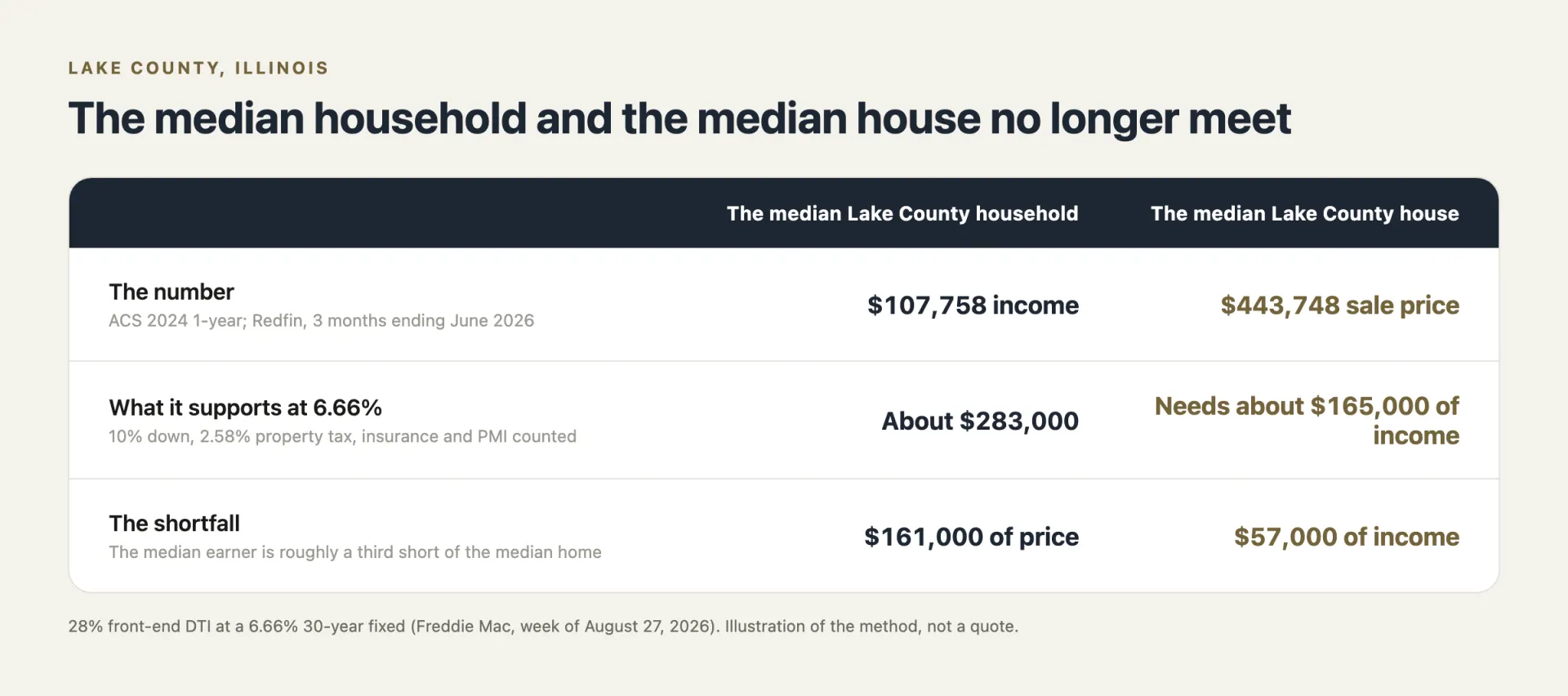
The Lake County affordability gap, in two numbers
I want to start with the comparison nobody publishes, because it reframes everything underneath it. The Census Bureau puts Lake County's median household income at $107,758 in its 2024 one-year survey. Redfin puts the county's median sale price at $443,748 over the three months ending June 2026, up 6.3% on the year.
Run the lender's math on that income and you get about $283,000 of purchasing power at 10% down. To clear the median sale price you need roughly $165,000 of household income. That is 53% more than the county's median household actually earns. So the median Lake County household cannot buy the median Lake County house, and it is not close.
That is not a reason to give up. It is a reason to stop taking a national calculator's number seriously and work out your own. Half the buyers I sit down with have been quoted a price by a website that assumed a property tax bill less than half of what this county charges. The correction is always unpleasant and it always comes late, usually after they have fallen for a house.
The formula a Lake County lender actually uses
Underwriters work from two debt-to-income ratios. The front-end ratio counts housing only: principal, interest, taxes, insurance, and any HOA dues. The back-end ratio counts housing plus every other debt payment you carry, so car loans, student loans, and credit card minimums. The common guideline is 28% front-end and 36% back-end, and FHA and some conventional programs stretch the back-end into the 43 to 50% range for strong borrowers. Whichever ratio produces the lower number is the one that actually caps you.
- Front-end, housing only: principal, interest, taxes and insurance at or under 28% of gross monthly income.
- Back-end, all debt: housing plus every other monthly debt payment at or under 36%, stretched to 43 or 50% on some programs.
- Credit: 620 and up for most conventional loans, 580 with 3.5% down on FHA, and 640 for Illinois down payment assistance.
Notice what is not on that list. Your savings balance, your job title, and how responsible you feel do not enter into it. The lender is buying a monthly payment stream and these two ratios are how they size it. Everything below is those percentages applied to a real income with Lake County's tax bill in the calculation from the start rather than bolted on at the end.
Which ratio is binding, and why it matters
Take the county median household at $8,980 a month gross. The 28% front-end cap allows $2,514 of housing. The 36% back-end cap allows $3,233 of total debt. Carry $650 a month in car and student loan payments and the back-end still leaves $2,583 for housing, which is more than the front-end permits, so the front-end is what caps you and your price stays around $283,000.
Push that other debt to $900 a month and the arithmetic flips. The back-end now allows only $2,333 of housing, the back-end becomes the binding constraint, and your price falls to about $261,000. At $1,200 a month of other debt it drops to roughly $225,000. That is a $58,000 swing in buying power driven entirely by debt that has nothing to do with the house, which is why paying off a car before you apply sometimes does more for your price than another year of saving.
What five incomes actually buy in Lake County right now
Every row below assumes the same thing: 10% down, a 6.66% thirty-year fixed, homeowners insurance at $165 a month, private mortgage insurance because you are under 20% down, and Lake County property taxes at 2.58% of value. I hold the assumptions constant so the rows are comparable to each other. Your own number moves with your other debts, your credit score, and the specific property's tax bill, which is why the last section tells you how to get the real one.
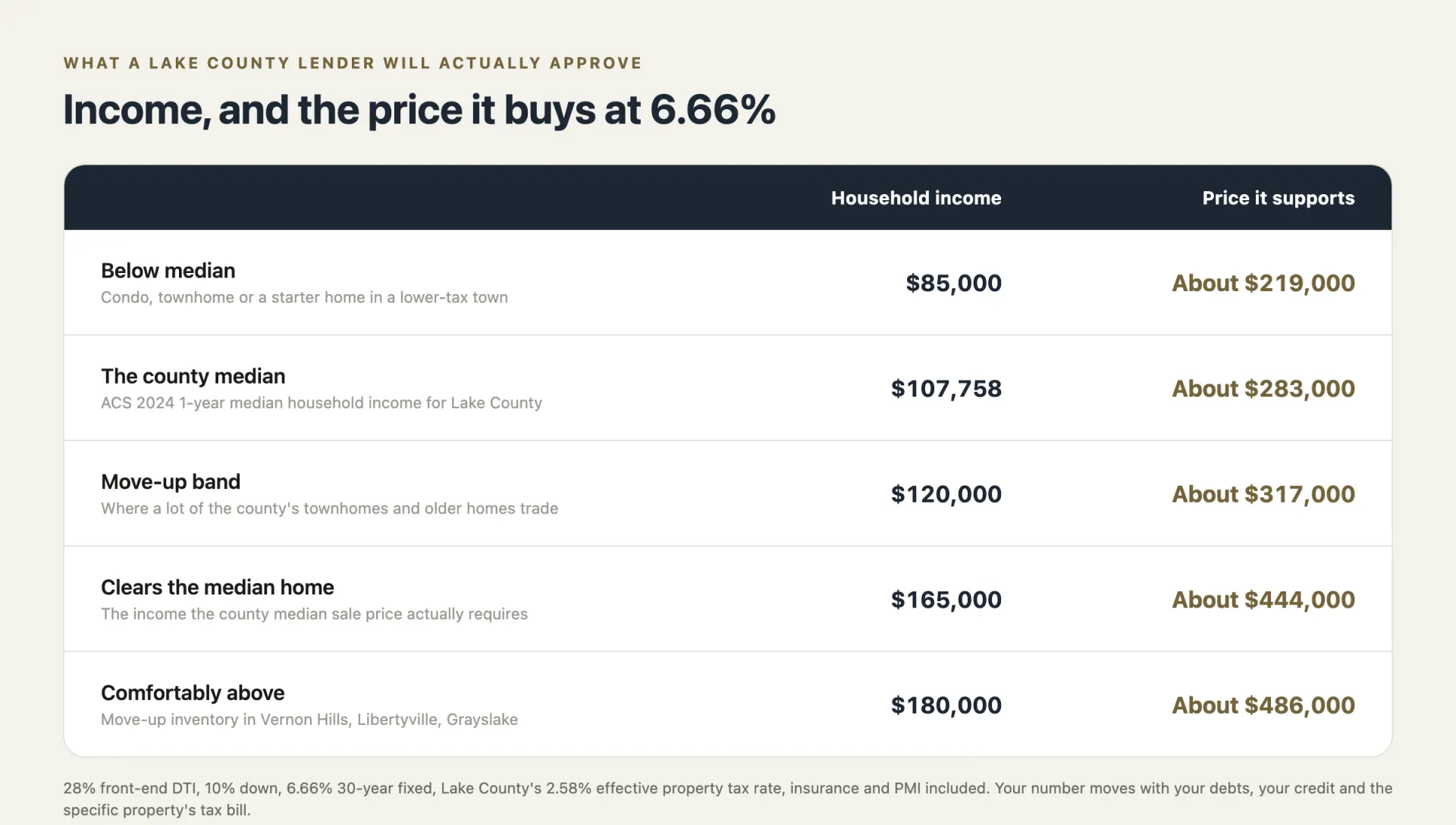
At $85,000, below the county median
That is about $7,083 a month gross and a 28% housing cap near $1,983. After taxes, insurance and mortgage insurance take their share, roughly $1,200 is left for principal and interest, which finances a loan near $197,000. Call it a purchase price around $219,000. In Lake County that is realistically a condo, a townhome, or a starter single-family home in one of the more affordable towns. It is not the median house and no amount of shopping will make it the median house.
At $107,758, the county median
About $8,980 a month gross, so a 28% cap near $2,514. That supports a purchase price around $283,000. This is the row that matters most, because it describes the middle of the county rather than a hypothetical buyer. A household earning exactly what Lake County typically earns is shopping about $161,000 below what Lake County typically sells for.
At $165,000, where the median home becomes reachable
About $13,750 a month gross and a 28% cap near $3,850, which is what the median $443,748 home costs per month once its $954 tax line and its mortgage insurance are counted. This is the honest income requirement for the middle of this market. When someone tells me they want to be in Lake County at the median and their household earns $120,000, this is the number I have to show them, and it is usually the moment the conversation turns into a real plan rather than a browse.
Why Lake County's property tax line breaks a national calculator
This is the single biggest reason a Lake County number comes back lower than a website promised. I checked the claim rather than repeating it. Using the Census Bureau's 2024 five-year estimates of median real estate taxes paid against median home value, I computed the effective rate for all 102 Illinois counties. Lake County comes out first at 2.58%, with a median annual bill of $8,923. The national figure is 0.94%. Lake County's rate is 2.7 times the national one.
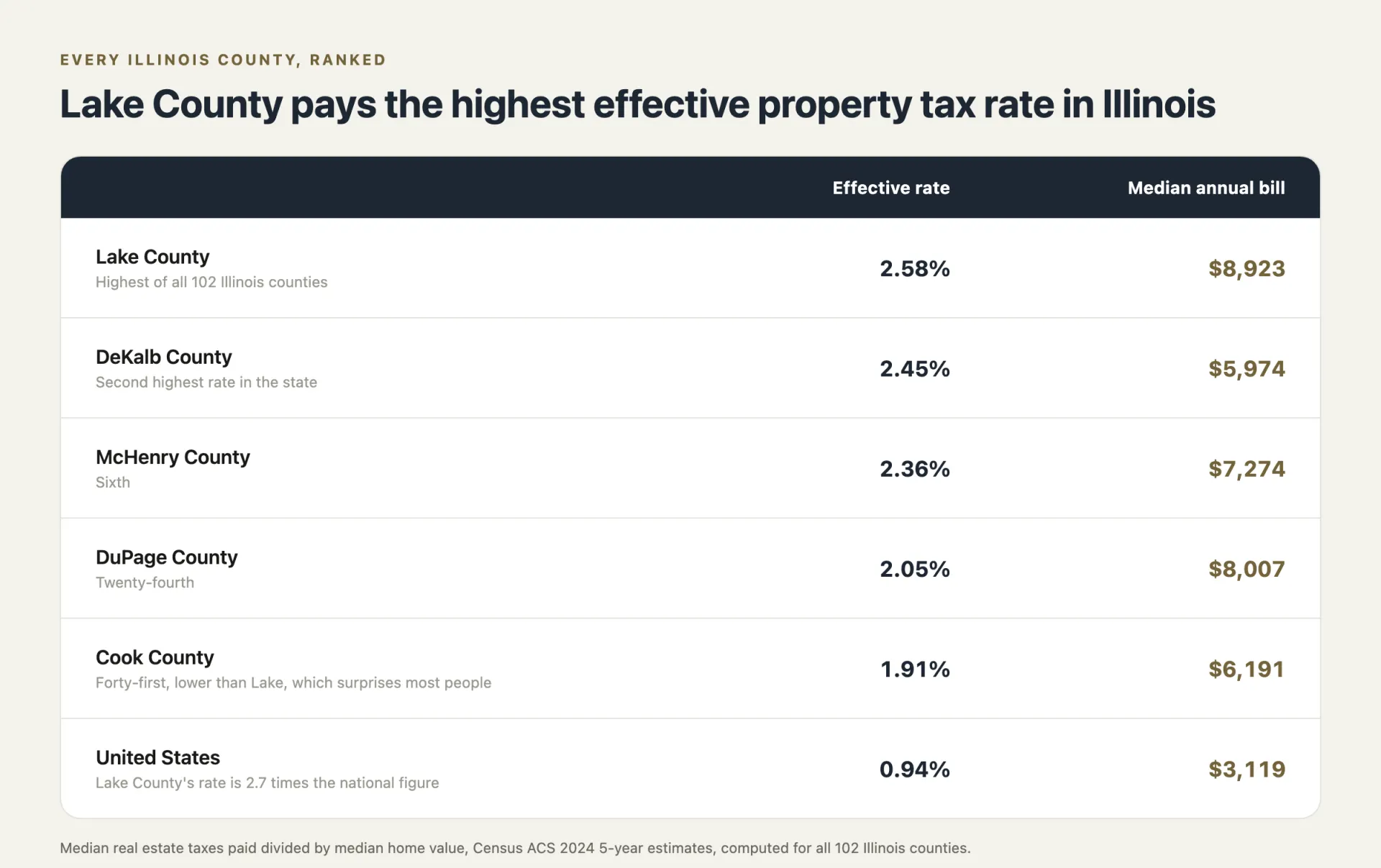
On the county's median $443,748 home that rate is $11,449 a year, or $954 a month, and it counts against your front-end ratio dollar for dollar before a cent reaches the house. A national calculator assumes something closer to $350 and hands you a price you cannot actually get approved for here. That one substitution is most of the difference between a national estimate and a Lake County pre-approval.
Your own rate will not be the county figure. It moves substantially by town and by taxing district, and it is worth pulling the actual bill on any specific address before you get attached to it. If your bill already looks wrong relative to what your house would sell for, that is a separate and genuinely winnable fight, and I have written up how the Lake County appeal process works.
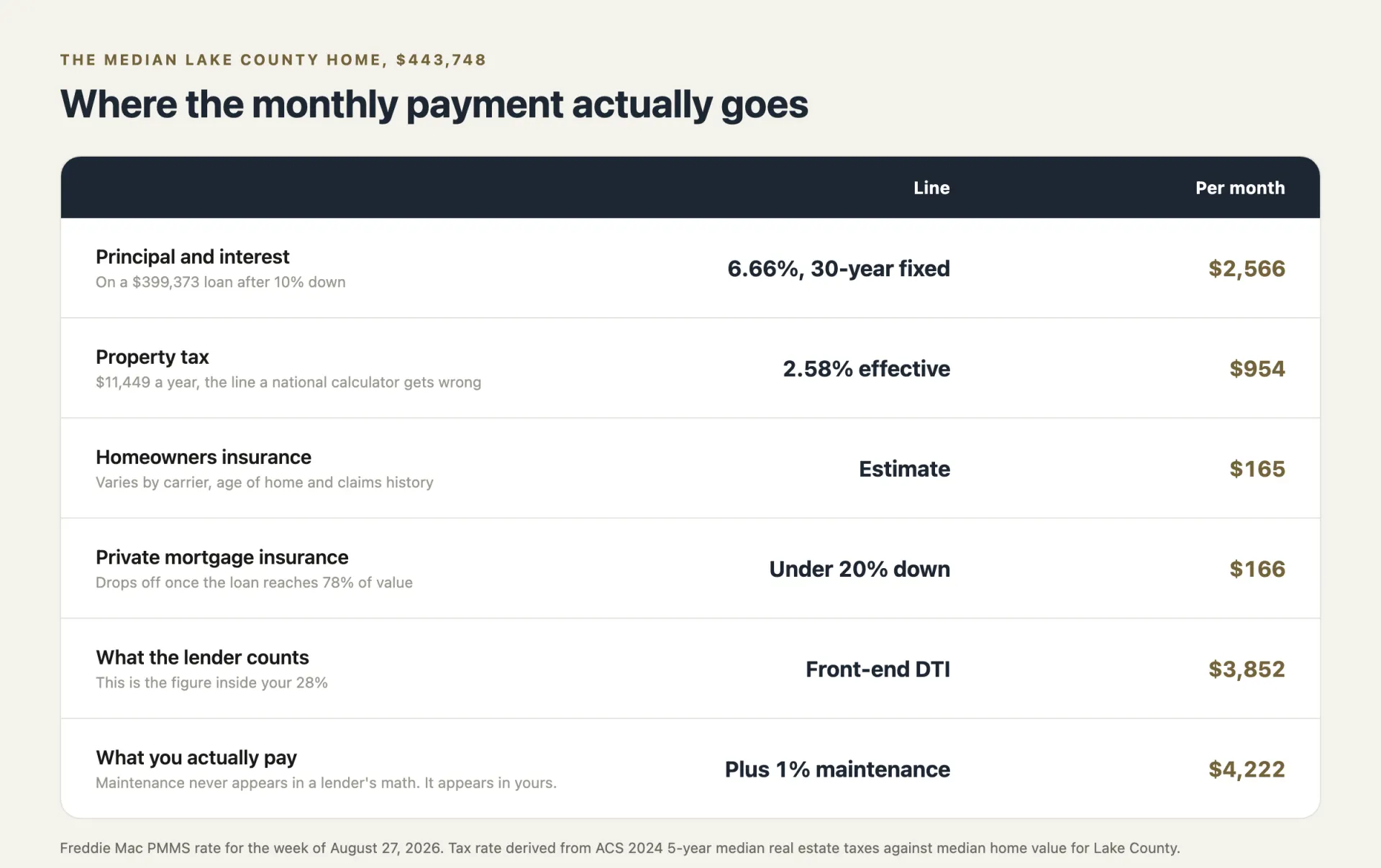
Two of those lines deserve a warning. The $165 insurance figure is an estimate and yours will depend on the carrier, the age of the roof, and your claims history, so get a real quote early rather than at closing. The maintenance line uses the common one-percent-of-value rule of thumb, which is a planning convention rather than a measurement. Neither appears in a lender's calculation. Both appear in your bank account.
The Illinois programs that can move you a bracket
Illinois has real help, and it is more generous in 2026 than most buyers realise. The Illinois Housing Development Authority runs four assistance programs, and the differences between them matter more than the headline amounts.
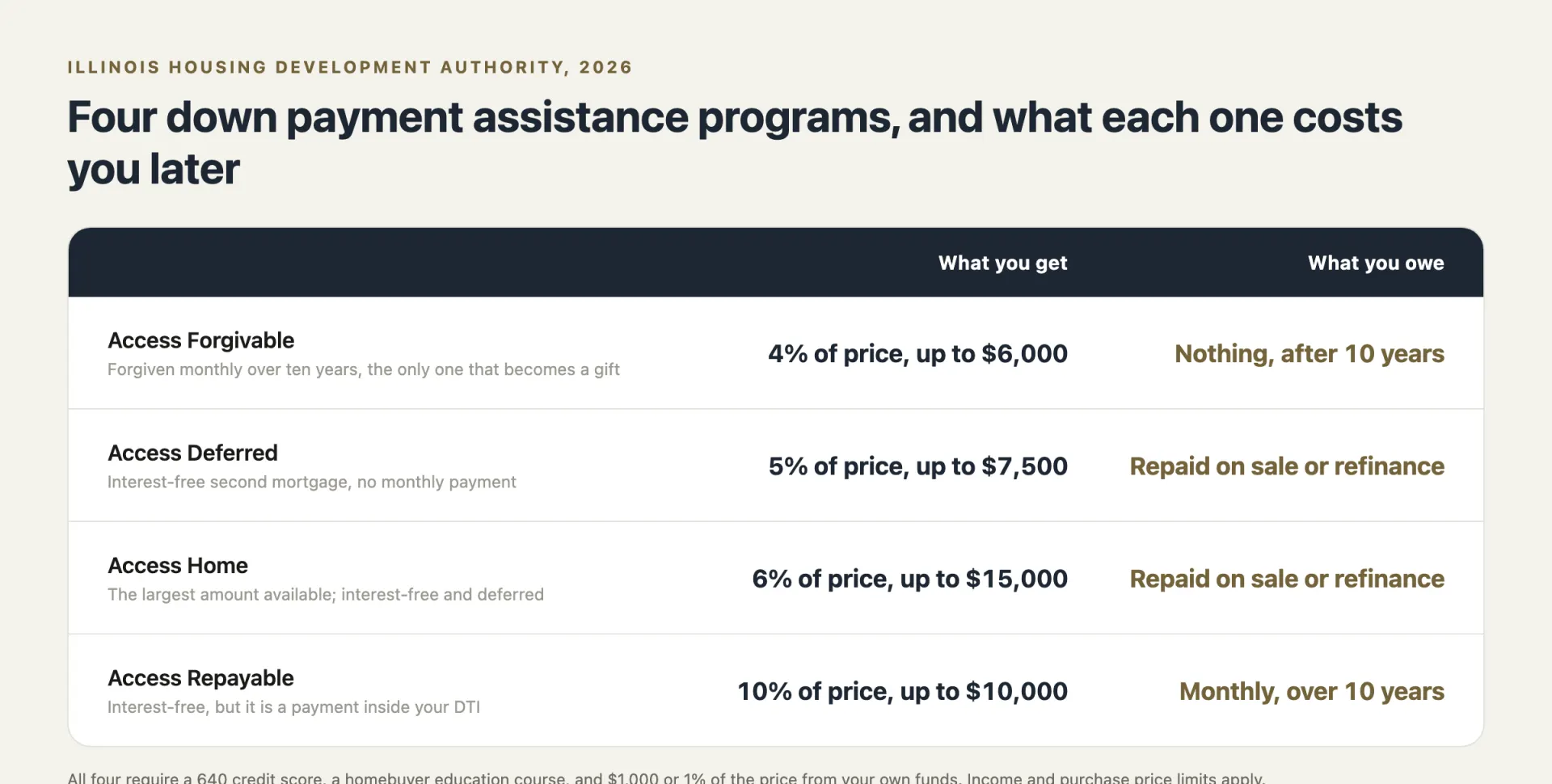
Read that last column before the first. Access Forgivable is the only program that turns into a gift, and it is the smallest. Access Home gives the most cash at $15,000 but sits on your title until you sell or refinance. Access Repayable is the one to watch, because a monthly repayment lands inside the back-end ratio that was already capping you, so the assistance can quietly cost you some of the borrowing power it was meant to add.
All four want a 640 credit score, a homebuyer education course, and $1,000 or 1% of the price from your own funds, and all four carry income and purchase price limits. None of them lifts your 28% ceiling, because they help with the cash to get in rather than the payment once you are in. What they solve is the wall most buyers actually hit, which is saving a down payment while paying Lake County rents. The full rundown sits in my Illinois first-time buyer guide, and the cash you still need at the table is in the closing costs guide.
How your credit score changes the Lake County number
Credit does not just decide whether you qualify. It sets your rate, and a rate difference compounds for thirty years. Moving from the low 600s to 740 and above can shift your rate by half a point or more, which on a $400,000 loan is roughly $130 a month. That is permanent buying power bought with nothing but a few months of paying balances down before you apply.
If your score is in the low 700s with a couple of cards near their limits, that cleanup is usually the highest-return thing you can do before you tour a single house. It is also the one piece of this that is entirely inside your control. You cannot move the rate, you cannot move Lake County's tax rate, and you certainly cannot move the median sale price. You can move your own score.
Treat your Lake County number as a ceiling, not a target
Everything above tells you the most a lender will let you borrow. It does not tell you what you should spend. Buying at the top of your 28% leaves no room for a reassessment, a special assessment on a townhome, or a furnace that dies in February. In a county where the tax bill can genuinely jump between assessment cycles, a cushion is not caution for its own sake. It is the specific risk this market hands you.
I would rather see a buyer come in a bracket under their maximum and sleep at night than stretch to the ceiling and hope the assessor is kind. It also changes how you weigh rate against price. If rates ease later you can refinance the payment down. You cannot renegotiate the price after you have paid it. That argues for the right house slightly under budget now rather than the bigger one at your limit, though it is genuinely personal and worth walking through against the rent versus buy break-even and the broader is it a good time to buy question.
Where the $165,000 requirement puts the median out of reach, the practical move is usually to widen the map rather than shrink the house. The tax rate varies enough between towns, and even between townships inside one town as my Lake Forest IL property tax breakdown shows, that the same monthly payment reaches a materially different property a few miles away, and towns like Vernon Hills and Libertyville sit at different points on that curve than the lakefront towns most buyers start with.
Get your actual number
These examples show how the math works. They do not replace it. The fastest way to see your real number, built on your income, your debts, your credit and your down payment, is the free affordability calculator on the tools page, which runs a quick estimate and a detailed version with taxes, insurance and mortgage insurance. Run it, then bring me the number. If you want it checked against the actual tax bill on a specific address and against what is genuinely selling in your price band, that is a conversation I am happy to have.
Frequently Asked Questions
About $165,000 a year at a 6.66% rate with 10% down, once Lake County's 2.58% property tax rate is counted. The county's median household income is $107,758, so the median household is roughly a third short of the $443,748 median sale price.
Roughly $219,000 at a 6.66% rate with 10% down, once Lake County's taxes are counted. Realistically that is a condo, a townhome, or a starter home in a more affordable town rather than the county median. Your exact number depends on your other debts, your credit, and the specific property's tax bill.
Property taxes. Computing the effective rate for all 102 Illinois counties from Census ACS 2024 five-year data puts Lake County first at 2.58%, against 0.94% nationally. On a $443,748 home that is $954 a month against roughly $350, and it counts against your borrowing capacity dollar for dollar.
Conventional loans typically want 620, FHA allows 580 with 3.5% down, and Illinois IHDA assistance requires 640. Above roughly 740 you start earning the best rates, which is where the long-term savings actually are.
No. Conventional loans commonly allow 3 to 5% down and FHA allows 3.5%. Below 20% on a conventional loan you pay mortgage insurance, and FHA carries it regardless, which is why both are inside the examples above. Twenty percent removes mortgage insurance. It is not a requirement to buy.
This is general information, not financial advice. Rates, tax rates and loan programs change, and every number here depends on your specific situation. Confirm your real figures with a licensed lender, and the tax side with the Lake County Assessor, before you make an offer.
Get new Lake County listings by email
I'll send you new Lake County homes as they come on the market. Just your email, no account needed.
Just your email. Unsubscribe any time by replying.
I'm Eshu Chikoti, a Lake County, IL agent. If you want the numbers in this article run for your specific home or purchase, let's talk it through — no pressure, no obligation.
Get in touch →