How to Appeal Your Lake County Property Tax Assessment
Lake County assesses homes at one third of market value, and appeals run on a strict 30-day window after the township assessment notice publishes. The strongest evidence is recent comparable sales showing your assessed value is too high relative to similar homes.
- Find your township's assessment publication date on the Lake County Board of Review filing-deadline page. Your 30-day window runs from that date.
- Multiply your assessed value by three to see the market value the assessor is using, since Lake County assesses at one third of market value.
- Pull recent comparable sales that support a lower value. That is the strongest evidence.
- Talk to your township assessor, then file with the Lake County Board of Review inside the 30 days.
- If the Board of Review decision does not resolve it, take it to the Illinois Property Tax Appeal Board, the stage at which an attorney becomes worth considering.

Quick answer: in Lake County you have exactly 30 days from the day your township's assessments are published to file an appeal with the Board of Review, and missing that window locks your number in for the year. Your home is supposed to be assessed at one-third of its market value, and when that math is off — which it often is — the county's own tools give you a real, winnable path to fix it. I have watched plenty of Lake County homeowners knock thousands off their assessed value with nothing more than a clean comparison of what their neighbors are assessed at. Here is how the process actually works, on the real calendar.
How your assessment actually works here
Start with the number you are fighting. Illinois law requires the Chief County Assessment Office to assess every property at 33 1/3 percent of its fair market value, and Lake County nudges toward that 33.33% target using an equalization factor. So if your home would sell for $360,000, its assessed value should land somewhere near $120,000. That figure is what your township assessor sets, and it is the only thing you can appeal. You cannot appeal the tax rate itself — that is set by the schools, the county, the park districts and every other taxing body based on their budgets, and it applies to everyone in the district equally. Lower the assessed value, though, and your bill drops right along with it. In a county where the effective rate runs around 2.68% — among the highest in the country, and a real factor in what you can actually afford to buy here — that is not a rounding error. On a $120,000 assessment, trimming even $30,000 off is close to $800 a year, every year, until the next reassessment.
Finding your number and your deadline
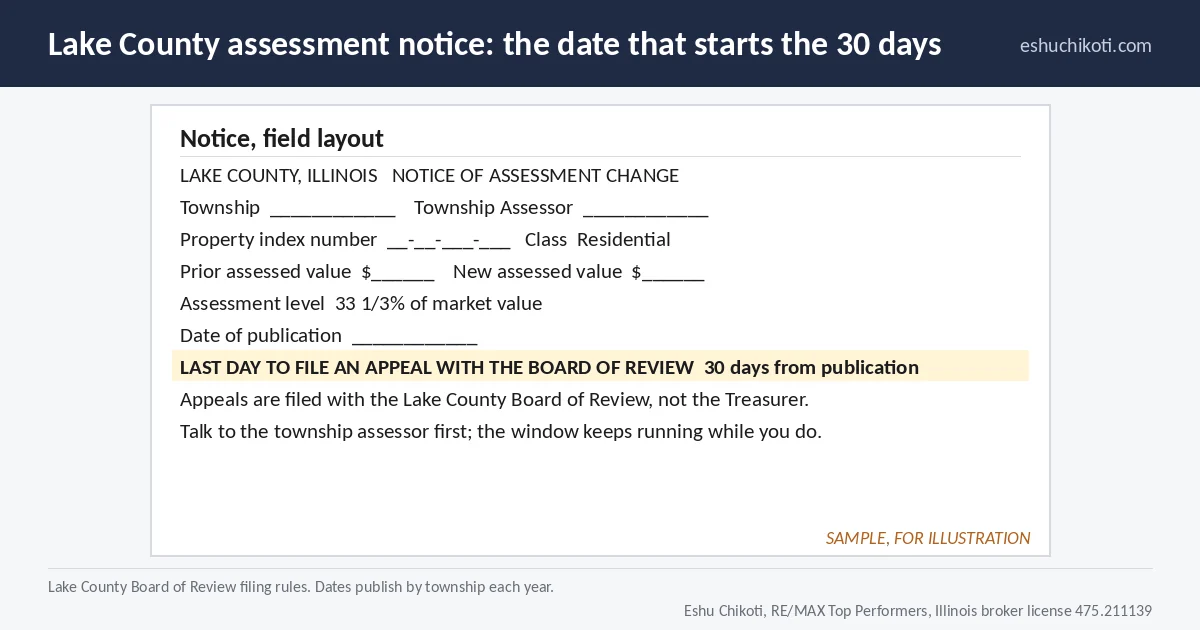
Lake County reassesses on a rolling township schedule, so your friends two towns over may be on a completely different clock than you are. Each township publishes its new assessments on its own timeline — notices go out in the mail in mid-to-late summer — and your 30-day appeal window starts the day your township's assessments are published, not the day you happen to open the envelope. The exact deadline for your property is printed right on the assessment notice, and the county posts a schedule of publication and appeal-deadline dates by township. Do not treat it as a suggestion. It is a hard 30 calendar days, and there is essentially no grace period once it passes. If you own in a place like Gurnee, Libertyville, or Vernon Hills, check your specific township's date rather than assuming the whole county moves together.
The evidence that actually moves a hearing
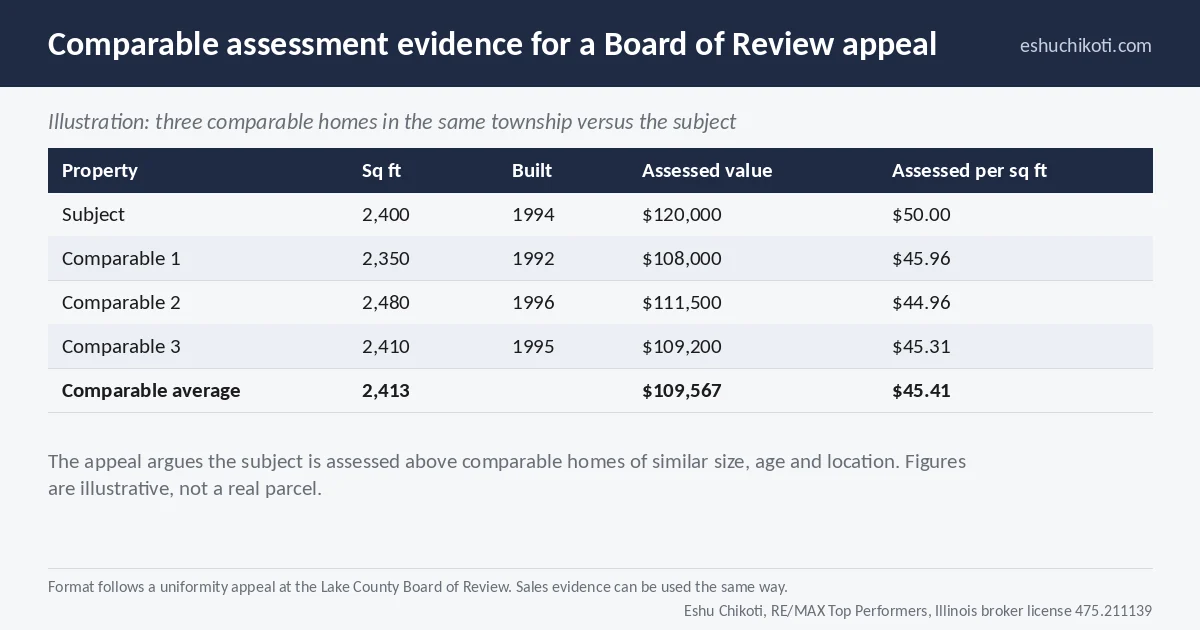
An appeal with no evidence goes nowhere. The Board of Review is not swayed by the feeling that your taxes are too high — it is swayed by a specific, documented case that your assessment is either above market value or out of line with comparable homes. Everything gets filed through the county's SmartFile e-filing portal, and three kinds of evidence carry the most weight:
- A uniformity case built on the Lake County Comparable Property Grid. The portal generates the grid for you: you show at least three similar homes — comparable age, size, construction and location — that are assessed lower than yours (the grid allows up to five). This is the argument I lean on most, because it is genuinely hard to rebut with data the county itself produced.
- A recent arm's-length sale, ideally your own purchase. If you bought below your assessed market value, the portal walks you through a set of questions about the transaction and lets you upload your HUD-1 or settlement statement as proof.
- An independent appraisal done for property-tax purposes. The county says one of the strongest single pieces of evidence is an ad valorem appraisal with a valuation date of January 1 of the assessment year. It costs a few hundred dollars, so it is worth it when the potential savings are large.
If the property is in Lake Forest specifically, the composite rate differs across the five townships the city sits in, and I have the numbers in my Lake Forest IL property tax breakdown. There is a fourth, quieter category that produces some of the easiest wins: plain factual errors in the county's record of your home. Wrong square footage, a bathroom that does not exist, a garage that was never built, a finished basement that is actually unfinished. These are objective and fixable, and correcting them can drop your assessment without any argument about value at all. Pull up your property record and read it line by line before you do anything else.
File with the township first, then the Board of Review
Before you file a formal appeal, the county encourages you to contact your local township assessor's office to talk it through. This is worth doing. A clear data error or an obvious miscalculation can sometimes get corrected right there, without a hearing at all. If that conversation does not resolve it — or you would rather go straight to a formal appeal — you file with the Lake County Board of Review through SmartFile, with your evidence attached, on or before your township's 30-day deadline. No attorney is required for a residential appeal, and homeowners represent themselves all the time. If you get stuck, the Chief County Assessment Office keeps a Taxpayer Advocate on the phone at 847-377-2050 during business hours.
The hearing, and what happens if you disagree
You get to choose how your hearing happens — by phone, on written documents alone, in person, or over Zoom. If it is a live hearing, both sides are sworn in: you present your evidence and argument first, then the township assessor's office defends the existing number. Keep it factual and specific. 'My neighbor's identical model two doors down is assessed $40,000 lower on the county's own grid' lands far better than a general complaint that everything costs too much. If the Board of Review's decision still does not sit right, you have one more level: you can appeal to the Illinois Property Tax Appeal Board (PTAB) within 30 days of the postmark or personal-service date on the Board's decision. The same evidence you filed locally is accepted there. Miss that 30-day window, and just like the original deadline, you generally lose the right to contest that year's assessment.
The strongest appeals I see aren't the ones arguing 'my home isn't worth that much.' They're the ones showing 'my home is assessed higher than the identical house down the street.' Uniformity, backed by the county's own comparable grid, is what actually moves these hearings.
Do not leave your exemptions on the table
An appeal fixes your assessed value. Exemptions are a separate lever, and they come straight off your equalized assessed value before the rate is even applied — which means a lot of homeowners are overpaying not because their assessment is wrong, but because they never filed. The General Homestead Exemption knocks $8,000 off the EAV of your primary residence. If you are 65 or older, the Senior Homestead Exemption adds another $8,000 on top of that. And the Low-Income Senior Citizens Assessment Freeze locks in your assessed value year to year for qualifying seniors — the household income limit was $65,000 for the 2025 tax year and, under Public Act 104-0452 signed in December 2025, rises to $75,000 beginning with the 2026 tax year (payable 2027). The freeze holds your assessment, not your tax rate, so it is not a magic bullet, but for a fixed-income household it matters. Check which of these you are already receiving on your assessment notice, and file for any you are missing. School districts are the largest single line on most Lake County tax bills.
Is it actually worth your time?
Honest answer: often, yes, but only if your evidence is real. It is also worth knowing what the win is worth: the tax line is the largest non-mortgage cost in a Lake County payment and it is what pushes the local rent versus buy break-even out past the national rule of thumb. Lake County has a lot of over-assessed homes, and a clean uniformity case or a recent below-assessment purchase is very winnable. What does not work is showing up annoyed — general complaints about rates, school funding, or taxes being high everywhere are simply not within the Board's power to change. If the numbers are close, the effort may not clear the savings, and that is a fair reason to skip a year. But if your assessment looks high relative to your street, the county's own grid is right there waiting for you. This is also why property taxes deserve a hard look before you buy — they weigh heavily on the math for anyone investing in Lake County real estate, and an over-assessment you inherit at closing is one you can often appeal down. If you want a second set of eyes on whether your assessment is out of line, that is a conversation I am always happy to have — I can pull the comparable assessments for your street before you commit to filing.
The Calendar Is the Whole Thing
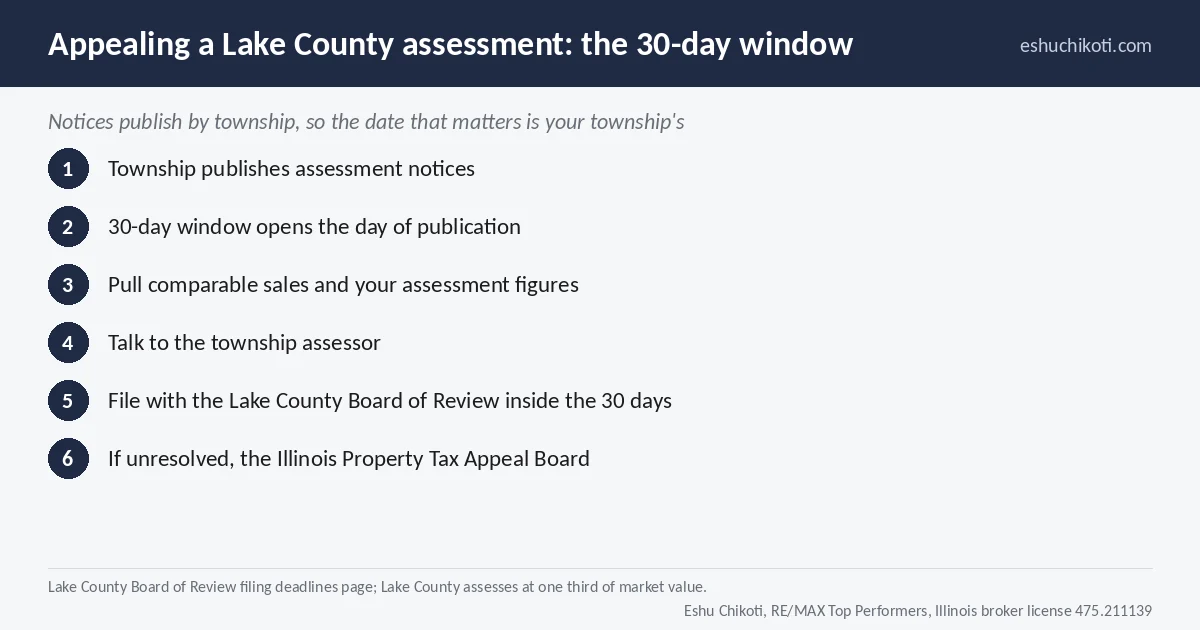
Miss the 30-day window and you wait a year. Assessment notices publish by township, not county-wide, so the date that matters is your township's. Check it annually rather than waiting for a bill that arrives long after the deadline.
Before you appeal, confirm the Illinois homestead exemption is on your bill.
Frequently Asked Questions
Every year your township publishes a new assessment, you get a fresh 30-day window — there is no limit on how many years in a row you can file. Most townships only reassess on a set cycle rather than annually, but the appeal right resets each time a new assessment is published, and the deadline is always printed on your notice.
No. Residential owners can and regularly do file and represent themselves, and no attorney is required. An attorney or a tax-appeal specialist can make sense for complex or high-value cases, but for a straightforward uniformity or factual-error appeal, most people handle it on their own through SmartFile.
It depends entirely on how far off your assessment is, but with Lake County's roughly 2.68% effective rate, a $20,000 to $40,000 reduction in assessed value translates to roughly $500 to $1,100 a year — and it recurs every year until the next reassessment, so a single successful appeal can pay off for a long time.
The Board of Review is the local, county-level body that hears your initial appeal. If you are not satisfied with its decision, the Illinois Property Tax Appeal Board (PTAB) is the state-level body you escalate to next, within 30 days of the Board's decision, using the same evidence you already filed.
For most homeowners it is the Lake County Comparable Property Grid showing similar nearby homes assessed lower than yours. If your case is about value rather than uniformity, an ad valorem appraisal with a January 1 valuation date is about as strong as it gets.
Call 847-691-4282 if you want the comps pulled for your appeal.
This is general information, not legal or tax advice. Assessment levels, publication dates, and appeal deadlines vary by township and change year to year — always confirm the exact deadline printed on your own assessment notice, or with the Lake County Chief County Assessment Office, before you rely on any date here.
Get new Lake County listings by email
I'll send you new Lake County homes as they come on the market. Just your email, no account needed.
Just your email. Unsubscribe any time by replying.
I'm Eshu Chikoti, a Lake County, IL agent. If you want the numbers in this article run for your specific home or purchase, let's talk it through — no pressure, no obligation.
Get in touch →