Rent vs. Buy in Lake County, IL for 2026: I Ran the Break-Even Year by Year
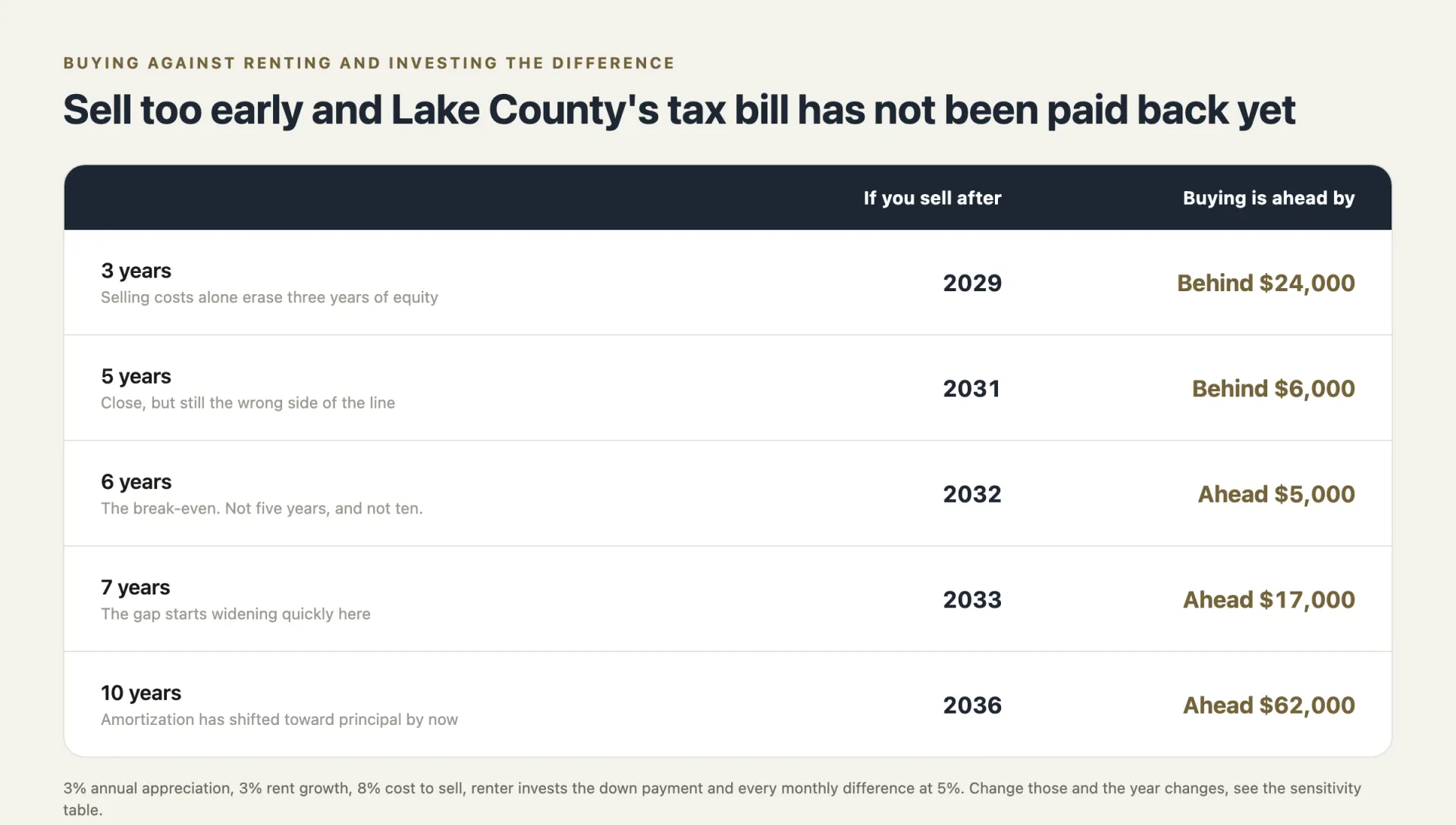
Quick answer: buying the median Lake County home beats renting a comparable house at about the six-year mark. Before that, selling costs and the county's property tax bill have not been earned back. That is at 3% appreciation. At the 6.3% the county actually posted this year, the break-even arrives in three. Here is the whole model.
Most Lake County rent versus buy math compares a house to an apartment
I have to start by correcting something, because I had it wrong in the earlier version of this post and the error runs through most of the advice you will find on this question. The standard move is to compare the cost of owning a house against the cost of renting a two-bedroom apartment. Those are not the same product. One has a yard, a garage and three bedrooms. The other does not.
Compared properly, the gap narrows a lot. Apartment List has Lake County's two-bedroom average at $2,590 in late August 2026 and its three-bedroom-and-up average at $3,585. If you would genuinely trade a house for a two-bedroom apartment, use the smaller number. If the alternative to buying a house is renting a house, and for most of the people I work with it is, the honest comparison number is $3,585.
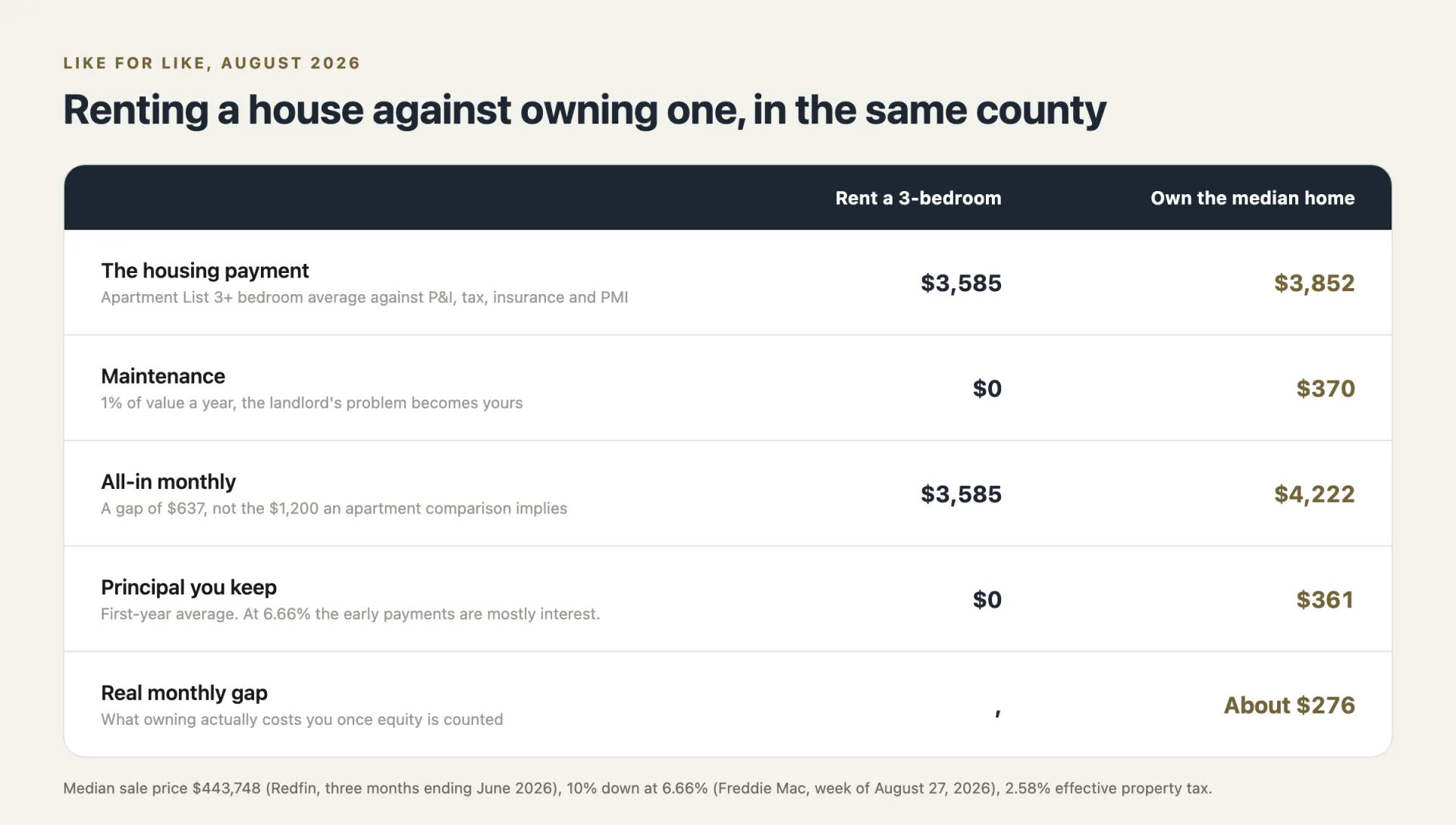
That single substitution moves the monthly gap from about $1,200 to about $637. It does not make buying automatically correct. It does mean the case against buying in Lake County is considerably weaker than the usual framing suggests.
What renting and owning actually cost in Lake County, side by side

Redfin puts the Lake County median sale price at $443,748 over the three months ending June 2026, up 6.3% year over year, with homes going under contract in a median of 46 days. Finance that with 10% down at the 6.66% thirty-year fixed rate Freddie Mac reported for the week of August 27, 2026 and the monthly picture looks like this.
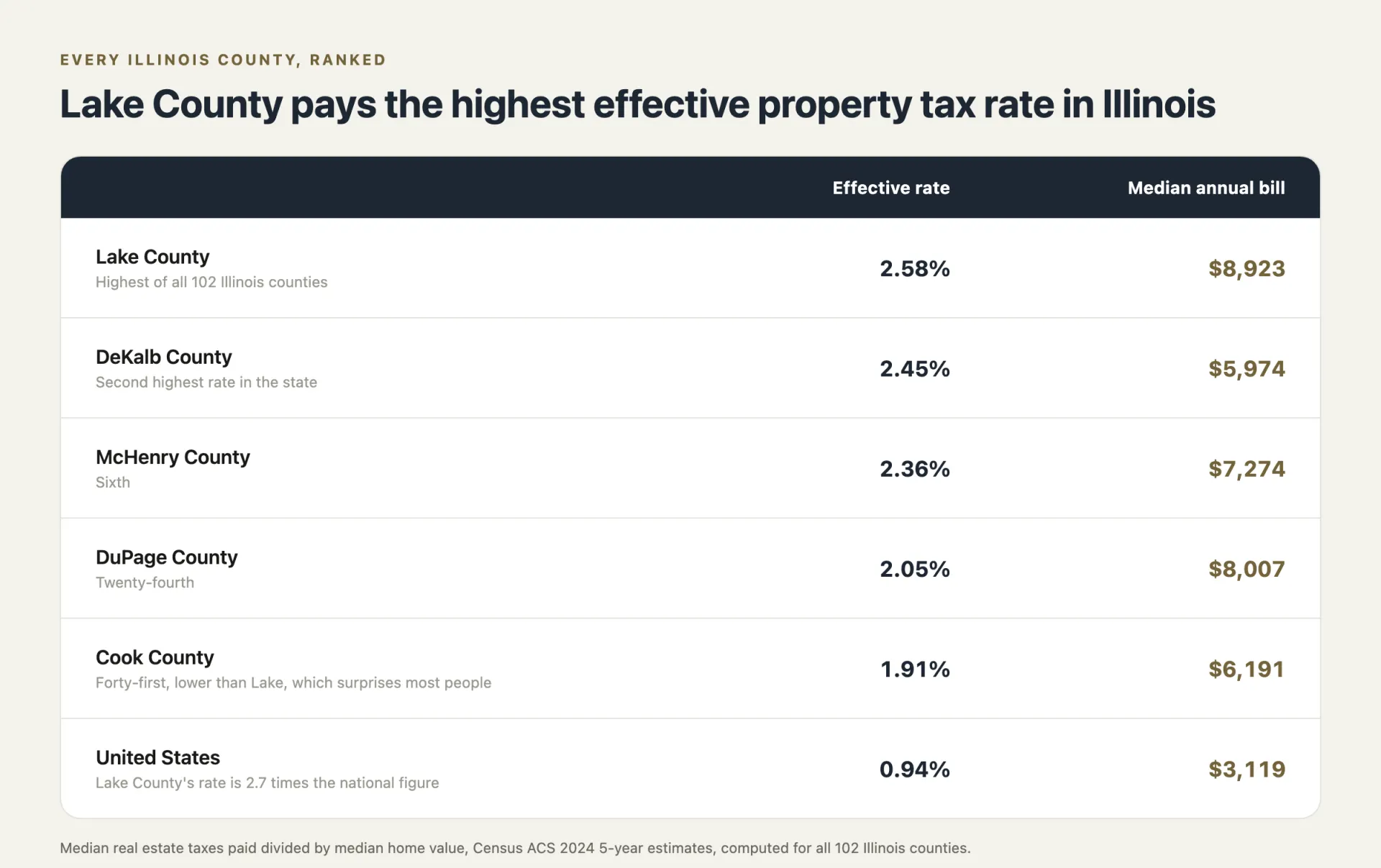
The line doing the damage is property tax. I computed the effective rate for all 102 Illinois counties from the Census Bureau's 2024 five-year estimates of median real estate taxes paid against median home value, rather than repeating a figure from an aggregator. Lake County comes out first in the state at 2.58%, with a median annual bill of $8,923. The national rate is 0.94%. On the county's median home that is $954 a month, every month, forever, and it is the reason the local break-even runs longer than a national one.
Be honest about the equity side too. At 6.66% the early payments are mostly interest, so in the first year you are only recovering about $361 a month in principal. It grows, but slowly. Appreciation is the bigger lever and it is also the one you cannot bank. Lake County values rose 6.3% over the past year. A long-run 3% is the safer number to plan on, and either way it is paper until you sell.
The Lake County price-to-rent ratio, done honestly
The quick screen on this question is the price-to-rent ratio: the typical home value divided by a year of rent for a comparable place. Under 15 leans buy, over 20 leans rent, and the middle is a genuine it-depends.
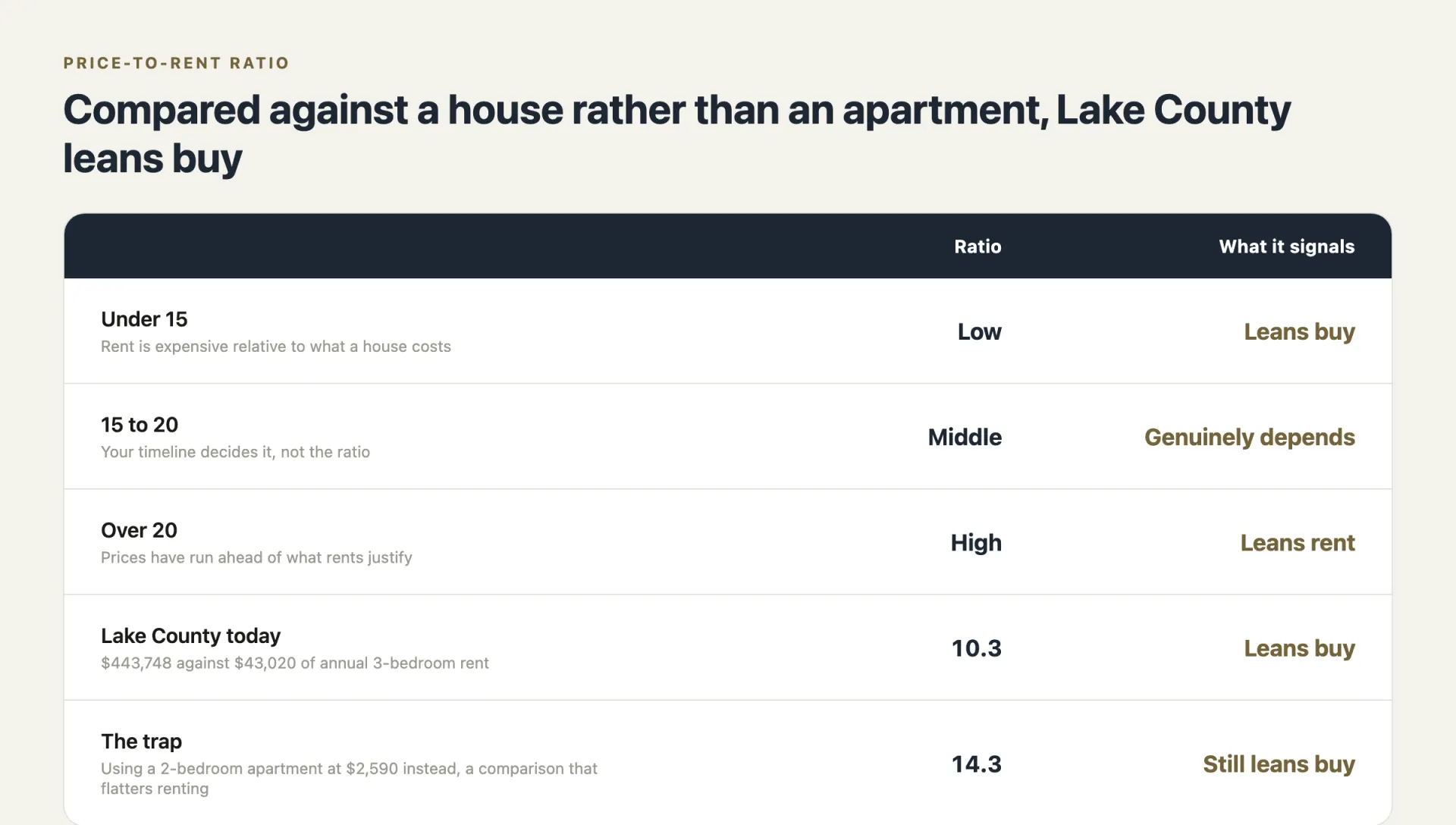
Lake County's median sale price against $43,020 of annual three-bedroom rent gives a ratio of 10.3. That is firmly buy-leaning, and it is worth sitting with because it contradicts the mood of most national coverage right now. Rents here are high relative to prices. That is the structural argument for buying in this county, and it is why the break-even lands sooner than the tax rate alone would suggest.
The ratio is a screen, not an answer. It ignores your borrowing rate entirely, it ignores the tax bill, and it says nothing about how long you are staying. Those three are what the actual model has to handle.
The Lake County break-even, year by year
So I built it. The model buys the median $443,748 home with 10% down at 6.66%, pays 2.58% property tax on a value that grows with the house, carries insurance, mortgage insurance until the loan reaches 78% of value, and sets aside 1% of value a year for maintenance. The renter pays $3,585, sees rent rise 3% a year, invests the down payment and closing costs on day one, and invests every monthly difference after that at 5%. When the owner sells, 8% of the price goes to selling costs.
The result is the chart at the top of this post. Sell at three years and buying is about $24,000 behind. At five years it is still about $6,000 behind, which is the part that surprises people, because five years is the number everyone repeats. Year six is where it crosses. By year ten buying is ahead by roughly $62,000.
Five years is the folk wisdom and it is wrong here by about a year. In the highest-taxed county in Illinois, the tax bill and the cost of selling take six years to earn back.
What moves the Lake County break-even
Any single break-even number is hiding two assumptions it cannot possibly know: what homes will do, and what the renter's invested money will do. Change either and the answer moves. Rather than pick the pair that flatters the conclusion I want, here is the whole grid.
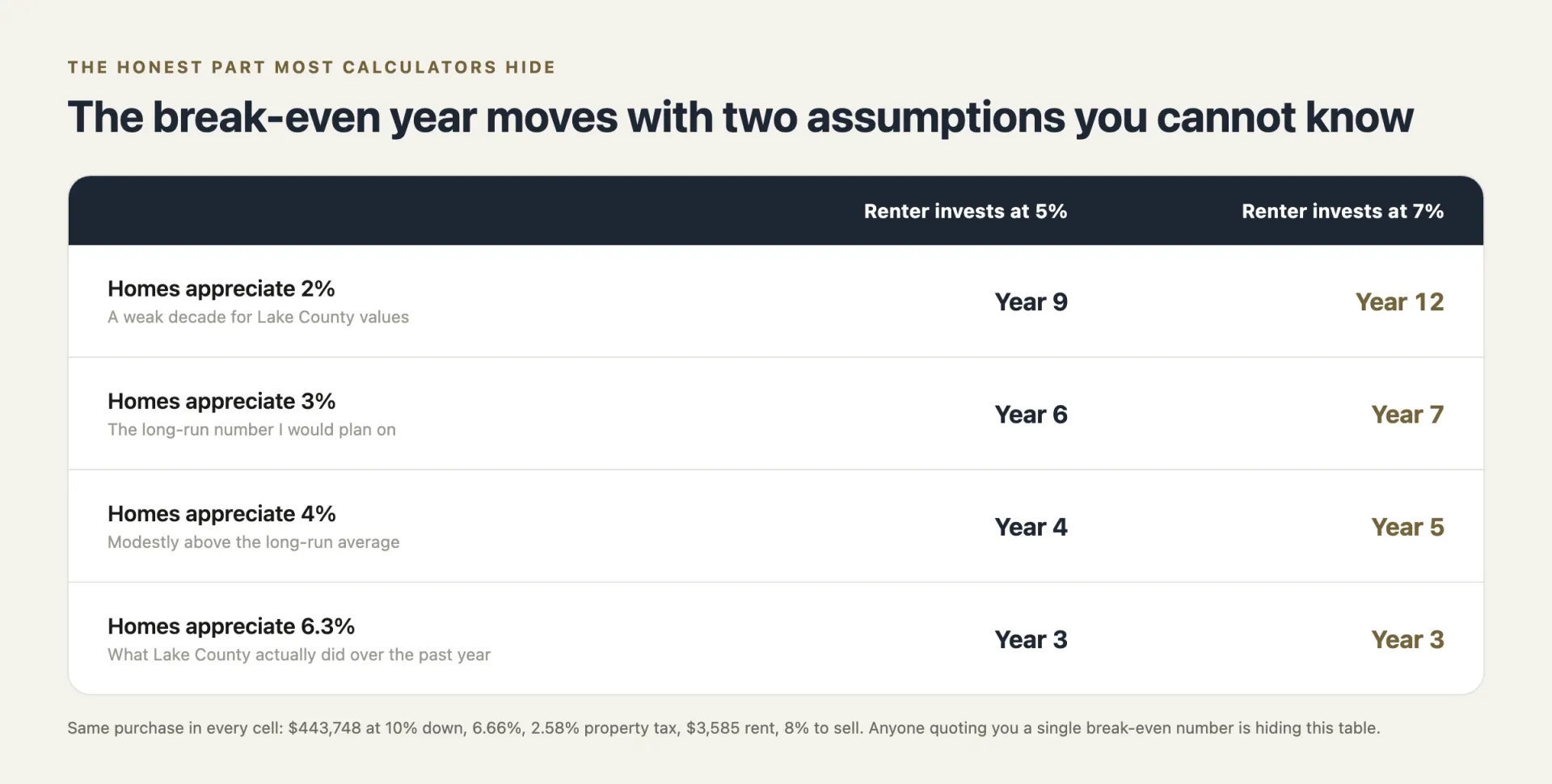
The range runs from year 3 to year 12. That is the honest answer, and it is why the national articles you will find contradict each other so violently. They are not disagreeing about Lake County. They are picking different assumptions and reporting the output as a fact.
The cost of selling matters less than you would think. Dropping it from 8% to 6% only pulls the break-even in by a year, and what sellers pay buyer agents has genuinely moved since the NAR settlement, so it is worth knowing where your number will land rather than assuming the old one. Rent growth barely moves it at all. Appreciation is the variable that dominates everything, and it is the one nobody can promise you.
When renting is still the smarter move in Lake County
- You might move within three years. At that horizon the model is $24,000 against you and no amount of appreciation reliably fixes it.
- You do not have an emergency fund that survives the down payment leaving your account.
- The only mortgage you would qualify for stretches you past comfortable. A rent payment that lets you save hard beats a mortgage that leaves you house-poor.
- You are genuinely unsure where in the county you want to be. Renting for a year in the wrong town costs far less than buying in it.
That last one is underrated. Lake County is not one market, and the tax rate, the school district and the commute change materially between towns that sit ten minutes apart. I have watched buyers spend a year renting in a town they then happily bought in, and I have watched buyers skip that step and spend three years in a house they never settled into.
When buying wins in Lake County
Buying wins when your horizon clears six years, and it wins comfortably past eight. It wins because Lake County rents are high relative to prices, which is what that 10.3 price-to-rent ratio is telling you. It wins when you value a housing cost that does not reset at every lease renewal. And it wins at the margin when you can shrink the two lines that hurt most.
Those two are the down payment and the tax bill. More down removes mortgage insurance and shrinks the loan you pay interest on. And the tax bill is not fixed the way people assume: a successful property tax appeal takes money off the single largest non-mortgage line in a Lake County payment, permanently. Before any of it, pressure-test the purchase itself against how much house you can actually afford here and the cash you need at the closing table.
If you are running the numbers as an investor rather than an owner-occupant, the arithmetic is different again, because rent becomes income rather than an avoided cost. I have written that up separately in investing in Lake County real estate.
What no calculator will tell you
Every number above assumes you behave like a spreadsheet. It assumes that if you rent you actually invest the difference every month, and that you sell exactly on schedule. Real life is messier. Owning forces a savings discipline renting does not, and most people who plan to invest the difference spend it instead. If that is you, the renter column in my model is fiction and buying is better for you than the math says.
On the other side, owning ties up cash, ties you to a place, and hands you a maintenance bill and a tax bill a landlord used to absorb. The furnace becomes your problem in February. The model is real and worth taking seriously, but it is the start of the decision rather than the end of it. The broader market question is worth a look too, and I keep that in is it a good time to buy in 2026.
If you want your actual numbers run, meaning your real rent, your real savings, your real timeline, and what a specific address's tax bill does to all three, that is a conversation I am happy to have. I would rather talk you out of a purchase that breaks even in nine years than sell you the version where it breaks even in four.
Frequently Asked Questions
Month to month, renting is cheaper. Owning the $443,748 median home at 6.66% runs about $4,222 all in against $3,585 to rent a comparable three-bedroom, a gap of roughly $637. Once the $361 a month of principal you keep is counted, the real gap is closer to $276.
About six years at 3% annual appreciation, on a model using Lake County's 2.58% effective property tax rate and an 8% cost to sell. At the 6.3% appreciation the county actually posted this year it is three years. At 2% appreciation it stretches to nine. Six is the number I would plan on.
Under 15 generally leans buy, over 20 leans rent. Lake County's $443,748 median sale price against $3,585 three-bedroom rents gives 10.3, firmly buy-leaning. Rents here are high relative to prices, which is the structural argument for owning.
Yes. Computing the effective rate for all 102 Illinois counties from Census ACS 2024 five-year data puts Lake County first at 2.58% with a median bill of $8,923, against 0.94% nationally. That is $954 a month on the median home, and it is the main reason the local break-even runs a year longer than the national rule of thumb.
It helps. More down removes mortgage insurance, lowers your principal and interest, and shrinks the balance you pay interest on, all of which narrow the monthly gap against renting. It does not touch the tax line, which is the largest single reason the local break-even runs long.
This is general information, not financial advice. Every situation turns on your own rate, savings, timeline and the specific property. Run your numbers with a lender, and confirm the current tax bill with the Lake County Assessor, before you decide.
Get new Lake County listings by email
I'll send you new Lake County homes as they come on the market. Just your email, no account needed.
Just your email. Unsubscribe any time by replying.
I'm Eshu Chikoti, a Lake County, IL agent. If you want the numbers in this article run for your specific home or purchase, let's talk it through — no pressure, no obligation.
Get in touch →