Lake Forest IL Property Tax: What You'll Actually Pay, Not the Listing Estimate
Quick answer: most of Lake Forest pays a 2025 property tax rate of 5.7757 per $100 of equalized assessed value, which is about $23,100 a year on a house assessed at $400,000. The tax figure printed on the listing is the seller's bill. Their exemptions do not come with the house.
How a Lake Forest property tax bill is actually built
Four numbers make your bill, in this order. The township assessor sets a value. The county applies an equalization multiplier to that value. Your exemptions come off what is left. Then the composite tax rate for your tax code is applied to the remainder. Miss any one of the four and your estimate will be wrong by thousands.
Illinois assesses homes at one third of market value, and Lake County's Chief County Assessment Office equalizes township assessments to 33.33 percent using an annual multiplier. So a house worth $1.2 million should carry an equalized assessed value near $400,000. That EAV, not the sale price, is what the rate touches.
The other thing to understand up front is the calendar. Illinois property taxes are paid a year behind. The bill mailed on May 1, 2026 is the 2025 tax year, and it is due in two installments, June 4 and September 4. Buy in September and your first bill is built on the seller's assessment year.

The 2025 Lake Forest property tax rates, township by township
Lake Forest is one city sitting in five townships: Shields, West Deerfield, Moraine, Vernon and Libertyville. Every one of them produces a different composite rate. I pulled the Lake County Clerk's tax code file for 2025 and worked out the rate on all 61 tax codes inside the city limits. Nobody publishes this, so here it is.
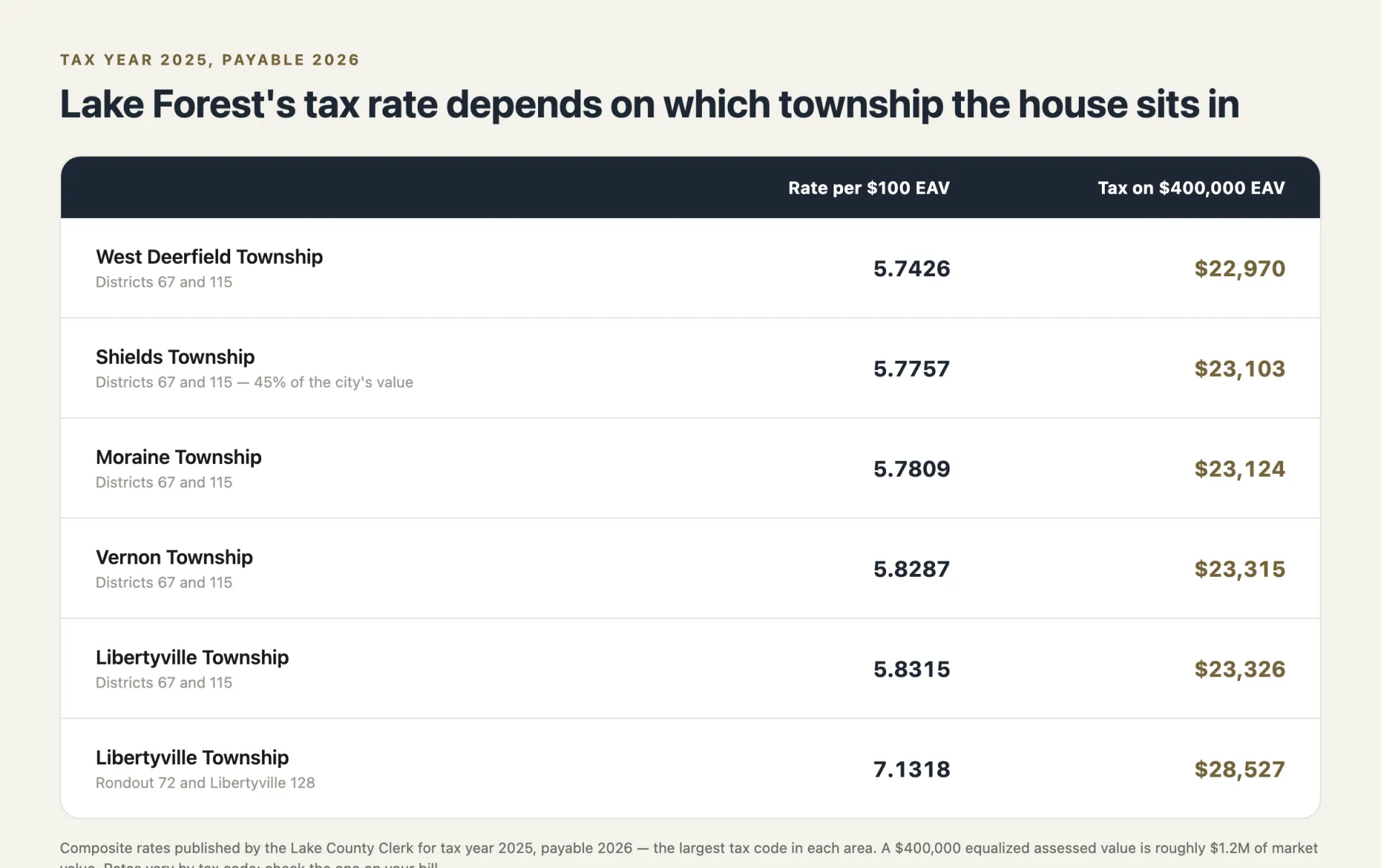
Shields Township carries 45 percent of the city's $2.99 billion in assessed value and taxes at 5.7757. West Deerfield, the next largest at 34 percent, comes in slightly cheaper at 5.7426. Across those four township versions of Districts 67 and 115 the spread is small, about $356 a year on a $400,000 EAV. That part is a rounding error.
The last row is not. A pocket of Lake Forest inside Libertyville Township sits in Rondout School District 72 and Libertyville High School District 128 rather than Districts 67 and 115, and it taxes at 7.1318. On the same $400,000 EAV that is $28,527 against $22,970 in West Deerfield. Same city, same price, and $5,557 a year of difference that shows up nowhere in the MLS. I have written before about which Lake Forest address gets which school; the tax consequence of that boundary is the part buyers never see coming.
Why the listing's Lake Forest property tax estimate is not your bill
The tax number on a listing sheet is whatever the last bill said. That bill belonged to the seller, and it was shaped by exemptions that are attached to them rather than to the house. Lake County states it plainly: exemptions do not transfer, and a new owner has to apply under their own name.
The general homestead exemption takes $8,000 off your EAV, and a senior homestead exemption takes another $8,000 for owners 65 and over. At Shields Township's rate those two together are worth about $924 a year. Real money, and easy enough to recover by filing.
The low-income senior assessment freeze is the one that quietly wrecks a budget. It holds a qualifying senior's equalized assessed value at a base year, so a homeowner who qualified in 2015 may be taxed on a decade-old value. Every $10,000 of EAV the freeze holds down is worth about $578 a year at Lake Forest's rate. Over ten years of appreciation that is not a small adjustment.
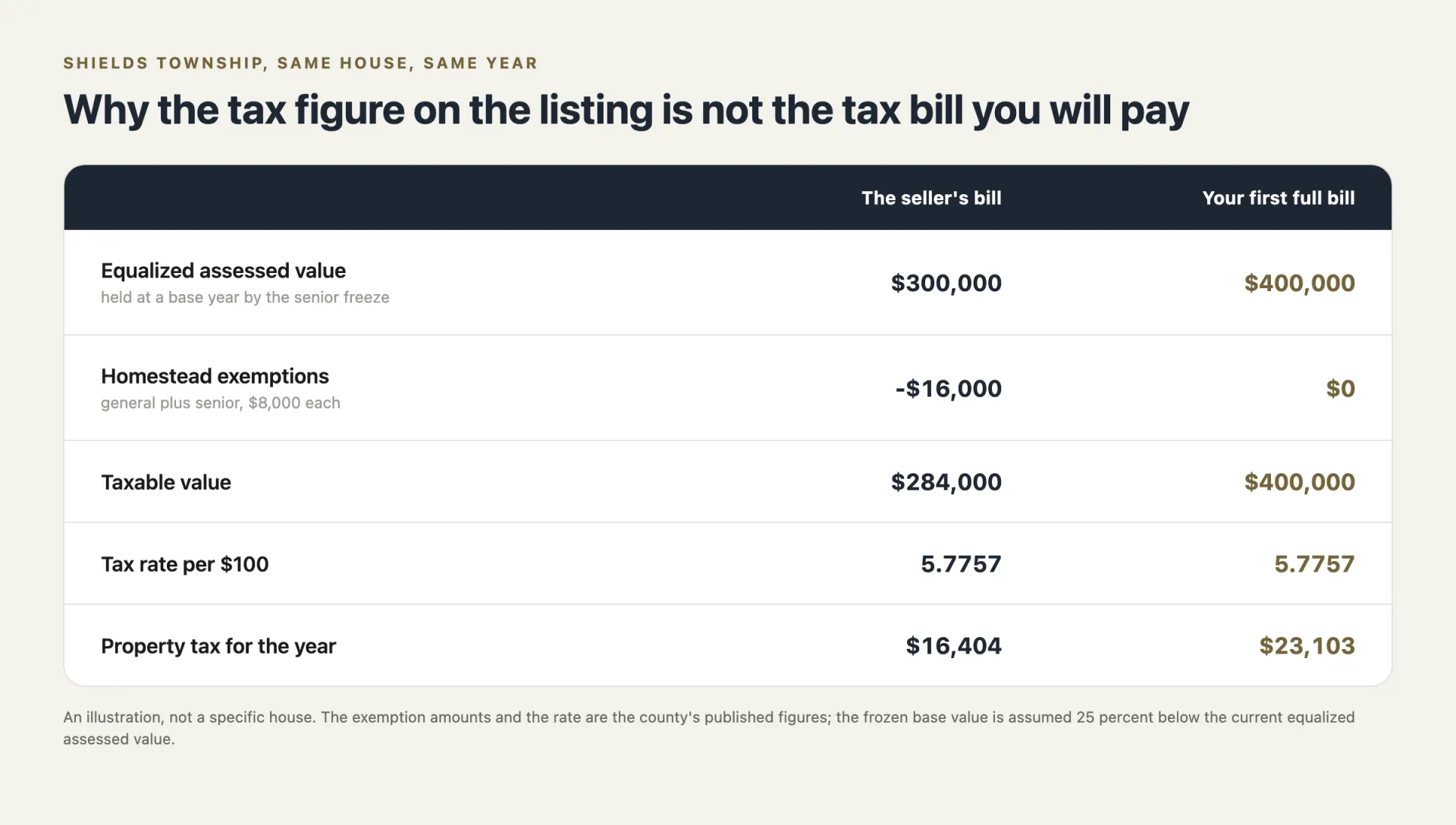
At closing your attorney will negotiate a tax proration, usually a credit from the seller at 100 to 110 percent of the last known bill. That credit is an estimate built on the same stale number, so it protects you against the timing and not against the size. When the true bill arrives, the difference is yours.
The Lake Forest exemptions worth filing for, and when
Filing is free and takes minutes through the county's Smartfile portal. The three that matter for most Lake Forest owners:
- General homestead, $8,000 off EAV. You must own and live in the home as of January 1 of the tax year. One property only, and there is no annual renewal.
- Senior homestead, another $8,000 off EAV for owners 65 and over. Stacks on top of the general exemption, and also does not renew annually.
- Low-income senior freeze, which fixes your EAV at a base year. This one must be refiled every single year, and the household income ceiling is $65,000 for the 2025 assessment year and $75,000 for 2026.
The freeze is the one people lose by forgetting. It is annual, it needs proof of income, and missing a year resets you to current value. If you inherited a Lake Forest house from a parent who had one, budget for the unfrozen number from day one.
What the 2026 equalization multipliers do to Lake Forest
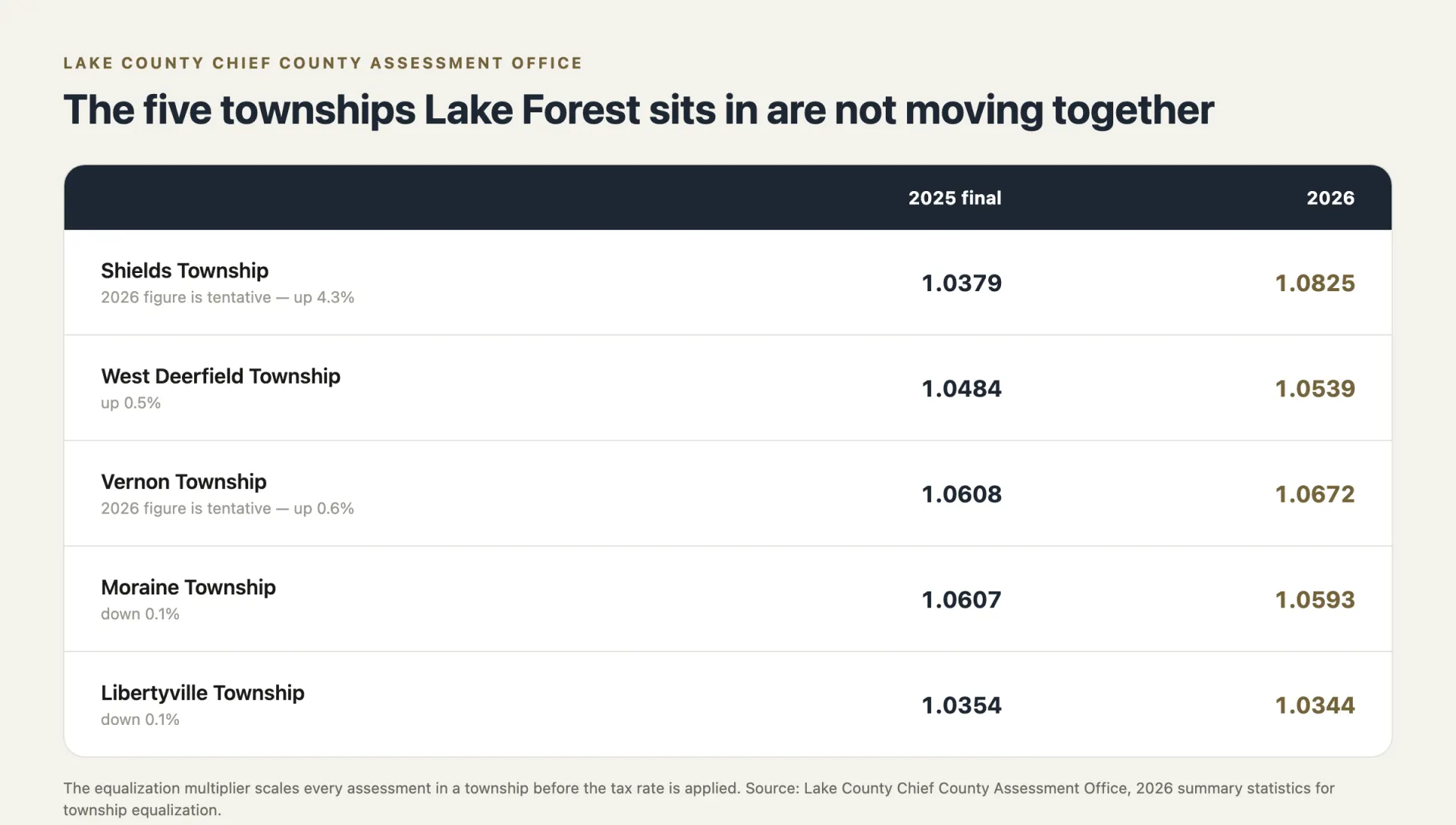
The multiplier is the least understood number in the whole system. It scales every assessment in a township before the rate is applied. Shields Township's 2026 tentative multiplier is 1.0825 against a 2025 final of 1.0379, a 4.3 percent increase. West Deerfield moves 0.5 percent. Moraine and Libertyville edge down.
That does not mean Shields bills rise 4.3 percent. Lake County has been under the Property Tax Extension Limitation Law since 1991, which caps how much a district's total extension can grow at 5 percent or the CPI, whichever is lower. The levy is capped, so when a township's assessed value rises the rate generally falls to compensate.
The catch is that Districts 67 and 115 span all five townships, and the cap applies to the district's whole levy rather than to any one township inside it. If Shields is equalized up 4.3 percent while West Deerfield moves 0.5, Shields parcels absorb a larger share of the same capped school levy. That is a redistribution inside the city, and it is why two identical Lake Forest houses can drift apart on tax over a few years for reasons neither owner did anything to cause.
Where a Lake Forest property tax dollar actually goes
Lake County counts more than 200 separate entities that levy property taxes, and says school districts take about 69 percent of the average county bill while county government itself takes about 7 percent. Those are county-wide averages.
Lake Forest does not match the average. The city states that it receives 22 percent of a Lake Forest property tax bill, which is high for an Illinois municipality and reflects a city that runs its own police, fire and public works at a level most towns contract out. The trade is real service for a real line item, and it is worth knowing which one you are buying.
One genuine point in Lake Forest's favor: the effective rate here is about 1.87 percent of market value against a Lake County median near 2.61 percent. The bills are enormous because the values are enormous. The rate is the mildest in the county.
What I do before a client writes an offer in Lake Forest
I pull the PIN and read the actual bill rather than the listing summary. That tells me the tax code, the composite rate, the current EAV, and which exemptions the seller is carrying. Then I strip the exemptions out, apply the rate to the raw EAV, and hand the buyer that number as the floor for year one.
The expectation I most often have to reset is the assumption that a $16,000 tax line on the listing means a $16,000 tax line for them. I have watched buyers find the real number in month four, after the furniture is in and the renovation is priced. It is a far better conversation in week one.
Nobody has ever thanked me for the tax number in the offer stage. Plenty of people have thanked me a year later. The bill is the second mortgage payment that never pays itself off, and it should be in the budget before the offer, not after the closing.
Checking the number on a specific Lake Forest address
If a large assessment does look out of line, the appeal window is only 30 days from the day your township's assessments are published, and I walk through the whole calendar in my Lake County property tax appeal guide. If you want the wider picture on carrying cost here, that is the subject of my honest buyer's guide to living in Lake Forest, and the Lake Forest town guide has the market and neighborhood detail.
If you want the real ownership math on a specific Lake Forest address, with the tax code, the exemptions stripped out and the year-one number written down, that is a conversation I am happy to have. Send me the address and I will run it.
Frequently Asked Questions
For tax year 2025, payable in 2026, most of Lake Forest taxes at 5.7757 per $100 of equalized assessed value in Shields Township and 5.7426 in West Deerfield, per the Lake County Clerk's tax code data. A pocket of the city inside Libertyville Township, served by Rondout 72 and Libertyville 128, taxes at 7.1318. Because EAV is roughly one third of market value, 5.7757 works out to about 1.9 percent of what the house is worth.
Almost always because the listing quoted the seller's bill. Homestead exemptions are attached to the owner rather than the property and do not transfer on sale, so a seller carrying a general and senior exemption was paying on $16,000 less EAV than you will. If they also held the low-income senior freeze, their assessed value was locked at a base year and yours will not be. The gap can run into five figures on a Lake Forest house.
Lake County mails bills on May 1 and collects in two installments, the first due June 4 and the second due September 4, with 1.5 percent monthly interest after each date, per the county's real estate tax calendar. Illinois bills a year in arrears, so the 2026 bill is for the 2025 tax year.
No. Lake County is explicit that exemptions do not carry over to a new owner or a newly assigned PIN, and you have to apply in your own name through the county's Smartfile portal. The general homestead and senior homestead exemptions are one-time filings; the low-income senior assessment freeze has to be refiled every year.
This is general information, not legal, financial or tax advice. Tax rates, multipliers, assessments and exemption rules change every year and vary by tax code and by address. Confirm your specific figures with the Lake County Chief County Assessment Office, the Lake County Treasurer and your real estate attorney before you rely on them.
Get new Lake County listings by email
I'll send you new Lake County homes as they come on the market. Just your email, no account needed.
Just your email. Unsubscribe any time by replying.
I'm Eshu Chikoti, a Lake County, IL agent. If you want the numbers in this article run for your specific home or purchase, let's talk it through — no pressure, no obligation.
Get in touch →