What Closing Actually Costs in Illinois, Line by Line
Illinois buyers typically pay lender fees, title charges, attorney fees, recording costs and prepaid taxes and insurance at closing. Sellers pay commission, state and county transfer tax, and a municipal transfer tax in some towns. The split is set by contract, not by law.
| Line | Usually paid by |
|---|---|
| Lender fees | Buyer |
| Prepaid taxes and insurance | Buyer |
| Recording costs | Both sides: the buyer records the deed and mortgage, the seller records any mortgage release |
| Attorney fees | Each side pays its own |
| Title charges | Both sides, for different policies and services |
| Listing commission | Seller |
| Buyer-agent compensation | Per the buyer's written agreement; the seller may agree to pay it |
| State and county transfer tax ($1.50 per $1,000) | Seller, on most sales |
| Municipal transfer tax | Set by each town; in Lake Forest the buyer pays $4.00 per $1,000 |
| Property tax proration | Seller credits the buyer, because Illinois taxes are paid in arrears |
Quick answer: in Lake County, a buyer taking out a loan usually pays somewhere between 2% and 3.5% of the purchase price in closing costs. On the county's $433,728 median sale price as of July 2026, that is roughly $9,000 to $15,000 on top of your down payment. Sellers pay less in hard fees but far more once the real estate commission is in the picture, landing most sellers around 7% to 9% of the sale price all in, per 2026 Illinois cost data. The difference between a scary round number and a plan is knowing which line is which — so here is every one of them, who customarily pays it, and what is actually negotiable.
Closing costs are really two separate piles
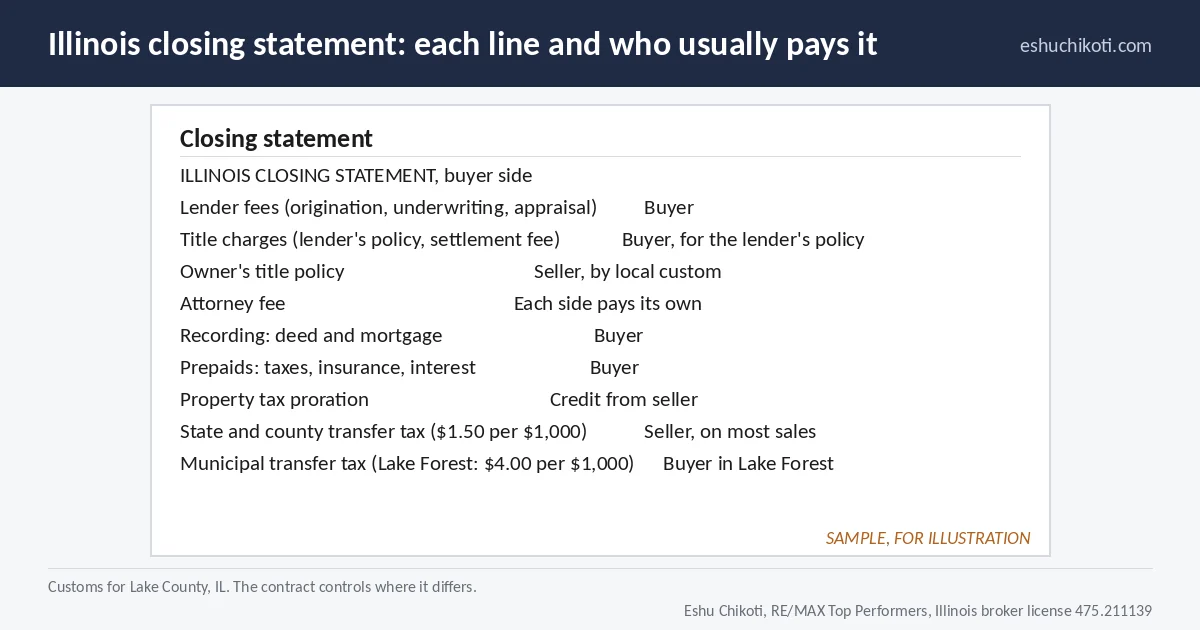
Most of the confusion clears up the moment you split them into two piles. The buyer's pile is mostly the cost of getting a loan and taking clean title: lender fees, the appraisal, title insurance, an attorney, and the prepaid taxes and insurance your lender collects up front. The seller's pile is the cost of transferring the property and paying the agents: state and county transfer taxes, the owner's title policy, their own attorney, and the commission. A few items shift by local custom, but that is the frame. Buyers pay to borrow; sellers pay to hand over the keys.
What the buyer actually pays
Here is the buyer's side of a typical Lake County closing disclosure, with the ranges Illinois buyers were seeing in 2026:
- Loan origination fee — what the lender charges to underwrite the loan, usually 0.5% to 1% of the loan amount.
- Appraisal — $400 to $600, required by your lender to confirm the home is worth the price.
- Credit report — a small fee, usually $50 to $100, for pulling your credit in underwriting.
- Lender's title insurance — $400 to $800, protecting the lender's stake in the property; the buyer pays this one.
- Recording fees — Lake County uses a flat, predictable fee of $70 per standard document, so recording your deed and your mortgage together runs about $140.
- Attorney fee — $500 to $1,000 for a standard residential closing; Illinois is an attorney-review state, so you will have one.
- Prepaid escrow and interest — your first deposits toward property taxes and homeowners insurance, plus interest from closing day to month-end.
That last line is the one that ambushes first-time buyers. Prepaid property taxes alone can run $1,000 to $5,000 at the table, because your lender wants a cushion in escrow before your first Lake County tax bill lands — and in a county with an effective property tax rate near 2.68%, those bills are not small. It is real cash, it has nothing to do with your loan amount or down payment, and it is far better understood before closing day than during it.
What the seller actually pays
The seller's hard costs are smaller than most sellers expect, right up until the commission. The seller customarily pays the Illinois state and county transfer taxes and buys the owner's title policy — which protects you, the buyer, but is paid by the seller across most of Illinois and runs from a few hundred dollars up past $1,200 as the price climbs. Add the seller's attorney at $500 to $1,000 and you are still only looking at a few thousand dollars.
Then comes the commission, which is the entire ballgame — the largest number on the seller's page by a wide margin, and since the NAR settlement more openly negotiable than it has been in decades, with no legal or standard rate. I wrote a whole separate piece on whether sellers should still cover the buyer's agent, because that one decision moves the total more than every other closing line combined.
Illinois's transfer tax, in plain numbers
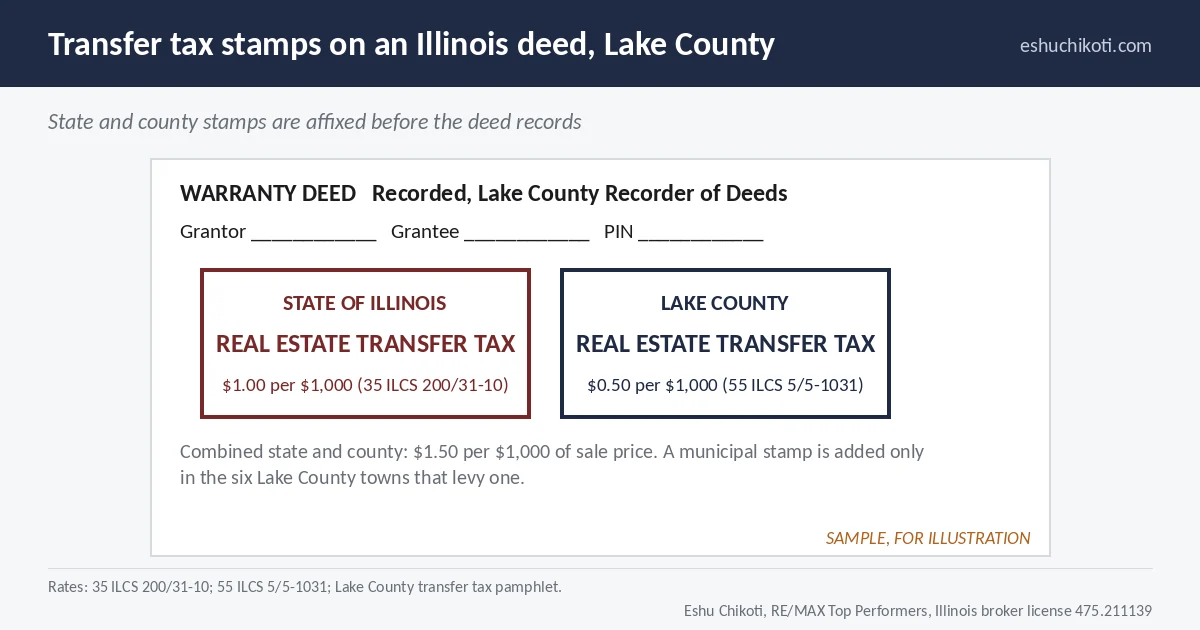
Illinois's transfer tax is refreshingly simple to compute. The state charges $0.50 per $500 of price, and the county adds $0.25 per $500 — so combined, the state and county take $0.75 per $500, or 0.15% of the sale price. On the $433,728 Lake County median that is about $651 total: roughly $434 to the state and $217 to the county, customarily paid by the seller at recording.
Where it gets local is the municipal stamp. Most Lake County towns charge nothing beyond the state and county tax — a genuine advantage over Chicago, where city stamps pile on another 1.2% or more. But a handful do levy their own: Highland Park, for one, charges $5.00 per $1,000 — an extra 0.5%, paid by the seller, more than $2,000 on a median-priced home. Confirm your specific town's rule before assuming there is no municipal stamp, because the map is not uniform.
The Illinois quirk: attorney review
Unlike most of the country, Illinois builds a lawyer into nearly every deal. The standard Illinois REALTORS contract includes a five-business-day attorney review period that starts the day after both sides sign, during which either party's attorney can request changes or, in rare cases, cancel without penalty and get the earnest money back. That is why an attorney fee shows up on essentially every Illinois closing statement, buyer and seller alike. The practical tip: line up your attorney before you are under contract. Scrambling to find one while a five-day clock is running is how buyers lose leverage in the exact window it was designed to give them.
A worked example on a $433,728 Lake County home
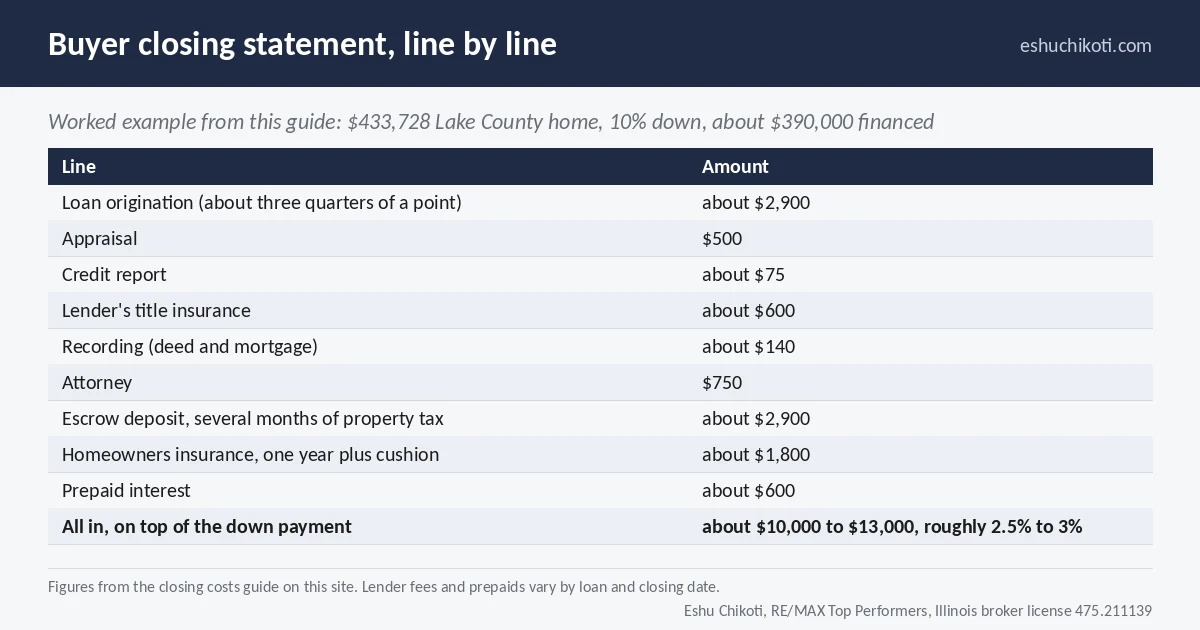
Say you are buying at the county median with 10% down, financing about $390,000. Origination around three-quarters of a point runs roughly $2,900. Add the appraisal at $500, a credit report near $75, lender's title insurance around $600, recording of the deed and mortgage at about $140, and your attorney at $750 — roughly $5,000 in flat fees before a single prepaid. Then escrow: a few months of property taxes near $2,900, a year of homeowners insurance with a cushion around $1,800, and prepaid interest around $600. All in, this buyer is near $10,000 to $13,000, or about 2.5% to 3% of the price on top of the down payment.
Flip to the seller on the same $433,728. Transfer tax is about $651, the owner's title policy runs north of $1,200, and the seller's attorney adds $750 or so — under $3,000 in hard costs. The commission, negotiable but easily the biggest line, is what pushes the seller's total into the 7% to 9% range, and in a town like Highland Park the municipal stamp adds another $2,000-plus. Same house, same closing table, two very different bills.
What's negotiable, and what isn't
- Lender fees — origination and rate vary meaningfully between lenders even in the same market, so get a Loan Estimate from at least two and compare Section A line by line.
- Who pays what — the whole custom split is just custom; a buyer can ask the seller for a credit toward closing costs, especially with more negotiating room than the 2021–2022 peak.
- The commission — fully negotiable, with no standard rate.
- Assistance funds — an FHA loan or an Illinois down payment assistance program can cover closing costs, not just the down payment, which is one of the most underused features of those programs.
What does not move: the transfer taxes, the recording fee, and the appraisal are fixed by the government or a third party regardless of which lender or agent you use. Chasing those is wasted energy; chasing the lender and the commission is where the real dollars are.
The line that catches almost every first-time buyer off guard isn't a fee at all — it's the prepaid escrow deposit, because it's real cash due at closing that has nothing to do with your loan amount or your down payment.
Closing costs feel like a black box right up until someone itemizes them, and then they are just a list. They are also the single biggest reason buying early costs more than it looks like it does, which is why they carry so much weight in the rent versus buy break-even. If you want your specific number run — your price, your town, your loan, your down payment — that is worth walking through before you write an offer, alongside how much house your budget actually supports and which Illinois first-time buyer programs you might qualify for. Bring me the address and I will show you both sides of the table.
Does Closing Cost Include Real Estate Agent Fees?
For a seller, yes, commission is the largest single line on the seller side of the settlement statement. For a buyer, usually not directly, though since the NAR settlement a buyer may now pay their own agent, in which case it appears on the buyer side. Check which structure your contract uses.
The five business days after acceptance are explained in attorney review period in Illinois, and the rest of the purchase is in my notes on buying in this market.
Frequently Asked Questions
Typically 2% to 3.5% of the purchase price for a financed buyer in the Chicago suburbs, Lake County included — roughly $9,000 to $15,000 on the county's $433,728 median, on top of your down payment. Prepaid property taxes and insurance are the biggest swing factor, since they depend on your specific home's tax and insurance bill.
By custom the seller pays the Illinois state tax ($0.50 per $500) and the Lake County tax ($0.25 per $500), a combined 0.15% of the price. Some towns like Highland Park add a municipal stamp — Highland Park's is $5.00 per $1,000, also seller-paid. Everything is negotiable in the contract, but that is the default split.
Illinois is an attorney-review state: the standard REALTORS contract gives each side's attorney a five-business-day window to review and revise the agreement. It is customary practice rather than an absolute legal mandate, but nearly every contract and title company assumes both sides have a lawyer, and the fee ($500 to $1,000) is small relative to the protection.
On most conventional purchase loans, no — they are due at closing. But seller credits and Illinois down payment assistance programs can offset them, and some refinance and specialty products do allow certain costs to be financed. Prepaid escrow, in particular, generally cannot be rolled into the loan.
Hard costs — transfer tax, owner's title policy, attorney — usually total under $3,000 on a median-priced home. The commission is what pushes the all-in figure to roughly 7% to 9% of the sale price, and it is the one line with real negotiating room, so it deserves the most attention.
On the seller's side, yes, agent commission is normally the largest line on the seller's closing statement. On the buyer's side it traditionally did not, but since the 2024 NAR settlement a buyer may pay their own agent directly, in which case it appears there. Check your contract.
Call 847-691-4282 for a line-by-line estimate on your actual price.
This is general information, not legal, tax, or financial advice. Fees, tax rates, and customary practice change and vary by town, lender, and contract. Confirm your specific figures with your lender, your real estate attorney, and the Lake County offices before you make or accept an offer.
Get new Lake County listings by email
I'll send you new Lake County homes as they come on the market. Just your email, no account needed.
Just your email. Unsubscribe any time by replying.
I'm Eshu Chikoti, a Lake County, IL agent. If you want the numbers in this article run for your specific home or purchase, let's talk it through — no pressure, no obligation.
Get in touch →