Buffalo Grove, IL Real Estate
Buffalo Grove, IL homes sold at a median of $442,707 in the three months to August 2026, according to Redfin. The village sits in two counties, and the tax math follows the line: Ownwell puts the Lake County side at a 2.95% effective rate with a median bill of $12,364, and the Cook County side at 2.81% with a median bill of $6,458. Two North Central Service stations reach Union Station in 53 to 64 minutes.
Closed sales
- 2147 Apple Hill Ln, Buffalo Grove: $577,000, represented the seller.
- 31 Berkshire Ln, Lincolnshire: $685,000, represented the buyer.
- 4585 Patricia Dr, Long Grove: $1,250,000, represented the buyer.
Closed sales by Eshu Chikoti, RE/MAX Top Performers, Illinois license 475.211139. Price and representation as shown on each listing page.
Buffalo Grove, IL is a built-out village of about 42,900 people that sits in both Lake and Cook counties, and the county line along Lake Cook Road shapes the tax bill, the high school and the price.
Living in Buffalo Grove, IL means a median sale price near $443,000 this summer, a Lake County side that generally feeds Stevenson High School, and property tax near 3% of value. The trade-offs are a commuter train with no weekend service and a housing stock that is mostly 40 years old. Here is how it breaks down.
| Median sale price | $442,707 (Redfin, 3 months to August 2026, down 0.52%); Zillow index $447,960, up 5.8% |
|---|---|
| Effective tax rate | Two counties. Lake side 2.95%, median bill $12,364. Cook side 2.81%, median bill $6,458 (Ownwell) |
| School districts | Six serve the village. Cook-side addresses typically feed Wheeling CCSD 21, then Buffalo Grove High School |
| Metra | Two North Central Service stations, Buffalo Grove on Commerce Court and Prairie View on Main Street. 53-64 minutes to Union Station, no weekend service |
| County | Split between Lake County and Cook County |
Written by Eshu Chikoti · 847-691-4282 ·
How Buffalo Grove, IL Got Here: A Short History
Buffalo Grove takes its name from Buffalo Creek, the stream that still runs through the village, and the grove of trees that once lined it. The Potawatomi held this land until the 1833 Treaty of Chicago opened it to settlement. German immigrant farmers arrived in the 1840s, built the first St. Mary's church in 1852 and its school in 1855, and for the next hundred years the area stayed farmland.
Then came 1958. Buffalo Grove incorporated that year with 164 residents living in 42 homes. Developer Al Frank pushed the incorporation so his development would sit outside Cook County's planning control, and he built houses of roughly 1,000 square feet marketed to returning World War II and Korean War veterans. The village counted 1,492 residents at the 1960 census and 12,333 by 1970. It added another 80% through the 1970s, reaching 22,230 in 1980 and 36,427 in 1990.
By 2000 the population was 42,909, and then it stopped growing. The 2020 census counted 43,212, and the newest Census ACS estimate (2020-2024) puts it at 42,891. A quarter century of flat population is the single most useful fact about the housing market here. Buffalo Grove is built out. What trades is existing stock, and the market moves on turnover rather than on new construction.
That history also explains the map. Because the village grew outward from the Cook County side in roughly one wave, the oldest homes are in the south near Dundee Road and the newest are at the north end near Route 22 and Aptakisic Road, in Lake County. If you know the decade a subdivision went up, you can usually guess which side of Lake Cook Road it is on, and the reverse is also true.
Buffalo Grove at a Glance
Buffalo Grove covers about 9.6 square miles roughly 30 miles northwest of the Loop. Its defining structural fact is that it sits in two counties at once: Lake County's Vernon Township to the north and Cook County's Wheeling Township to the south, divided along Lake Cook Road. That split changes your assessor, your assessment math, your exemptions, your appeal deadline, your tax calendar, your sales tax rate and the office that records your deed. It gets its own section below because it deserves one.
The village borders Long Grove to the west and northwest, Vernon Hills to the north, Lincolnshire to the northeast, Riverwoods and Deerfield to the east, Wheeling to the southeast and Arlington Heights to the south and southwest. Almost all of it uses ZIP code 60089, which also spills into parts of Long Grove, Lincolnshire, Vernon Hills and Wheeling. A 60089 address is not proof a house is in Buffalo Grove, and it says nothing about which county the house is in.
The 2020-2024 Census ACS counts 16,593 housing units, and 79.8% of occupied homes are owner-occupied. The ACS median home value is $412,300 and the median gross rent is $2,037. That rent figure averages existing leases over five years, so current asking rents on a newly listed unit usually run higher.
Buffalo Grove's Two Counties: Lake vs Cook, Explained
Buffalo Grove sits in two counties, and this is the most important thing to understand before you buy here. It changes who assesses your home, how that assessment is calculated, which exemptions you get, when your bill arrives, when you can appeal, what you pay at the register and where your deed is recorded. The listing sheet will not explain any of it. The question I get most on Buffalo Grove listings is some version of "which side is this one on, and does it matter?" It matters.
The line is Lake Cook Road. North of it is Lake County, in Vernon Township. South of it is Cook County, in Wheeling Township. Those are the only two townships involved; no part of Buffalo Grove is in Ela Township, despite what a few sites say. By each county's own parcel records there are about 10,641 Lake County parcels with a Buffalo Grove address and 6,085 in Cook, so roughly 64% of the village's parcels are on the Lake side. One warning: the village boundary and the county line are not the same line. Wheeling holds land north of Lake Cook Road inside Lake County, and Buffalo Grove extends north of the road near Milwaukee Avenue. Do not settle it from a map.
Here is the fastest way to settle it. Look at the property index number on the listing. A Buffalo Grove PIN that starts with 03 and runs 14 digits is Cook County. One that starts with 15 and runs 10 digits is Lake County. That check takes five seconds and tells you which of the two systems you are buying into.
The systems differ in mechanics, not just in rate. Cook County assesses homes at 10% of market value, multiplies by one county-wide state equalization factor and reassesses each township every three years. The Illinois Department of Revenue set the final 2025 Cook factor at 3.0300 in June 2026, down slightly from 3.0355 for 2024. Wheeling Township was reassessed for tax year 2025. Lake County does close to the opposite on every axis: it assesses every year against a target of 33⅓% of market value and applies a township-specific multiplier instead of a county-wide one. Vernon Township's ran 1.0598 for tax year 2024 and 1.0608 for 2025. Cook also taxes commercial property at a higher assessment level than homes; Lake has no classification system.
Exemptions differ too. The general homestead exemption is $10,000 of equalized assessed value in Cook and $8,000 in Lake. A few older sources still list Lake's as $6,000; that figure is out of date. Billing differs as well. Lake sends two roughly equal installments, typically due in early June and early September. Cook's first installment is fixed at 55% of the prior year's total, and its second installment has moved around by months in recent years as the county replaced its old mainframe system. If you are prorating taxes at a Cook County closing, confirm the actual due dates rather than assuming last year's calendar.
Some things do not split at the line, and it is worth saying so because it cuts against the worry. The Village of Buffalo Grove takes about a tenth of the bill on either side. Schools take roughly seven of every ten dollars on both sides. The village's real estate transfer tax of $3 per $1,000 of price is the same in both counties, and the fire department is municipal, so fire service does not change at the line either.
At the closing table the split shows up in small, practical ways. Illinois property taxes are paid a year in arrears, so every closing here includes a credit from the seller to the buyer for the taxes that have built up but not yet been billed. How that credit is calculated depends on the county's most recent bill and its calendar, which is why a Cook-side proration can look quite different from a Lake-side one on houses at the same price. The deed goes to a different county office on each side, and the lender's title work will follow the county too. None of this is hard. It just means your attorney and lender need to know from day one which side of Lake Cook Road the house is on, and the PIN tells them.
Cook County side, south of Lake Cook Road. Wheeling Township. Assessed at 10% of market value, multiplied by the state equalization factor (3.0355 for tax year 2024, 3.0300 for 2025), reassessed every three years and most recently for tax year 2025. The Cook County Clerk's 2024 tax rate report puts the village's average composite rate at 10.957162% of equalized value, up 3.21% from 10.616% the year before. Homestead exemption $10,000.
Lake County side, north of Lake Cook Road. Vernon Township, whose assessor's office is itself in Buffalo Grove on North Main Street. Assessed every year against a 33⅓% target, then multiplied by a township factor (1.0598 for tax year 2024, 1.0608 for 2025). No classification system. Homestead exemption $8,000. Appeals run on a short window after assessments are published, so watch for the township's notice each year.
What actually drives the rate: the school district. On the Cook side, District 21 and District 214 together make up about 7.5 of the roughly 11 points in the composite rate. On the Lake side, the Lake portion alone contains three elementary districts, two library districts and two park districts, so two Lake County houses a mile apart can carry different rates. Pull the tax code for the specific parcel rather than reasoning from the county.
Services that cross or split at the line. Indian Trails Public Library District reaches across the county line and serves thousands of Lake County parcels alongside Vernon Area Public Library District. The Buffalo Grove Park District spans both counties. Sales tax does split: the village publishes general merchandise at 10% on the Cook side and 8% on the Lake side, with restaurant food and drink at 11% and 9%.
Buffalo Grove Neighborhoods, Pocket by Pocket
Buffalo Grove is a village of named subdivisions, roughly 90 of them. Because it built out in a fairly orderly wave from south to north, the name usually tells you the decade, the builder and the price tier at once. Locals split it two ways. The first split is Lake Cook Road, which decides the county and, as a rule of thumb, the high school. The second is age: the Cook side holds the oldest single-family homes and the older condominium complexes, and the north end near Route 22 and Aptakisic Road holds the 1990s estate subdivisions and the few recent builds.
A piece of local history most agents miss: Levitt and Sons, the firm that built Levittown, developed four communities here. Strathmore is the big one, and Strathmore Grove, the Villas at Buffalo Creek and Serendipity followed. If you are looking at a mid-century home on Checker Road east of Arlington Heights Road, there is a decent chance it is a Levitt house.
Two naming traps before you start searching. Strathmore Square is a shopping center on Dundee Road, not a neighborhood. Town Place is a townhome subdivision, not a shopping center. And several names that come up in searches, such as Frenchmen's Cove, Arlington Trails and Cambridge Country, are in Arlington Heights or Mundelein, though Frenchmen's Cove Park is a Buffalo Grove Park District park.
Walkability also varies more than the village number suggests. Walk Score rates Buffalo Grove 40 overall, but its named neighborhoods run from 46 in Ridgewood and 45 in Highland Grove and Highland Point down to 34 in Old Farm Village and 28 in the Woodlands of Fiore. That is the difference between walking to a grocery store and driving to everything.
Prices move by pocket too, and small samples swing hard. Redfin shows Old Farm Village at a $615,000 median over the three months ending August 2026, against the village-wide $443,000 in the same window. Strathmore's August figure was $535,000 on just four sales, which is a reason to read any single subdivision median with care.
When I sold 2147 Apple Hill Lane this July for $577,000, above asking and with a lot of offers, the first questions buyers asked were about the tax bill, not the finishes. That is the pattern across the whole village. Where a house sits in Buffalo Grove moves the price more than what is inside it. If you want to know which pocket a specific address falls in and what that pocket has sold for lately, that is a conversation I am happy to have here.
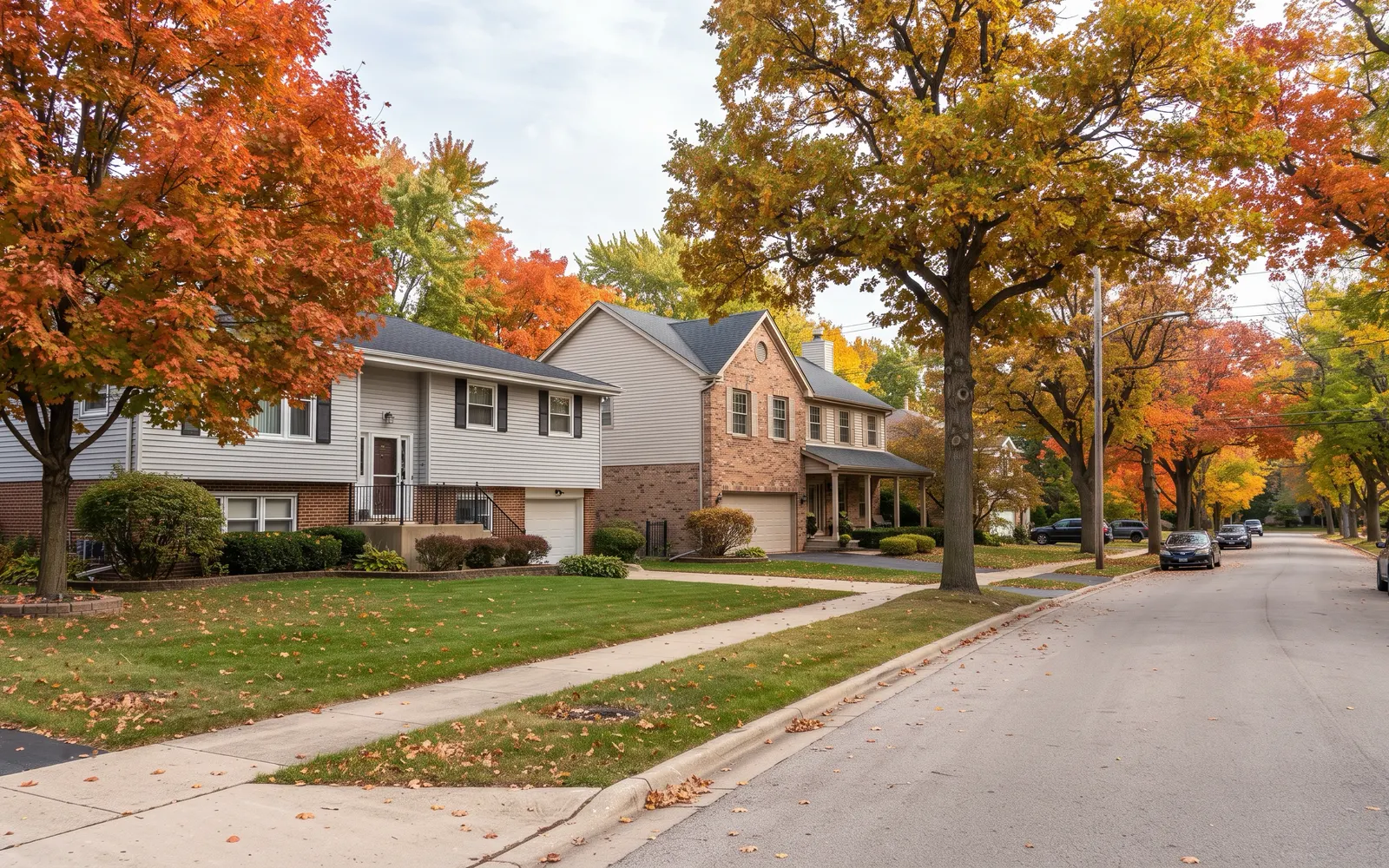
Old Buffalo Grove. The original. Single-family homes built from 1952 to 1973 along Bernard Drive and Buffalo Grove Road south of Lake Cook Road, in Cook County, where Al Frank's first development stood. Homes run roughly 1,046 to 3,500 square feet, the smallest and most affordable single-family stock in the village.
Strathmore. The Levitt and Sons community, built from 1961 to 1981 on Checker Road east of Arlington Heights Road, in Lake County. Homes run about 1,553 to 3,787 square feet, with a clubhouse, pool, tennis courts and a lake. Strathmore Grove, Grove East and Grove Lake are adjacent Levitt-era extensions from the late 1960s through the 1980s.
Old Farm Village. A Lexington Homes community built from 1984 to 1996 north of Deerfield Parkway and west of Weiland Road, in Lake County. A mix of single-family homes, townhouses and condominiums from about 802 to 3,711 square feet, with a clubhouse, pool, tennis and trails. Walk Score 34.
Woodlands of Fiore. Built from 1986 to 1996 by the Zale Group on Buffalo Grove Road south of Route 22, in Lake County. Townhomes, single-family homes and condominiums across eighteen floor plans from roughly 1,412 to 4,739 square feet, with a clubhouse, pool, tennis and lake frontage. Walk Score 28, the lowest of the named pockets.
Ridgewood, Highland Grove and Highland Point. The most walkable named pockets in the village, at Walk Scores of 46, 45 and 45. Devonshire (42), The Crossings (38) and Green Knolls (36) follow. Ask for the build year and school assignment on each; they vary.
Canterbury Fields and Mirielle. The estate tier, both in Lake County at the north end. Canterbury Fields is 96 homes by Dartmoor Homes, built from 1990 to 2000 on Buffalo Grove Road just north of Route 22, with plans from 2,800 to 4,500 square feet. Mirielle, by Town & Country Homes, went up from 1996 to 2001 off Prairie Road with plans from 2,235 to 3,785 square feet. These carry some of the village's highest tax bills.
Cambridge on the Lake, Chatham and Delacourte. The condominium tier, and the least expensive way into Buffalo Grove. Cambridge on the Lake was built from 1970 to 1983 on Dundee Road east of Buffalo Grove Road in Cook County. The Chatham group is a cluster of 1980s condominium and coach-home buildings around Weidner and Dundee. Delacourte, built from 1998 to 2001 on Dundee Road east of Arlington Heights Road, runs larger at 1,211 to 2,319 square feet with heated underground parking.
Link Crossing and Waterbury. The newest single-family and townhome wave. The Villas at Link Crossing went up from 2020 to 2024 northeast of Aptakisic and Buffalo Grove Roads, part of a development of 68 clustered single-family homes and 119 townhomes. Waterbury is the other neo-traditional subdivision the village names from the 2000s.
What Buffalo Grove Homes Look Like, by Era
Buffalo Grove's housing is a close record of the 1970s and 1980s. Of the 16,593 housing units the 2020-2024 ACS counts, 30.5% were built in the 1980s, 28.3% in the 1970s and 17.5% in the 1990s. That is 76.3% of everything here built between 1970 and 1999. Only 6.5% dates from 2000 or later and 2.0% from 2010 onward. If you are shopping Buffalo Grove, you are almost always shopping a well-kept house that is about forty years old, and you should underwrite what comes with that: original-vintage windows, aging electrical panels, and roofs and furnaces on their second or third replacement.
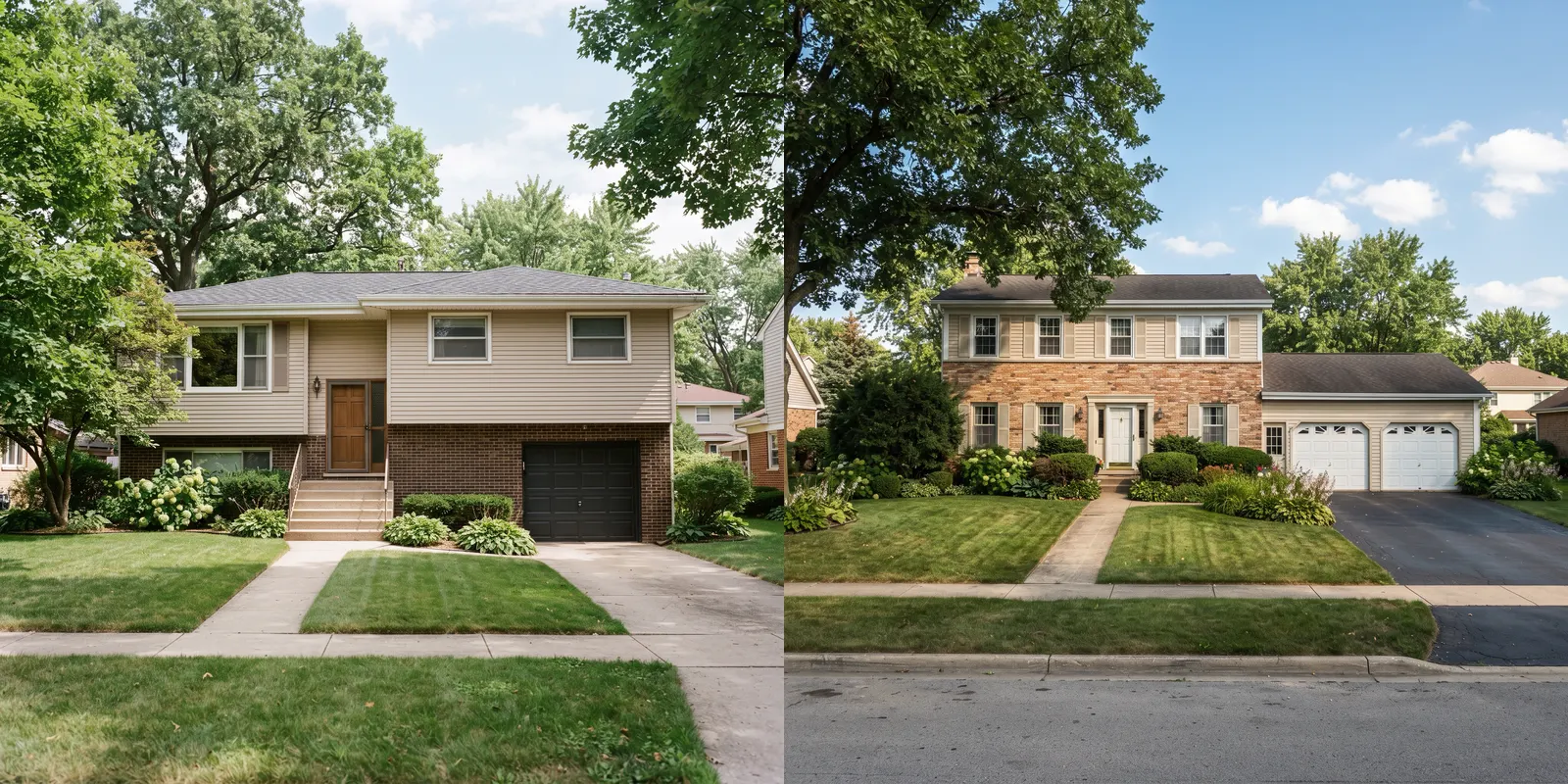
The village's own planning work sorts the stock into a handful of types, and two of them cover most of what you will tour. The postwar homes of the 1950s through 1970s are ranches, raised ranches and split-levels: wood frame, one to one-and-a-half stories, limited brick with wood or aluminum siding, bay and picture windows, and the large lower-level windows a raised ranch allows. The single-family homes of the 1980s through 2000s mix brick, stone and vinyl, run one to two stories with two- and three-car attached garages, and have the steep, busy rooflines of the era, with gables, hips and dormers. The newer waves add paired homes that share a party wall and 2010s townhomes with parking moved to the rear.
The mix is broader than a drive down Buffalo Grove Road suggests. Detached single-family homes are 53.7% of units and attached townhomes another 13.6%, so two-thirds of the village is single-family in some form. The other third is in multi-unit buildings, from three- and four-flats up to buildings of fifty units or more. That spread is why the entry point is low for a town with this reputation. In the week before I wrote this, Redfin's recent sales list showed a two-bedroom condominium on Weidner Road closing at $245,000 and a four-bedroom house on Logsdon Lane at $670,000, both in September 2026.
I have walked buyers through enough 1970s and 1980s houses in this part of the county to know which surprises to expect: original aluminum branch wiring in some 1970s homes, windows that have lost their seals, and basements that have taken water at least once. None of those should kill a deal. All of them belong in the price. My home inspection checklist is a good place to start if you are weighing an older house.
Condominiums and townhomes need a different kind of homework, and with a third of the village in multi-unit buildings, a lot of Buffalo Grove buyers end up doing it. The unit is only half of what you are buying. The other half is the association: its monthly assessment, what that assessment covers (heat and water are included in some of the older complexes and not in others), the size of its reserve fund, and whether a special assessment is planned for roofs, balconies, elevators or parking decks. Ask for the budget, the reserve study if one exists and the last year of board minutes before the attorney review period ends. A building from the 1970s or 1980s that has kept its reserves funded is a very different purchase from one that has not.
Renting in Buffalo Grove Before You Buy
Buffalo Grove has always been mostly an ownership town. The 2020-2024 ACS counts 3,268 renter-occupied homes out of 16,213 occupied, about 20%, and puts the median gross rent at $2,037. Much of that rental stock is individually owned condominiums and townhomes leased out by their owners, which means availability comes and goes one unit at a time.
That is changing. The 250 at The Clove is the first large new apartment building the village has seen in a generation and was over 90% leased by August 2026, according to the village's project page. Bison Crossing on Dundee Road includes a planned apartment building, and the August 2026 proposal at Chase Plaza would add 256 more market-rate units. Within a few years, renting in Buffalo Grove will mean a real choice between new amenity buildings and older owner-leased condominiums, rather than waiting for one to open up.
If you are renting first to learn the village, two things are worth knowing. First, a lease does not settle the school question; the same district rules apply to a rental address as to a purchase, so check the attendance area for the unit before you sign. Second, if a condominium is your eventual target, renting in the complex you are considering is the cheapest inspection you will ever get. You learn how the building handles snow, parking, noise and repairs before you commit to its association.
The Buffalo Grove Housing Market in 2026
Buffalo Grove homes sell at close to asking price, and the good ones still draw competition. Over the three months ending August 2026, Redfin reported a median sale price of $442,707, down 0.52% from the same period a year earlier. The median home sold in about 47 days, compared with 45 a year before, and 189 homes sold in August, up from 156 in August 2025. The sale-to-list ratio was 100.2%, homes drew about two offers on average, and Redfin gives Buffalo Grove a Compete Score of 71 out of 100, which it calls very competitive. By its estimate, the typical home sells around list price and goes pending in about 48 days, while the homes buyers compete over sell about 3% above list in around 35 days.
Here is the part that confuses people. The Redfin median was flat to slightly down. Zillow's home value index for August 2026 is $447,960, up 5.8% from $423,332 a year earlier and up 10.6% from $405,123 in August 2024. Both can be right. Redfin's median is the middle of whatever sold in a three-month window. Zillow's index estimates the value of all homes, sold or not. Redfin's price per square foot, $244, was up 1.7%, which points the same way as Zillow. My read is that values kept rising modestly and the mix of what sold shifted toward condominiums and smaller homes.
That mix matters more in Buffalo Grove than in most Lake County towns, because a third of the housing is in multi-unit buildings. A quarter in which more condominiums close pulls the village median down without any individual home losing value. Do not read a falling median as falling equity, and do not price your own home off one. What sold down the street in the last 90 days, adjusted for size and condition, is the number that matters.
The spread inside the village is wide. In September 2026 alone, Redfin's recent-sales list showed a two-bedroom condominium on Weidner Road at $245,000, a townhome-style unit on Town Place Circle at $290,000, and four-bedroom houses on Silver Rock Lane at $592,000 and Logsdon Lane at $670,000. Old Farm Village's three-month median was $615,000. The village median tells you about Buffalo Grove and very little about a specific house. For a broader read across the county, see my Lake County market report for Q3 2026.
The individual closings show how thin the margin is. On that same September list, the four-bedroom on Silver Rock Lane sold for 3% over its $575,000 list price and the Logsdon Lane house for 2% over its $659,000 list. A three-bedroom on Dorncliff Lane listed at $430,000 took 39 days and closed 2% under, at $420,000, and a two-bedroom condominium on Satinwood Court listed at $340,000 closed 4% under, at $328,000. Houses priced to the market sold at or over. The ones that tested the ceiling gave some of it back.
For a buyer, the practical read is that Buffalo Grove is a market where preparation beats speed. With homes averaging about two offers and 47 days on market, you usually have time to see a house twice, pull the tax record and check the school boundary before you write. What you cannot do is offer well under asking on a house that is priced right and expect the seller to engage; the sale-to-list ratio above 100% says those homes are not negotiating much. Where there is room is on the listings that have sat past a month, and on condominiums, where the September closings show sellers accepting 2% to 4% under list.
What this means in practice for a seller: a well-priced house in a good pocket still sells at or above asking, and mine on Apple Hill Lane did. An overpriced one sits, and 47 days on market is long enough for buyers to start asking what is wrong with it. Buffalo Grove rewards getting the list price right on the first day.
Buffalo Grove Property Taxes on Each Side of the Line
Property tax is the number that changes the monthly payment most in Buffalo Grove, and it never shows up in the list price. There is no single village-wide rate, because the composite rate attaches to the tax code, and Buffalo Grove spans two counties, six school districts, two library districts and two park districts. What I can give you is a sourced median for each side and a worked example.
On the Lake County side, Ownwell's data, last updated April 2026, puts the median effective rate at 2.95% and the median annual bill at $12,364, with the 75th percentile at $15,737 and the 90th percentile at $19,148. On the Cook County side, Ownwell's Cook figures put the median effective rate at 2.81% and the median bill at $6,458. The Cook median bill is lower mostly because the Cook side holds more condominiums and older, smaller homes, not because Cook is cheap.
Here is a worked example on each side. On the Lake side, at the 2.95% median rate, a house bought at $500,000 would carry about $14,750 a year once it is reassessed, roughly $1,230 a month on top of the mortgage. On the Cook side, the math runs through the formula. A $350,000 house is assessed at 10%, or $35,000. Multiplied by the 3.0300 factor for 2025, that is $106,050 of equalized value. Less the $10,000 homestead exemption, it is $96,050. At the village's average composite rate of 10.957162% from the Cook County Clerk's 2024 report, the bill comes to about $10,520 a year, or about $877 a month. Of that rate, District 21 and District 214 account for about 7.5 points.
The caution that applies on both sides: whatever the current owner pays is a floor, not a forecast. Assessments trail the market and usually catch up after a sale. On the Cook side there is an extra wrinkle right now. Wheeling Township was reassessed for tax year 2025, so a buyer closing today may be inheriting an increase that has not fully landed in a bill yet. The expectation I most often have to reset is buyers who budget off the seller's current bill. Ask for the actual tax record rather than the listing's tax line, and budget above it.
For the Lake side, the parcel-level record is public on the county's tax site, and the authoritative rate tables come from the Lake County Clerk's tax extension data. Lake County's tax-code rate files do not load for automated tools, which is why I give you the sourced median instead of a rate I cannot stand behind. For a specific address, the real answer is one lookup away, and I am happy to pull it.
Beyond the tax bill, everyday costs tilt with the line in one visible way. The village publishes sales tax at 10% on general merchandise in the Cook portion and 8% in the Lake portion, with restaurant food and drink at 11% and 9%. Week to week that is small. If you already own and think your assessment is high, my Lake County property tax appeal guide walks through the Lake side's process and deadlines. This is general information, not tax advice. Your actual bill depends on your parcel, your exemptions and the assessor.
Buffalo Grove Schools: Six Districts and Two High Schools
Six public school districts serve Buffalo Grove addresses, per the village's own new-resident information: Wheeling CCSD 21, Aptakisic-Tripp CCSD 102, Kildeer Countryside CCSD 96 and Lincolnshire-Prairie View SD 103 for elementary and middle school, and Township HSD 214 and Adlai E. Stevenson HSD 125 for high school. None of their boundaries match the village limits. This is the most consequential thing to get right before you write an offer, because the district a house feeds is worth real money and it can change from one block to the next.
The organizing rule, and it is a rule of thumb rather than a legal guarantee, is the county line. Cook-side addresses generally run through Wheeling CCSD 21 for kindergarten through eighth grade and then Buffalo Grove High School in District 214. Lake-side addresses generally run through District 102, 96 or 103 and then Stevenson. I say generally on purpose. No district or county document certifies that the high school boundary follows the county line at every point, so treat it as the shape of the thing and verify the specific address.
On the Cook side the pathway is worth memorizing: Kilmer or Longfellow Elementary for kindergarten through fifth grade, then Cooper Middle School, then Buffalo Grove High School. Cooper also draws from Poe Elementary in Arlington Heights, one more example of these lines ignoring municipal borders. There is one loose end no published source resolves. Wheeling High School, the other District 214 campus nearby, also lists Buffalo Grove among the communities it serves, and nothing states which addresses feed it. If you are shopping the Cook side, confirm that one with the district.
On the Lake side, District 102 runs a grade-center model: Tripp and Earl Pritchett for kindergarten through third grade, Meridian for grades four and five plus early childhood, and Aptakisic Junior High for six through eight, so a District 102 student changes buildings twice before high school. District 96 has Willow Grove, Ivy Hall, Prairie Elementary and Twin Groves Middle School in the village and keeps its district office on Ivy Hall Lane. District 103 covers the northeast edge.
GreatSchools itself says its boundaries are for reference only, which is the same warning every district gives.
Stevenson is in Lincolnshire and serves Lincolnshire, Long Grove, Prairie View and portions of Buffalo Grove and 13 other communities.
Confirm the district for a specific address with the district office, and read each district's profile on the Illinois Report Card at illinoisreportcard.com.
Verify before you fall for a house. Every district publishes a boundary tool: District 96 and District 103 use address locators, District 21 has an interactive map, District 214 publishes a map, and Stevenson's boundary is on Lake County GIS. District 21 attaches a disclaimer to its own tool saying it gives only a general idea and to call the office. That is the right instinct for all of them. The authoritative answer is a call to the district registrar, and it takes five minutes. I am happy to run the boundary for a specific house.
Adlai E. Stevenson High School. 1 Stevenson Dr., Lincolnshire. District 125. Serves most Lake-side Buffalo Grove addresses.
Buffalo Grove High School. District 214. Serves most Cook-side addresses.
Kilmer Elementary and Longfellow Elementary. District 21, Cook side, kindergarten to grade 5.
Cooper Middle School. District 21, grades 6 to 8.
Tripp School and Earl Pritchett School. District 102, kindergarten to grade 3.
Meridian School and Aptakisic Junior High. District 102, grades 4-5 and 6-8.
Ivy Hall, Prairie Elementary, Willow Grove and Twin Groves Middle. District 96.
Half Day School. District 103, grades 3 to 5, serving part of the northeast edge.
Commuting from Buffalo Grove: Metra and the Better Option
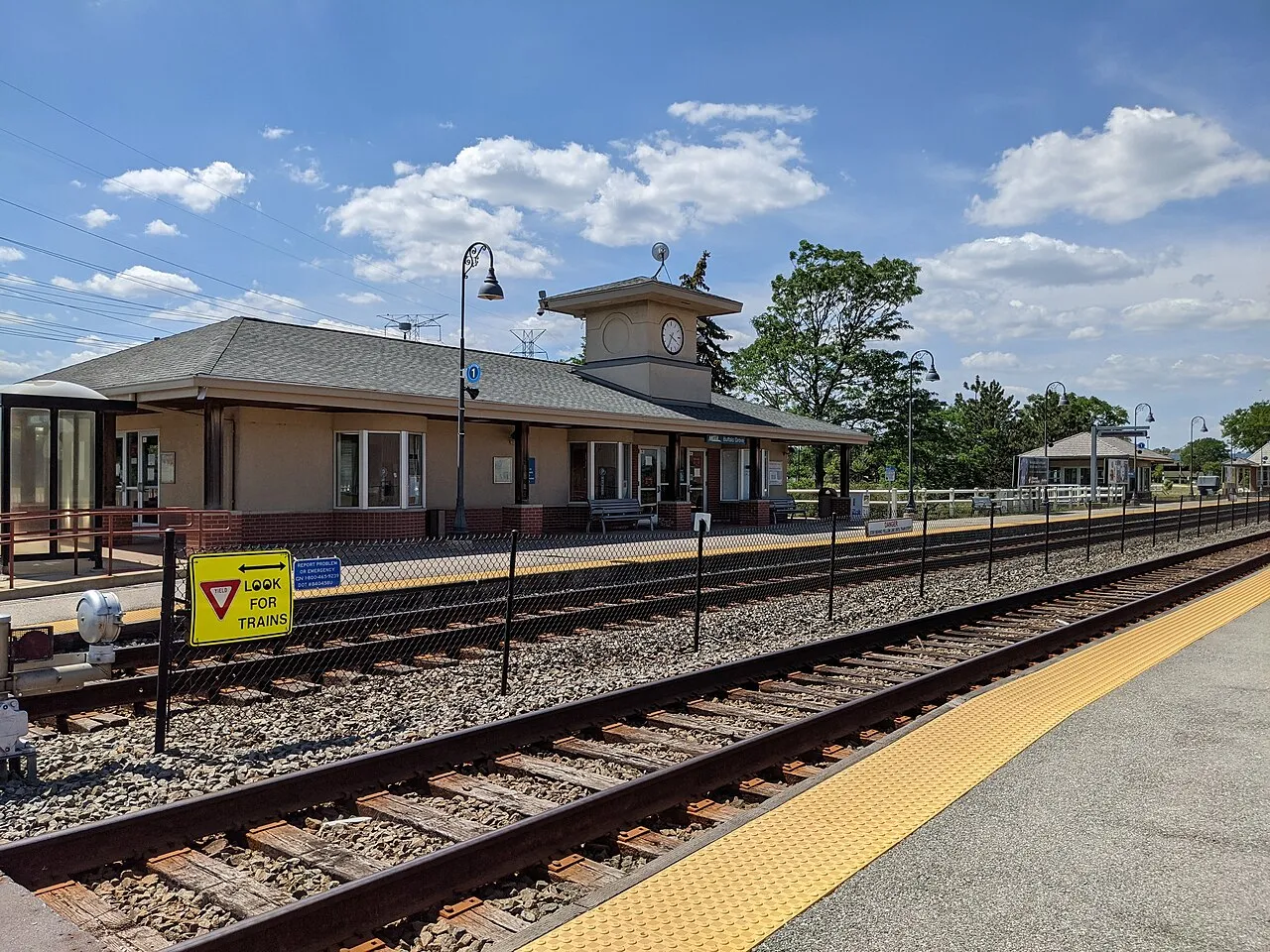
Buffalo Grove has two Metra stations, which sounds ideal and is the most oversold fact about the village. Both the Buffalo Grove station on Commerce Court and the Prairie View station on Main Street are on the North Central Service, a limited line. Buffalo Grove is in fare Zone 4, and according to Metra's current NCS schedule the ride to Union Station takes 53 to 64 minutes. Only one train all day, the 7:09 a.m., gets there in under an hour.
Here is what the timetable gives you. Seven inbound and seven outbound trains on weekdays. None on Saturdays, Sundays or holidays. The last morning inbound leaves Buffalo Grove at 9:48 a.m., and the next one is 4:19 p.m., a gap of six and a half hours. The last train home leaves Union Station at 6:00 p.m., so a late meeting, a ballgame or dinner downtown means you drove. Outbound there is exactly one morning train, which leaves Union Station at 7:10 a.m. and reaches Buffalo Grove at 8:10, so reverse commuting into Buffalo Grove by rail is close to impossible.
For the record, the full weekday inbound list from Buffalo Grove is 5:51, 6:37, 7:09, 7:38, 8:38 and 9:48 a.m., then 4:19 p.m. The outbound trains reach Buffalo Grove at 8:10 a.m., 2:20, 4:20, 5:25, 6:00, 6:30 and 6:55 p.m. If your schedule fits inside those times, the line works. If it does not, no amount of wishing will make it.
The line does have one quiet advantage most guides miss: it stops at the O'Hare Transfer station, which connects to the airport terminals by shuttle. Six weekday inbound trains make that stop, and the ride from Buffalo Grove takes about 21 to 22 minutes. Six outbound trains come back from O'Hare Transfer, in roughly 21 to 26 minutes. For a weekday flight that lines up with the timetable, it beats paying for airport parking.
The village has said as much itself. When it took up plans for the Prairie View station area, trustees questioned calling it transit-oriented development at all, and the village has since acknowledged that the vision fell short partly because of how few trains the line runs. That is an unusually honest read from a municipality about its own train.
The practical answer most Buffalo Grove commuters reach is to drive ten or fifteen minutes to a fuller line. Deerfield, on the Milwaukee District North, has 27 weekday trains in each direction, plus 10 each way on Saturdays and 9 each way on Sundays, and its rush-hour expresses reach Union Station in about 45 minutes. Arlington Heights, on the Union Pacific Northwest line into Ogilvie, has 31 weekday trains each way on Metra's current UP-NW schedule, plus 17 each way on Saturdays and 10 to 11 on Sundays, with all-stops trains taking about 53 minutes. One note for this fall: Metra is running a construction schedule on the Milwaukee District North from September 9 to October 23, 2026, which affects midday trains.
Three Pace bus routes serve the village. Route 234 runs between Wheeling and Des Plaines on weekdays. Route 272 runs Milwaukee Avenue between Golf Mill in Niles and Hawthorn Mall in Vernon Hills, and is the one route here with Saturday service. Route 626 is a weekday limited-stop run that connects to the CTA Yellow Line at Dempster-Skokie and serves the Lake Cook employment corridor. No Pace route serving Buffalo Grove runs on Sundays.
Driving from Buffalo Grove: Highways and O'Hare
There is no interstate or expressway inside Buffalo Grove, and that shapes daily life more than any single road does. Every highway trip starts with a few miles of arterial driving. The state routes through the village are Dundee Road (IL-68), Half Day Road (IL-22), McHenry Road (IL-83) and Milwaukee Avenue (US-45/IL-21). Lake Cook Road and IL-83 are the connectors out to I-294, with I-90 and I-94 reached the same way.
The IL-53 freeway ends at Lake Cook Road, right at the village's southwest corner, and it is going to stay that way. The proposed 25-mile extension north through Lake County was cancelled in June 2022. That matters locally, because the traffic the extension would have carried stays on the arterial grid. The village's own corridor planning puts Lake Cook Road at roughly 40,000 vehicles a day through Buffalo Grove.
What that means day to day: Buffalo Grove is well placed for suburban driving and poorly placed for a car-free life. O'Hare is roughly 17 road miles away. The northwest and north suburban office belt, including the Lake Cook corridor, Deerfield, Northbrook and Lincolnshire, is an easy drive. M/I Homes markets its new Highbury Club site as about eight minutes from I-294, which matches my experience from the east side of the village. Downtown Chicago is about 28 road miles, a comfortable trip on a Sunday and a very different one at 8 a.m. on a Tuesday.
The 2020-2024 ACS backs this up. Of commutes to a workplace, 75% take under 35 minutes, which tells you most working trips from here end in the suburbs rather than downtown.
Is Buffalo Grove Walkable?
Mostly not, with some real exceptions. Walk Score rates Buffalo Grove 40 for walking, which it calls car-dependent, and 52 for biking, the more flattering number and a reflection of a decent path network. The village maintains about 43 miles of paths and sidewalks, much of it eight feet wide and tied into regional trails.
The village number hides a range. Ridgewood (46), Highland Grove (45) and Highland Point (45) are the most walkable named pockets, followed by Devonshire (42), The Crossings (38) and Green Knolls (36). Highland Grove North and Old Farm Village sit at 34, and the Woodlands of Fiore at 28. If walking to a store or a park matters to you, it narrows your search to a small part of the village, and it is worth scoring the specific address rather than the town.
The commuting data says the same thing. Per the 2020-2024 ACS, 58.1% of commuters drive alone and 4.9% carpool, while all public transit combined accounts for 2.8%, about 2.2% on commuter rail. Walking is 1.0%. The largest share after driving alone is working from home, at 32.1%, more than eleven times the transit share.
For recreation, the path network is the real asset. You can ride from most of the village to Buffalo Creek Forest Preserve on the west edge without much time on a busy road, and the Des Plaines River Trail is reachable east of Milwaukee Avenue.
Shopping in Buffalo Grove: Lake Cook and Dundee Corridors
Buffalo Grove's retail runs along two planned corridors, Lake Cook Road and Dundee Road, and both are in the middle of the biggest reinvestment the village has seen in decades. The Lake Cook Corridor covers more than 472 acres and carries over a million square feet of commercial space, with a tax increment financing district set up in 2020. A second TIF covering about 107 acres around Dundee and Arlington Heights Roads followed in 2023.
The centerpiece is The Clove, the 22-acre rebuild of the former Town Center at Lake Cook and McHenry Roads, a project the village describes at over $150 million. Per the village's August 2026 update, the seven-story apartment building known as The 250 is over 90% leased, Whole Foods still expects to open in 2027 after a full interior and exterior remodel, Naani's Cafe is under construction next to Sushi Grove, and the Bowlero is being rebranded as a Lucky Strike. Chick-fil-A, Guzman y Gomez and Panda Express are open, and Dutch Bros Coffee opened in late July 2026 to a line that started the night before. Planning for a one-acre park at the center of the site is still underway.
Chase Plaza, at Lake Cook and Arlington Heights Roads, sat largely empty for more than a decade. The former Dominick's space is now under construction for a Club Studio fitness center and a Sprouts Farmers Market, which has said it will open in 2027. In August 2026, the Daily Herald reported that Shorewood Development Group and UrbanStreet Group had proposed a 256-unit, six-story apartment building with a three-story, 384-space garage on the east side of the site, along with a new 6,000-square-foot building replacing the old Buffalo restaurant at the corner. That proposal still has to go through the planning and zoning commission.
On Dundee Road, Bison Crossing is turning the 16-acre former Rohrman dealership site at 915-945 Dundee Road into a Tesla sales and service center, which held its grand opening on September 26, 2025, plus apartments and commercial outlots. Strathmore Square, also on Dundee, is the Aldi-anchored center of about 95,000 square feet.
The soft spot is Woodland Commons at Half Day and Buffalo Grove Roads, whose Mariano's anchor closed in 2025. The center at 450 W. Half Day Road has a new owner, and in February 2026 the village president said the village hopes a new grocer will go in. As of this writing no replacement has been announced. For regional shopping, Deer Park Town Center is to the northwest, Hawthorn Mall in Vernon Hills to the north, Woodfield in Schaumburg to the southwest and Westfield Old Orchard in Skokie to the southeast.
Groceries and Everyday Errands in Buffalo Grove
Grocery shopping in Buffalo Grove is in an unusual moment, and it is worth understanding before you pick a neighborhood. The anchor is Woodman's Markets at Deerfield Parkway and Milwaukee Avenue, a large employee-owned warehouse-format store where, per village officials in June 2026, roughly a quarter of the building goes to storage and distribution. Beyond Woodman's, the village has a Jewel-Osco on McHenry Road, Garden Fresh Market on South Buffalo Grove Road and an Aldi in Strathmore Square on Dundee Road.
The gap is at the north end. The Mariano's at Woodland Commons on Half Day Road closed in 2025, and no replacement had been announced as of September 2026. Two new stores are on the way but neither is open yet. Whole Foods is taking the space at The Clove that was first meant for Amazon Fresh. Amazon halted its build-out in September 2025, and in June 2026 the village approved changes letting Whole Foods use 35,000 square feet for the store and 8,000 for fulfillment and storage, and extended the developer's completion deadline to June 30, 2027. Sprouts Farmers Market is coming to Chase Plaza, also in 2027.
If you are buying near Half Day Road, plan on driving to Woodman's or Jewel for groceries in the meantime. And if you read older coverage naming Amazon Fresh as The Clove's grocer, that changed to Whole Foods in March 2026.
Pharmacies, banks and everyday services cluster along Dundee Road, McHenry Road and Lake Cook Road, so most weekly errands from anywhere in the village are a five- to ten-minute drive.
Where Buffalo Grove Eats
Buffalo Grove's dining is spread along Dundee Road, McHenry Road and The Clove rather than gathered in a walkable downtown, because the village does not really have one. What it does have is a varied independent scene that outpaces what a town this size usually supports.
The institution is Wiener Take All at Weiland Road and Deerfield Parkway, serving Vienna Beef hot dogs, gyros and fresh-cut fries since 1987. Sal and Tony's Italian sits next to the Buffalo Grove Golf Club on Raupp Boulevard. Prairie House Tavern on North Main Street makes its pizzas in house and shows Premier League matches on the patio. Lou Malnati's has been on South Buffalo Grove Road since 1989.
The range is the real story. Samarkand Cafe on Dundee Road serves Uzbek food, which is uncommon anywhere in the region. Flambé Karma runs Indian cuisine through French flambé technique. Sanjo Ramen, Yeero Revolution for Greek street food, Poke Hale for Hawaiian bowls, Buns on Fire for smash burgers and hot chicken, and Brunchy's Pancakes and Cafe on Dundee Road fill out a lineup with real variety.
Two recent arrivals are worth naming because older listings still call them upcoming. Lazy Dog Restaurant and Bar opened on McHenry Road in March 2025 with a separate dog-friendly patio, and Dutch Bros Coffee opened at The Clove in July 2026. The Clove also has a combined Cinnabon, Jamba and Auntie Anne's under one roof. One caution when you search: several highly rated restaurants that show up under "Buffalo Grove" are actually in Wheeling, Lincolnshire or Long Grove, because the apps search by radius rather than by village boundary.
Parks, Golf and Recreation in Buffalo Grove
This is where Buffalo Grove outperforms its size. The Buffalo Grove Park District maintains 50 park sites totaling 415.3 acres, and it has been a Distinguished Accredited Agency under the Illinois park and recreation associations' program since 1995. For a village of about 43,000 people, that is a lot of park.
Mike Rylko Community Park is the flagship at about 76.5 acres, with a skate park, inline rink, pickleball courts, the Adriane Johnson Amphitheater, a golf dome and the Spray 'N Play water feature. Next to it on Deerfield Parkway is the park district's fitness center, a facility of about 80,000 square feet with an indoor lap pool and therapy pool, an indoor track, courts, sauna and steam rooms, and no enrollment fee. Willow Stream Park adds about 54 acres with a disc golf course, lighted tennis, sand volleyball and the village's outdoor seasonal pool.
Two smaller parks stand out. Rick Drazner Park on Aptakisic Road has Kendrigan Field, a baseball field built for play with walkers, crutches and wheelchairs, alongside a Safety Town course, a nine-hole disc golf course, bocce and an accessible playground. Reiner Park has a cricket pitch, butterfly and sensory gardens and a fishing lake. Happy Tails Dog Park sits by the Metra station on Commerce Court.
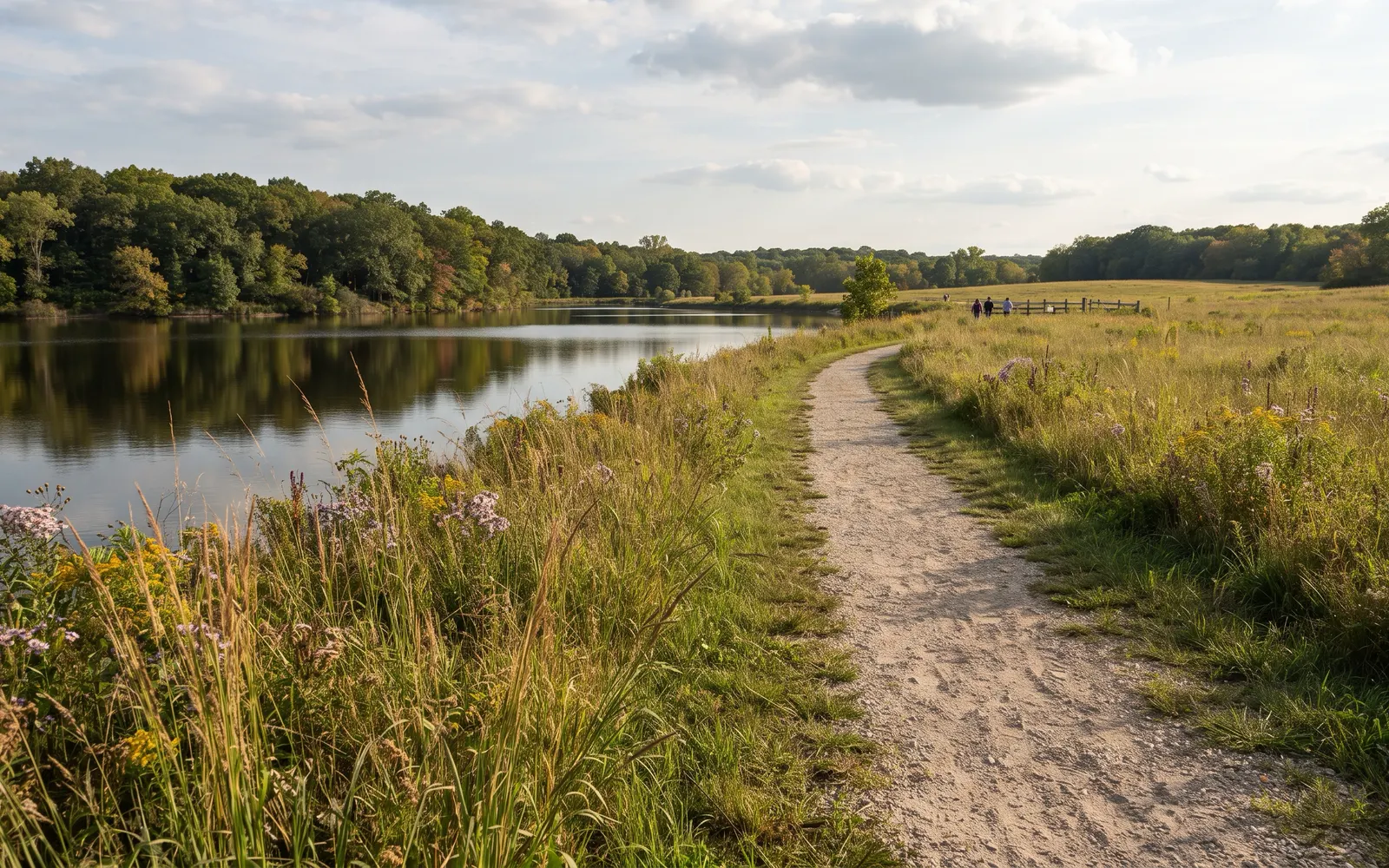
For open space, Buffalo Creek Forest Preserve, a 408-acre Lake County preserve on the village's west edge, has about five and a half miles of gravel trail through restored prairie and around a flood-control reservoir that is open for fishing. The village also owns two public golf courses: the Buffalo Grove Golf Club on Raupp Boulevard, a par-72 course that opened in the late 1960s, and the Arboretum Club on Half Day Road, a par-72 course that opened in 1990.
Buffalo Grove Libraries and Community Centers
Buffalo Grove is split between two library districts, which shows how little the village's various boundaries line up. Indian Trails Public Library District, based at 355 Schoenbeck Road in Wheeling, serves Wheeling, Buffalo Grove and Prospect Heights. Vernon Area Public Library District, at 300 Olde Half Day Road in Lincolnshire, serves Lincolnshire, Prairie View, most of Long Grove and parts of Buffalo Grove, Riverwoods and Vernon Hills. Indian Trails reaches across the county line into thousands of Lake County parcels, so the library district does not follow the county.
The two districts' borders cut through neighborhoods and individual streets. For years that meant a resident could walk into one library, find out they belonged to the other and have to drive to that building to register. In June 2026 the districts launched a reciprocal registration agreement, so a Buffalo Grove resident can now walk into either library, verify residency and leave with a fully active card, whichever service area their home is in.
There is no separate municipal community center. The park district's Alcott Center on Bernard Drive houses its offices and community space, the Community Arts Center sits on McHenry Road, and the fitness center covers the rest. The Raupp Memorial Museum, on land the Raupp family donated to the village in 1964, tells the village's farming history from an 1890s farmhouse.
Hospitals and Health Care Near Buffalo Grove
Buffalo Grove has no hospital of its own, but it is well covered for outpatient care. A four-story, 80,000-square-foot Endeavor Health outpatient center opened at 15 South McHenry Road in 2021, with walk-in immediate care, lab services, physical therapy and on-site X-ray, CT and ultrasound. Advocate runs several offices in the village, including primary care on West Lake Cook Road, and there is a freestanding urgent care on North Buffalo Grove Road.
The closest hospital is Northwest Community Hospital in Arlington Heights, part of Endeavor Health, roughly eight miles southwest and designated a Level II trauma center. Glenbrook Hospital in Glenview is about nine miles southeast. Advocate Condell Medical Center in Libertyville, the Level I trauma center for Lake County, is roughly eleven miles north. Highland Park Hospital and Advocate Lutheran General in Park Ridge round out the options.
One naming note that trips people up: NorthShore University HealthSystem, Northwest Community Healthcare, Edward-Elmhurst and Swedish merged under the single name Endeavor Health. A doctor described as NorthShore or Northwest Community is in the same system now.
Buffalo Grove Days and the Village's Yearly Traditions
The big one is Buffalo Grove Days, five days over Labor Day weekend at Mike Rylko Community Park, 951 McHenry Road. In 2026 it ran September 3 through 7, with live music, a carnival, a business and craft fair, a dog show, a Rotary duck race and food vendors. It is the closest thing the village has to a town square moment. If you are house hunting over Labor Day, go. It tells you more about the place than any listing will.
The Fourth of July runs at Willow Stream Park, where the Buffalo Grove Symphonic Band plays a free evening concert before the village's fireworks. The band, roughly 70 members, is the village's adult community instrumental group and marked its 25th year in 2026.
The farmers market runs Sundays from mid-June through mid-October at Rylko Park, 8 a.m. to 12:30 p.m., with produce, meats, cheeses, flowers, honey and donuts made on site. The park district adds Movies Under the Stars, a summer concert series at the amphitheater, National Night Out and the Huck Finn Fishing Derby, and it offers special recreation through the Northwest Special Recreation Association. The police department runs a Citizen Police Academy each spring.
What's Being Built in Buffalo Grove
The Village Board adopted the BG2050 comprehensive plan on August 17, 2026. It sets direction for land use, housing, transportation, economic development and natural resources over the next 15 to 20 years, with input from more than 1,500 people. For a built-out village, a plan like this is really a redevelopment strategy. There is very little raw land left, so growth means rebuilding what is already there.
The Clove is the largest and most visible example: 22 acres at Lake Cook and McHenry, replacing the old Town Center. The 250 apartment building is over 90% leased, several restaurants are open, Whole Foods is expected in 2027 and the one-acre park is still in planning. Under the June 2026 amendment, the developer's deadline for substantial completion is now June 30, 2027.
Chase Plaza is next. The former Dominick's space is being built out for Club Studio and Sprouts, and the August 2026 proposal would add 256 market-rate one- and two-bedroom apartments in a six-story building with a clubhouse, fitness center, dog park and outdoor pool, plus a new corner building where the Buffalo restaurant stands. Bison Crossing on Dundee Road opened its Tesla center in September 2025 and has apartments and commercial outlots still to come.
On the for-sale side, new construction is real but small. M/I Homes broke ground on Highbury Club in May 2026: 33 single-family homes on 9 acres at 301 Weiland Road, the former Schwaben Center site. The two-story homes run 2,300 to 2,700 square feet with three or four bedrooms, full basements and two-car garages, and first deliveries are planned for early 2027. Pricing started at $749,990 in May; M/I's current page shows it from $783,990 as of September 2026. The builder markets it as in the Stevenson and District 102 area.
For buyers, all of this means more rental options, two more grocers and a handful of new homes over the next two years. For sellers of condominiums and starter homes, several hundred new apartments at The Clove and Chase Plaza mean a little more competition for the same first-time buyers, who can now rent in Buffalo Grove before they buy.
I don't label any town or neighborhood as safe or unsafe.
Flood Risk in Buffalo Grove
Flooding is not a village-wide problem in Buffalo Grove, but it is a house-by-house one. Redfin, using First Street's model, rates the village's flood risk as minor overall, with about 6% of properties at risk of severe flooding over the next 30 years. Buffalo Creek and the low ground along it, including the flood-control reservoir at the forest preserve, are where that risk concentrates, along with the detention ponds many subdivisions were built around.
Two checks before you write an offer. Look the address up on the FEMA flood map, because a mapped flood zone can mean required flood insurance on a mortgage. And ask the seller directly about water in the basement. In a housing stock this age, the answer is often "once," and the follow-up question about what they did about it is the one that matters. A sump pump with a battery backup and a clean drain tile record is the answer you are hoping for.
The same First Street data on Redfin covers the other hazards. It rates wind risk as minor for every property in the village and heat risk as minor for 69% of properties over the next 30 years, and it labels wildfire risk moderate, with 38% of properties showing some exposure. For a buyer in Buffalo Grove, water in the basement is the hazard worth the most attention by a wide margin.
Working With a Buffalo Grove Real Estate Agent
Buffalo Grove sits in two counties, and that single fact changes the math on every purchase. On the Lake County side the median effective tax rate is 2.95% with a median bill of $12,364. On the Cook County side it is 2.81% with a median bill of $6,458, pulled down by the condominium stock there.
Two assessors, two classification systems, two sets of appeal deadlines. An agent quoting you one village-wide tax figure has not looked at which side of the line the house is on.
Six school districts serve the village. Cook-side addresses generally feed Wheeling CCSD 21 and then Buffalo Grove High School. With a median sale price of $442,707 and two Metra stations on the North Central Service, this is a village where the address does far more work than the average.
Selling on either side of the county line starts with the right tax figure; that is the first thing I set up as a listing agent in Lake County IL.
Frequently Asked Questions
Is Buffalo Grove in Cook County or Lake County?+
Both. The county line runs along Lake Cook Road: Lake County's Vernon Township is to the north and Cook County's Wheeling Township to the south, with about 10,641 Lake parcels and 6,085 Cook parcels carrying a Buffalo Grove address. The fastest check is the property index number on the listing: a Buffalo Grove PIN starting with 03 and running 14 digits is Cook County, and one starting with 15 and running 10 digits is Lake County. Do not rely on a map alone, because the village boundary and the county line are not identical. Wheeling holds land north of Lake Cook Road inside Lake County, and Buffalo Grove extends north of the road near Milwaukee Avenue.
How much are property taxes in Buffalo Grove, IL?+
It depends which county the home sits in. Ownwell puts the Lake County side at 2.95% effective with a median bill of $12,364, and the Cook County side at 2.81% with a median bill of $6,458. The Cook figure is lower partly because of the condominium stock there.
Is it cheaper to buy on the Lake County or Cook County side of Buffalo Grove?+
Purchase prices are generally lower on the Cook side, where more of the older homes and condominiums are. For the tax bill, the county sets the system but the school district sets most of the rate. Inside the Lake portion alone there are three elementary districts, two library districts and two park districts, so two Lake County houses a mile apart can carry different bills. Get the tax code for the exact parcel and work from that, and remember the county also generally decides whether a house feeds Stevenson or Buffalo Grove High School.
What school district is Buffalo Grove, IL in?+
Six districts serve the village and the answer depends entirely on the address. As a rule of thumb, Cook-side addresses feed Wheeling CCSD 21, moving through Kilmer or Longfellow Elementary and Cooper Middle School, then Buffalo Grove High School. Confirm any specific address directly.
Does Buffalo Grove have a Metra station?+
Two, Buffalo Grove on Commerce Court and Prairie View on Main Street, both on the North Central Service. There are 7 inbound and 7 outbound trains on weekdays and none on weekends or holidays, the ride to Union Station takes 53 to 64 minutes, and the last train home leaves Chicago at 6:00 p.m. Many daily commuters drive to Deerfield, which has 27 weekday trains each way plus weekend service and expresses of about 45 minutes, or to Arlington Heights on the UP-Northwest line.
How long is the Metra commute from Buffalo Grove to downtown Chicago?+
By train, 53 to 64 minutes from the Buffalo Grove station to Union Station on the seven weekday North Central Service trains. There is no weekend service. A rush-hour express from Deerfield, after a short drive, runs about 45 minutes.
Is Buffalo Grove walkable?+
Not village-wide. The Walk Score is 40, which is car-dependent, and the Bike Score is 52, helped by about 43 miles of village paths and sidewalks. Named pockets range from 46 in Ridgewood and 45 in Highland Grove and Highland Point to 34 in Old Farm Village and 28 in the Woodlands of Fiore, so it is worth scoring the specific address.
What neighborhoods are in Buffalo Grove, IL?+
Commonly named subdivisions include Old Buffalo Grove, Strathmore, Old Farm Village, Woodlands of Fiore, Canterbury Fields, Mirielle, Cambridge on the Lake, Chatham, Delacourte, Link Crossing, Waterbury, Ridgewood, Highland Grove and Highland Point, out of roughly 90 in all. Locals usually describe them by their side of Lake Cook Road and the decade they were built, since the village built out from south to north.
Where do you buy groceries in Buffalo Grove?+
Woodman's Markets at Deerfield Parkway and Milwaukee Avenue, a Jewel-Osco on McHenry Road, Garden Fresh Market on South Buffalo Grove Road and an Aldi in Strathmore Square on Dundee Road. The Mariano's at Woodland Commons on Half Day Road closed in 2025 and had not been replaced as of September 2026. Whole Foods at The Clove and Sprouts at Chase Plaza are both expected in 2027.
What is being built in Buffalo Grove?+
Mostly redevelopment, because the village is built out. The Clove has a 90%-leased apartment building, restaurants open and Whole Foods coming in 2027; Chase Plaza is getting Club Studio, Sprouts and a proposed 256-unit apartment building; Bison Crossing opened its Tesla center in September 2025; and M/I Homes broke ground on the 33-home Highbury Club in May 2026. The village adopted its BG2050 comprehensive plan on August 17, 2026.
What is the average home price in Buffalo Grove, IL?+
Redfin reported a median sale price of $442,707 for the three months ending August 2026, down 0.52% year over year, while Zillow's index was $447,960, up 5.8%. The two disagree because they measure different things: sold homes versus all homes.
How do I choose a real estate agent in Buffalo Grove, IL?+
Ask which county the address is in before anything else. Buffalo Grove straddles Lake and Cook, with different assessors, different rates and different appeal processes. An agent who quotes a single village tax rate has skipped the most important variable here.
Eshu Chikoti has extensive access to off-market listings throughout Buffalo Grove and the surrounding North Shore — homes that never make it to the public listing sites. That matters right now: in a seller's market like this one, well-priced homes routinely go under contract within days, and buyers relying only on public listings are competing for whatever is left over. Working with someone plugged into off-market inventory means seeing homes before the crowd does.
Eshu Chikoti · 847-691-4282 ·
Get new Buffalo Grove listings by email
When a home comes on the market in Buffalo Grove, I'll email it to you.
Just your email. Unsubscribe any time by replying.
Thinking About Buffalo Grove?
Whether you're buying, selling, or just curious what's on the market, I can walk you through Buffalo Grove street by street.