Living in Vernon Hills, IL: A Buyer's Guide to Jobs, the Commute and the Real Cost of Owning Here
Confirm the district for a specific address with the district office, and read each district's profile on the Illinois Report Card at illinoisreportcard.com. The median home sold for about $440,000 over the three months ending May 2026, up 3.5% year over year, and homes here move in about 21 days against a 56-day national average. That is a tight market. CDW, a Fortune 500 company, is headquartered in town. What you are paying for is a well-run, job-dense suburb. What most buyers underweight is the tax bill attached to all of it.
If you want the reference version of the town, my Vernon Hills town guide is the page built for that. It covers the history, every subdivision, the parks, the mall redevelopment, and the events calendar.
The Vernon Hills price tag is only half the number

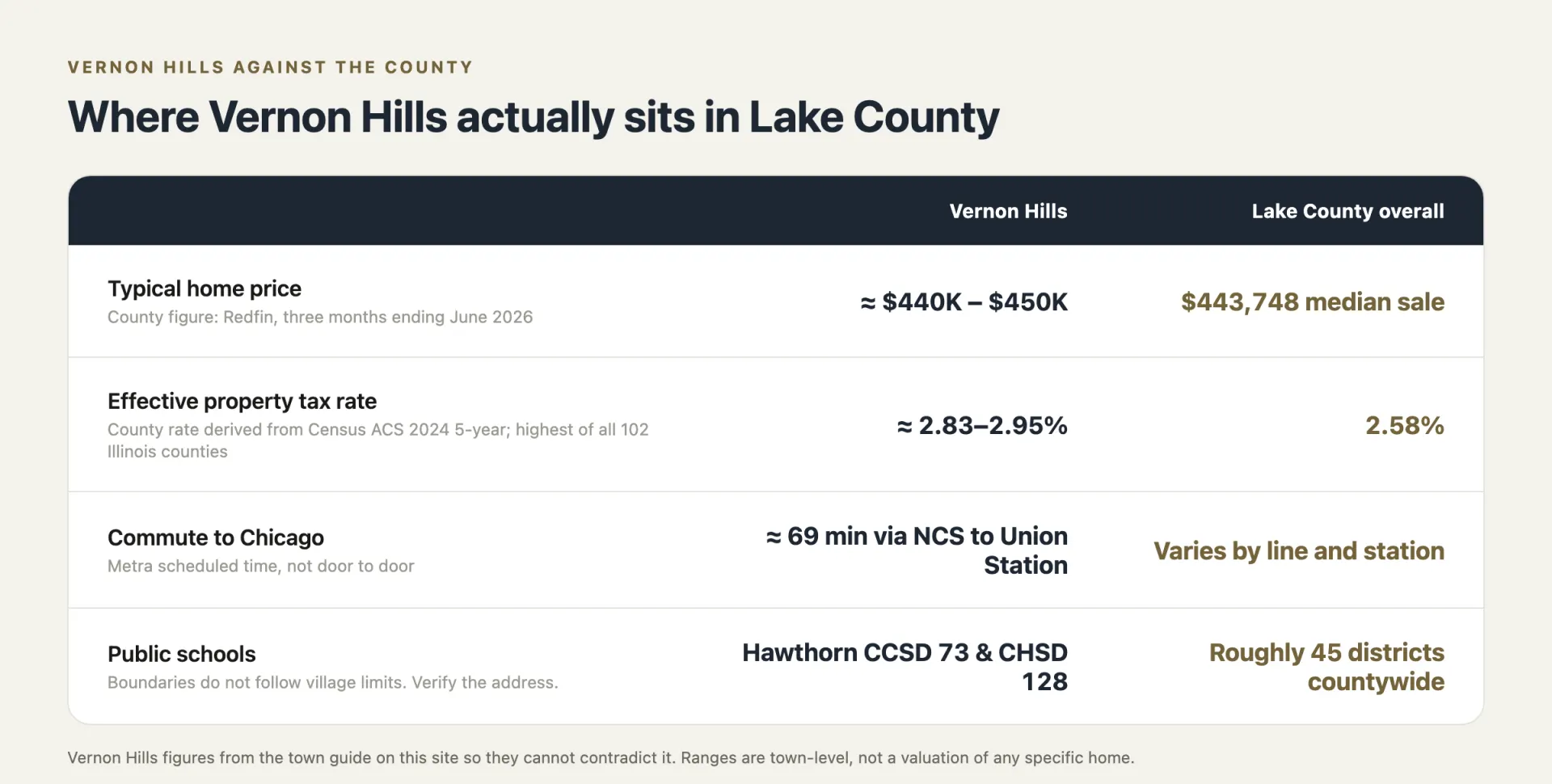
That $440,000 Redfin figure is a three-month median through May 2026, so treat it as a starting point, not a target. Vernon Hills is not one market. It is several. Townhomes and older single-family homes near the retail corridor trade well below the median, while the newer subdivisions and bigger lots on the north and west edges run far above it. Homes.com puts the median at $450,000 for the same three months, and Zillow's average home value estimate runs $451,812, up 5.4% over the prior year. Movoto had the median asking price at $490,000 as of July 2026, which is what sellers hoped for rather than what buyers paid. The Census Bureau's 2020–2024 American Community Survey put the median owner-occupied home value at $412,300, and the gap between that older estimate and today's sale prices is the appreciation story in one line. Plan on the mid-$400,000s for the broad middle where most move-up buyers land, with real spread on either side.
Property taxes in Vernon Hills: the number nobody puts in the listing
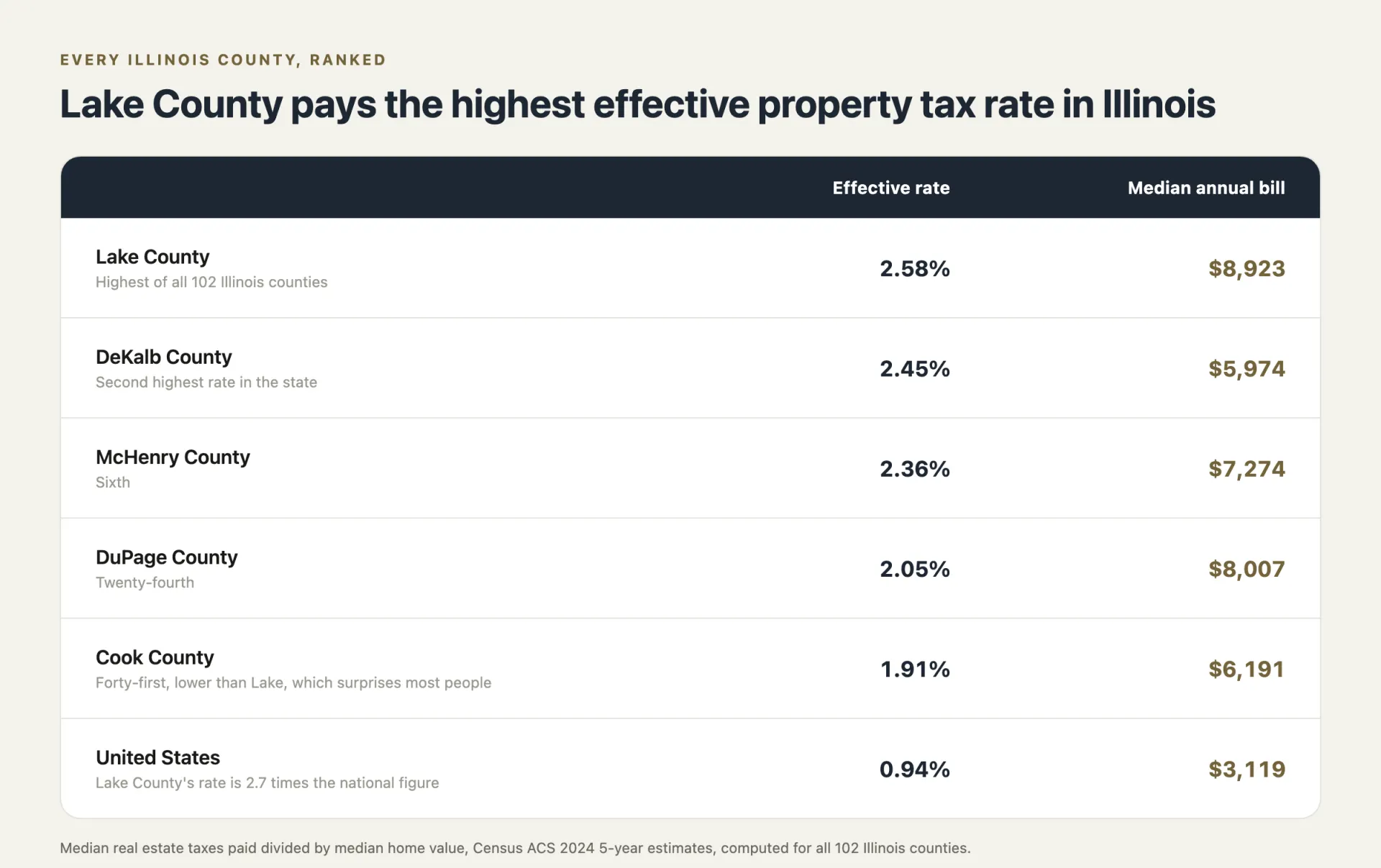
Now the number that quietly reshapes every budget in this town. Property taxes. Lake County carries one of the heaviest effective property tax rates in Illinois, roughly 2.43%, with a median bill near $8,943, the highest of any county in the state. Take a $415,000 Vernon Hills home, a little under today's median: the bill runs about $9,000 to $10,000 a year, or close to $800 a month before you have paid a dollar of principal or interest. I tell every buyer to add the tax line to the mortgage line before they fall in love with a listing. That is the difference between a payment you can carry and one that owns you. If your bill looks high relative to the house, learn how a property tax appeal works. Then run the whole picture through how much house you can actually afford, with the taxes included instead of bolted on afterward. The cost-of-living breakdown on my Vernon Hills guide lists which local bodies actually make up that bill, since the village itself does not levy one.
It sits in Community High School District 128, the same district that runs Libertyville High.
The elementary picture is where buyers get tripped up, so read this part carefully. Most of Vernon Hills feeds Hawthorn School District 73, but the town is actually split across several elementary districts. Diamond Lake District 76, Lincolnshire/Prairie View District 103, and Kildeer Countryside District 96 each serve pieces of it. On the high school side, some addresses feed Stevenson or Mundelein rather than Vernon Hills High. Attendance follows your address, not the town line and not the zip code. I have watched buyers assume a house was in the school they wanted and find out otherwise after the offer. Verify the exact boundary for the specific address before you write anything. The district lineup on my Vernon Hills guide is the reference version. If you want one address checked against a boundary, that is a five-minute job I am glad to do.
Jobs in Vernon Hills, not just a train to Chicago
Vernon Hills is unusual for a Lake County suburb of its size. It has real employers inside its own borders. CDW is a Fortune 500 technology company with roughly 15,000 employees, headquartered here, and Zebra Technologies sits next door in Lincolnshire. A meaningful share of residents have a commute measured in minutes, not hours. The data backs that up: the average commute is about 26.9 minutes, right around the national norm. That is quietly impressive for a town this far from downtown Chicago.
For the Chicago commuters, be honest with yourself about the trade. Vernon Hills sits on Metra's North Central Service line, which runs limited weekday service and no weekend trains, so most residents here drive. Downtown Chicago is roughly 35 miles southeast, a 45-to-70-minute drive depending on the Tri-State's mood. Vernon Hills works as a car-and-occasional-train town, not as a walk-to-the-station town.
Confirm the district for a specific address with the district office, and read each district's profile on the Illinois Report Card at illinoisreportcard.com.
What living in Vernon Hills is like day to day
Vernon Hills is built around convenience rather than a downtown, and I mean that as a compliment. Plenty of buyers want convenience. You are minutes from the Hawthorn Mall corridor, Century Park, the trail network, and every big-box errand you will ever need to run. The neighborhood, parks and shopping rundown on my Vernon Hills guide covers all of that in reference detail, including where the mall redevelopment is headed. What you do not get is a walkable historic Main Street. Confirm the district for a specific address with the district office, and read each district's profile on the Illinois Report Card at illinoisreportcard.com.
What to Verify Before You Buy in Vernon Hills
Vernon Hills ran a $517,158 median sale price in the three months to August 2026 at a median effective tax rate of 2.75%, which is about $9,854 a year in ZIP 60061.
The thing to verify here is the district boundary. Vernon Hills addresses do not all sit in the same school district and the boundary does not follow the village line, so two houses on the same road can be assigned differently. Confirm the assignment for a specific address with the district office before you write an offer, not after. This is address-specific and no listing description is a substitute for the district's own answer.
On the commute, read the timetable rather than the map. The North Central Service runs seven weekday trains each way, 60 to 71 minutes to Union Station, with no weekend service. A lot of buyers discover that order of operations after they have moved rather than before.
How to buy here without overpaying
Verify the assignment first, every time. After that it is arithmetic. Get pre-approved with the real Lake County tax figure baked into your payment, not a placeholder. Know which of the several districts your target address feeds. And do not plan your strategy around a slow market, because this one is not. Homes go in about 21 days, less than half the 56-day national average, so the house you want to sleep on is often gone by the weekend. Tour with financing already in place and decide fast. Save your negotiating for the inspection, where you still have real leverage, rather than for an opening number well under ask. If you want those three numbers run for an address you are considering, meaning the payment with taxes, the real boundary, and a fair offer, that is a conversation I am happy to have.
Frequently Asked Questions
Three, in the order they actually bite. First, the tax bill is heavy: Lake County's effective rate runs near 2.43%, with a median bill around $8,943, so plan on roughly $9,000 to $10,000 a year on a $415,000 house before principal or interest. Second, there is no walkable historic downtown, and no amount of money buys you one here. Third, the Metra option is thinner than the map suggests. The North Central Service line runs limited weekday-only service, so a daily downtown commuter is usually driving 35 miles or parking at a station on another line.
This is general information, not financial or tax advice. Home prices, tax rates, and school boundaries change and vary by address, so confirm current figures and your specific attendance zone before making a decision.
Get new Lake County listings by email
I'll send you new Lake County homes as they come on the market. Just your email, no account needed.
Just your email. Unsubscribe any time by replying.
I'm Eshu Chikoti, a Lake County, IL agent. If you want the numbers in this article run for your specific home or purchase, let's talk it through — no pressure, no obligation.
Get in touch →