First-Time Buyer Programs You Can Actually Use in Illinois in 2026
Illinois first-time buyers can access IHDA Access programs offering down payment assistance, alongside conventional and FHA routes. Amounts, credit minimums and income limits change by program and by year, so the figure that matters is the one current when you apply.
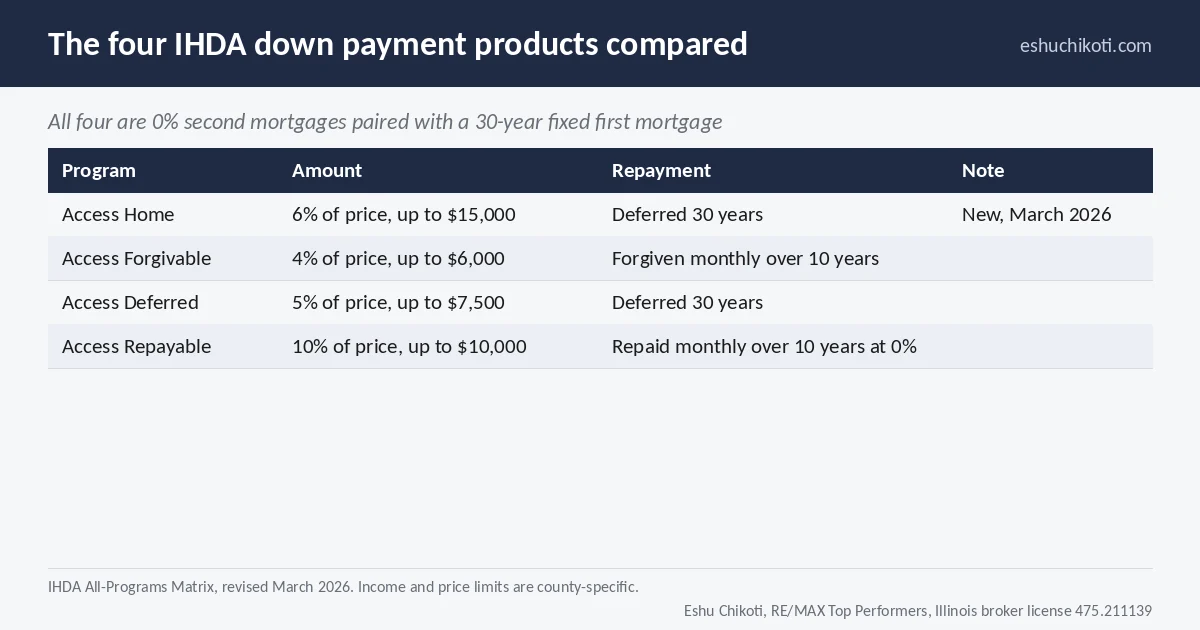
| IHDA program | Amount | How it is repaid |
|---|---|---|
| Access Home | 6% of purchase price, up to $15,000 | Deferred for 30 years |
| Access Forgivable | 4% of purchase price, up to $6,000 | Forgiven monthly over 10 years |
| Access Deferred | 5% of purchase price, up to $7,500 | Deferred for 30 years |
| Access Repayable | 10% of purchase price, up to $10,000 | Repaid monthly over 10 years at 0% |
Source: IHDA All-Programs Matrix, revised March 2026. All four are 0% second mortgages paired with a 30-year fixed first mortgage.
If you are buying your first home in Lake County, the single most useful thing I can tell you is that Illinois has real down payment money on the table right now — and that a lot of the advice floating around about it is out of date. The state's IHDA programs put between $6,000 and $15,000 toward your down payment and closing costs, most of them ask only for a 640 credit score, and far more buyers qualify than ever actually use them. But one program that older guides still push hard — the Mortgage Credit Certificate — has been shut off for years. So before you plan around a number you read on some national blog, here is what is genuinely available in 2026, what each piece gives you, and where the fine print bites.
I sell homes here, I am not a lender, and I do not get paid to steer you toward any of this. What follows is just the map I wish every first-time buyer had before they assumed they needed 20% saved.
The IHDA programs, and what each one actually does
All of these come from the Illinois Housing Development Authority, and none of them is a standalone loan. They layer on top of a normal 30-year fixed-rate first mortgage — the assistance is the part that covers your down payment and/or closing costs so you do not have to save the whole amount yourself. You do not apply to IHDA directly either; every one of these is originated through an IHDA-approved participating lender, the same way you would get any other mortgage.
There are four of them, and the differences are entirely about how you pay the help back.
Access Forgivable gives you 4% of the purchase price, up to $6,000, and forgives it monthly over 10 years. Stay in the home a full decade as your primary residence and you owe nothing; sell or refinance before then and whatever has not been forgiven comes due. This is the right pick if you are confident you are staying put.
Access Deferred gives you 5% of the purchase price, up to $7,500, at 0% interest. It is not forgiven, but you do not repay a cent until you sell, refinance, or pay off the first mortgage. For buyers who want more help and do not want a 10-year residency clock hanging over them, this is often the more flexible choice.
Access Repayable gives you the most of the older three — 10% of the purchase price, up to $10,000, at 0% interest — but here you actually make a payment: it is repaid monthly over 10 years, on top of your regular mortgage. More cash at closing, a slightly higher monthly nut.
Access Home is the newest and largest option, launched by IHDA in March 2026: a deferred, 0%-interest second mortgage worth 6% of the purchase price, up to $15,000, with nothing due until you sell, refinance, or pay off your primary loan. On a $400,000 Lake County home, that is the difference between scraping the down payment together and walking into closing with your savings still intact.
All four require a minimum 640 credit score and a borrower contribution of at least $1,000 or 1% of the purchase price, whichever is greater. These programs supplement your own money; they do not replace all of it.
The Mortgage Credit Certificate: why you can't count on it right now
Here is the correction I promised. A lot of first-time-buyer guides — including an older version of this one — describe the Mortgage Credit Certificate as if you can go get one. When it is running, an MCC lets you claim 25% of the mortgage interest you pay each year as a direct federal tax credit, capped at $2,000 a year, for as long as you hold the loan. It is genuinely good money, and it keeps paying every April rather than only helping once at closing.
The problem is that IHDA's MCC program has been suspended since June 17, 2020, and it is still not open in 2026. IHDA is not issuing new certificates, and MCCs from other entities cannot be paired with an IHDA mortgage. If a lender or a blog is dangling an MCC in front of you as part of your Illinois plan, treat that as a sign the information is stale and confirm everything else they told you too.
The biggest mistake I see first-time buyers make isn't picking the wrong program. It's assuming they need 20% saved before they can start looking — or planning around a tax credit that Illinois quietly shelved five years ago.
FHA, VA, and USDA: the loan underneath the assistance
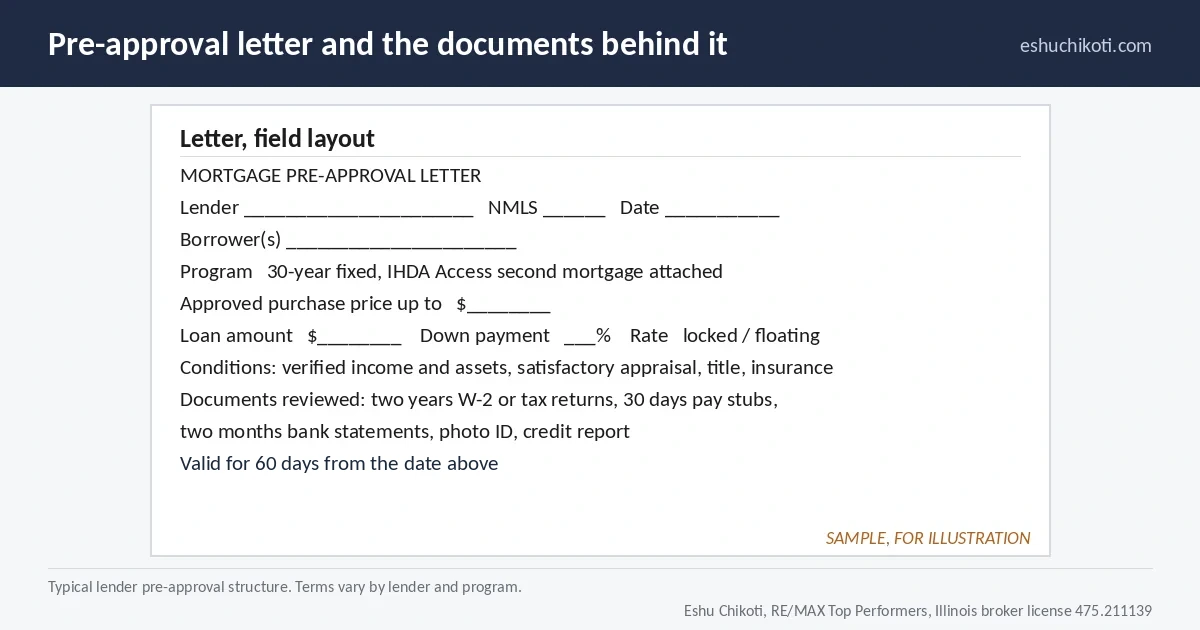
IHDA help sits on top of a first mortgage, and which first mortgage you use matters on its own.
An FHA loan is the workhorse for first-time buyers: 3.5% down if your credit score is 580 or higher, or 10% down for scores between 500 and 579. In Lake County the 2026 FHA loan limit is $541,287 for a one-unit home, which covers most first purchases here comfortably. Just know that many lenders layer their own minimums on top, so a 620–640 score is what you will usually need in practice.
A VA loan, if you or your spouse served, is hard to beat: 0% down, no monthly mortgage insurance, and no VA-set minimum credit score (individual lenders set their own). There is a one-time funding fee, but for eligible veterans this is almost always the strongest option, and it pairs with IHDA assistance too.
A USDA loan offers 0% down in eligible rural areas, with a household income cap around 115% of the area median. Most of developed Lake County is not USDA-eligible, but some of the far northwest edges of the county can be — it is decided address by address, so check the USDA property map before you rule it out.
Who qualifies, and where Lake County prices meet the limits
Across the IHDA Access programs, the recurring requirements are a 640 credit score, a debt-to-income ratio within the program limits, that $1,000-or-1% contribution of your own, a HUD-approved homebuyer education course before closing, and household income and purchase price that fall under IHDA's county limits.
This is where Lake County buyers usually worry, and usually for the wrong reason. The purchase price limit for a one-unit home runs to $610,939, and the income limit for the Chicago-area counties (Cook, DuPage, Kane, Lake, McHenry, and Will) sits around $134,520 — both generous enough that most first-time buyers here are not priced out by the caps at all. The real friction is the other direction: $6,000 to $15,000 is meaningful, but it is a modest slice of a $350,000–$500,000 home, so treat this as help clearing the cash-to-close hurdle, not as a way to buy more house than the monthly payment supports. If you have not run that monthly math yet, do that first.
The honest tradeoffs
None of this is free money with no strings. Three of the four Access programs are real second liens that come due when you sell or refinance (Repayable adds a monthly payment from day one), and even the Forgivable one claws back if you leave before 10 years. There is a required education course and a bit more paperwork on your closing timeline. Not every lender participates, so you have to ask for IHDA products specifically when you shop rates rather than assuming your loan officer offers them. And because the assistance targets cash to close and not your monthly budget, it does nothing to make an overpriced payment affordable — in a town like Gurnee, where price points vary block to block, that distinction is the whole game.
For a first-time buyer whose main obstacle is the pile of cash needed at closing, though, these are often the single highest-leverage tool available. The tragedy is how many people who qualify never even ask.
What to do if you're buying here this year
Get pre-approved with a lender who actually offers IHDA products, confirm the current income and purchase-price limits for your household with the official calculator rather than a blog table, skip any guide still selling you the MCC, and complete the homebuyer course early so it is not a last-minute scramble. If you want a straight read on which of these fits your situation — or just a second set of eyes before you commit — that's a conversation I'm happy to have.
Who Counts as a First-Time Buyer in Illinois
Most programs define it as not having owned a principal residence in the past three years, which means buyers who owned previously often still qualify. That single definition qualifies more people than most buyers expect.
How each program is repaid is covered in Illinois down payment assistance, and the rest of the process is in my notes on buying in this market.
Frequently Asked Questions
Between $6,000 and $15,000 through IHDA's Access programs, depending on which one you use: 4% up to $6,000 (Forgivable), 5% up to $7,500 (Deferred), 10% up to $10,000 (Repayable), and 6% up to $15,000 (Access Home). All layer onto a standard 30-year first mortgage and require a 640 credit score.
No. IHDA's MCC program has been suspended since June 17, 2020 and is not open in 2026, and MCCs from other issuers cannot be used with an IHDA mortgage. Any guide telling you to plan around one is out of date.
640 is the standard minimum across the IHDA Access programs. If you are below that, a few months of on-time payments and paying down revolving balances can close the gap — even a 20-to-30-point jump can open these up.
Rarely on price. The one-unit purchase price limit runs to $610,939 and the Chicago-area household income limit is around $134,520, both high enough that most first-time buyers here still qualify. Confirm your exact numbers with a participating lender, since only the official IHDA calculator settles it.
Not for all of them. Access Forgivable, Deferred, and Repayable are open to first-time and repeat buyers statewide. Access Home is limited to first-time buyers, though veterans with a valid COE/DD214 and buyers in designated target areas are exempt from that requirement.
Most Illinois programs define a first-time buyer as someone who has not owned a principal residence in the previous three years. Previous ownership does not automatically disqualify you. Income limits and purchase price caps apply and vary by county, so check the Lake County figures specifically.
Call 847-691-4282 to work out which program you actually qualify for in Lake County.
This is general information, not legal, tax, or financial advice. Program terms, amounts, and limits change and are set by IHDA and federal agencies, not by me. Confirm current eligibility with an IHDA-approved lender and, for the tax questions, a tax professional before you rely on any of it.
Get new Lake County listings by email
I'll send you new Lake County homes as they come on the market. Just your email, no account needed.
Just your email. Unsubscribe any time by replying.
I'm Eshu Chikoti, a Lake County, IL agent. If you want the numbers in this article run for your specific home or purchase, let's talk it through — no pressure, no obligation.
Get in touch →