Forest Park, IL
Forest Park, IL is a 2.4-square-mile Cook County village at the west end of the CTA Blue Line, with Madison Street as its main street, five historic cemeteries inside its limits and a summer 2026 median sale price near $387,000.
Living in Forest Park, IL means a summer 2026 median sale price near $387,000, a Blue Line ride of about 42 minutes to Clark/Lake, and property tax near 2.71% of value. Almost half the homes predate 1940, and two-flats, condos and apartments outnumber single houses. Every home is in Cook County. Here it is, block by block.
Written by Eshu Chikoti · 847-691-4282 ·
How Forest Park, IL Got Here: From Harlem to the Village of Cemeteries
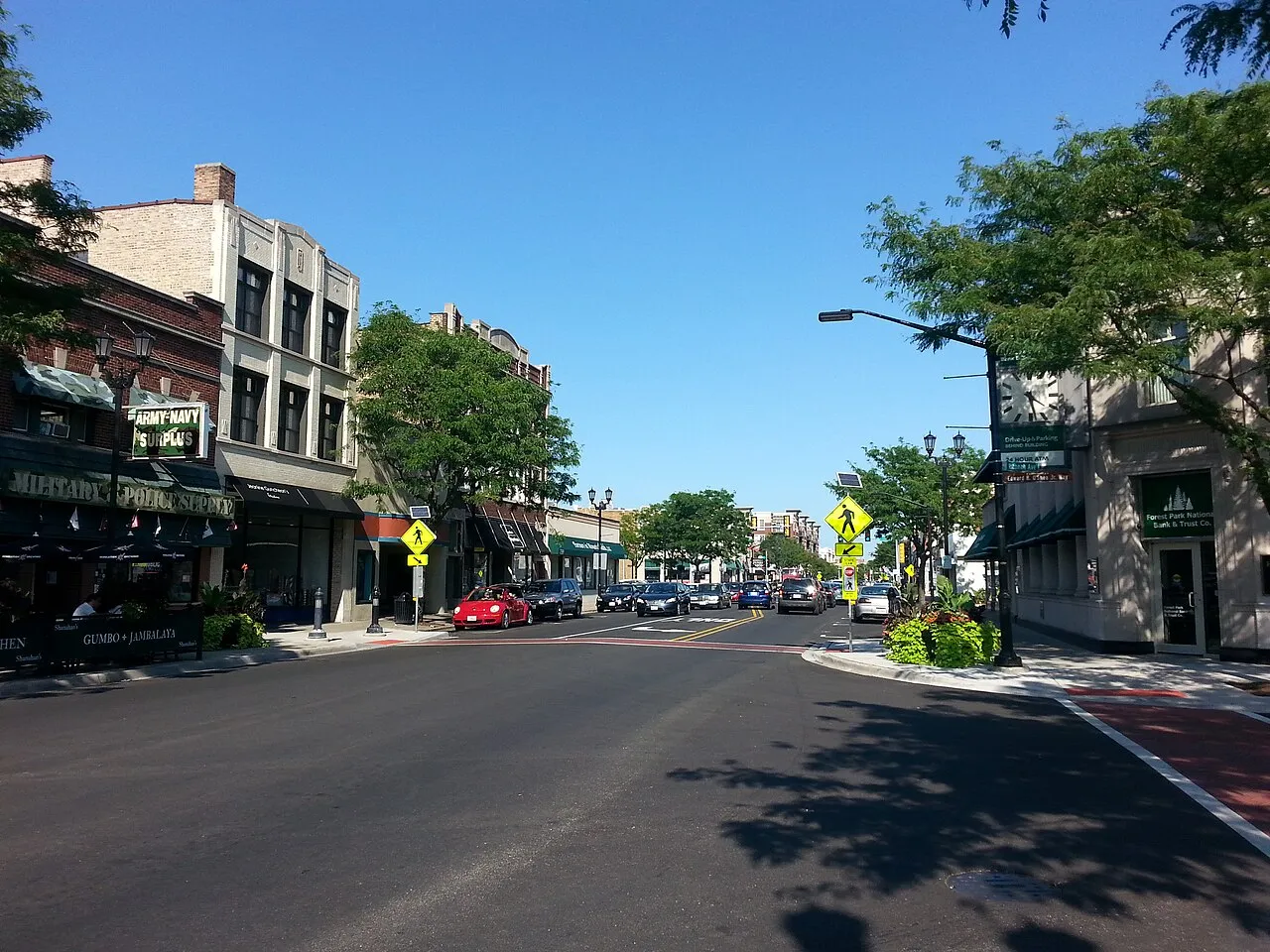
Forest Park began as a farm on the Des Plaines River. According to Wikipedia's Forest Park entry, French trader Leon Bourassa bought 160 acres here in 1839, and Ferdinand Haase bought 40 acres of it in 1851, a holding that grew to 240 acres. In 1856 John Henry Quick bought the land and named it Harlem after his hometown. The community of Harlem incorporated in 1884. It was renamed Forest Park and incorporated under that name on April 17, 1907.
The cemeteries came early and stayed. Forest Park has long been called a village of cemeteries, and Wikipedia repeats an estimate that the dead outnumber the living about 30 to 1. The list includes Altenheim, Forest Home, the Waldheim cemeteries, Woodlawn (with Showmen's Rest) and Concordia. Forest Home Cemetery), at 863 S. Des Plaines Avenue, straddles the Des Plaines River next to the Eisenhower. It traces back to German Waldheim (1873) and Forest Home (1876), which merged in 1969, and its Haymarket Martyrs' Monument was named a National Historic Landmark in 1997. A 2020 Forest Park Review column explains the geography: the village sits on an old Lake Michigan sandbar, higher and sandier than the prairie to the east, and that sandy ridge became the west suburbs' cemetery belt.
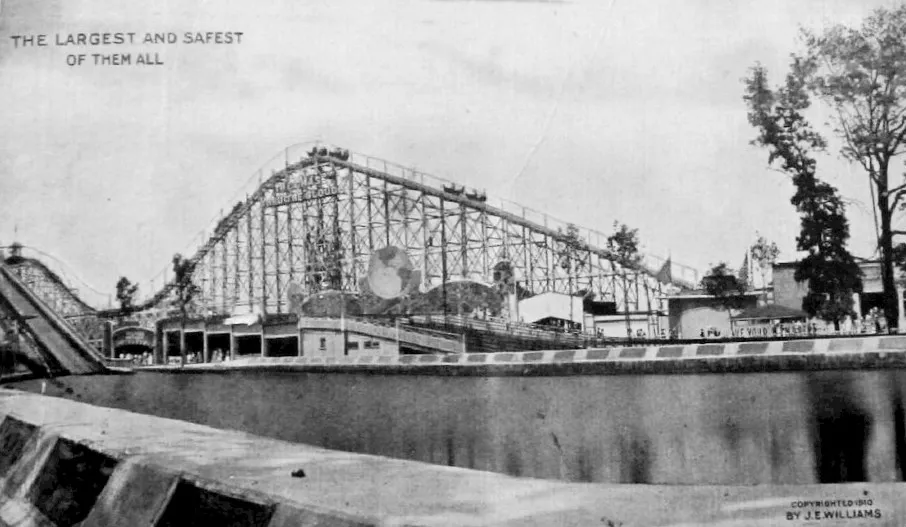
For 15 summers the village had an amusement park. Forest Park Amusement Park ran from 1907 to 1922 just west of Des Plaines Avenue and north of the old Waldheim cemetery, per Wikipedia. A 1918 fire destroyed about a fifth of it, and it never reopened after the 1922 season. The Blue Line's Forest Park terminal sits on that ground today.
The 20th century added industry. The Naval Ordnance Plant on Roosevelt Road opened early in World War II, employed up to 6,500 workers and built 19,000 torpedoes, per Wikipedia. Most of the plant became a shopping mall in 1971, the site of today's Forest Park Plaza, and part stayed a Naval Reserve center until 2007. The Eisenhower Expressway came through in the 1950s. Wikipedia notes it took the field of a women's professional softball team that had played here since the 1930s.
The population has barely moved in a century. Wikipedia's census table shows 14,555 people in 1930, 14,969 in 1950, 15,688 in 2000 and 14,339 in 2020. That matters for a buyer. The village was built out before most of the west suburbs were, so the house you buy here is usually older than the one you would buy in a newer suburb farther west.
Forest Park at a Glance
Forest Park is small. Wikipedia puts it at 2.40 square miles, all land, and CMAP's June 2026 community snapshot counts 1,537.1 acres in its 2023 land use inventory. Harlem Avenue is the east edge, with Oak Park across the street. River Forest is to the north, Maywood and Broadview to the west across the Des Plaines River, and North Riverside and Berwyn to the south.
The county question is simple. The Census Bureau's Vintage 2025 population estimates put all 13,829 village residents in Cook County. The township question is not. Unlike Oak Park and River Forest, which are each their own township, Forest Park is one piece of Proviso Township, which the same file counts at 147,144 people. That means Forest Park homes are reassessed on Proviso's calendar, alongside Maywood, Bellwood, Westchester and a dozen other towns, which I cover in the tax section below.
The housing is close to half rented. The 2020-2024 Census ACS counts 7,649 housing units, with 52.8% of occupied homes owned and 47.2% rented. That is a much higher rental share than most suburbs I cover, and it follows from the building stock: two-flats, courtyard buildings and larger condo and apartment buildings make up most of the village.
The land use is unusual. CMAP's 2023 inventory classifies 41.2% of Forest Park's acreage as institutional, a category that includes the cemeteries, and 21.2% as transportation and other, which includes the Eisenhower and the rail lines. Single-family residential is only 13.3% of the land and multi-family 9.0%. There is also more work here than the size suggests. CMAP counts 8,553 private-sector jobs in 2025, up 46.9% since 2015, or 1.21 jobs per household against 1.07 for Cook County.
At a Zillow index near $291,000 and a summer sale median near $387,000, it offers condos, two-flats and older houses on the Harlem Avenue corridor with no village transfer tax.
Only 2.2% of homes were built since 2010, fewer than a third of units are detached houses, the 2.71% effective rate is above the county's 2.14%, and 2026 is a Proviso reassessment year. The village budget is tight, the Altenheim and zoning questions are unresolved, and flood and sewer backup need checking on every house.
Forest Park Neighborhoods, Block by Block
Forest Park has no official neighborhoods and no big named subdivisions. The village was platted in small pieces long before the subdivision era, so listings describe location by street, not by development name. The one line that matters most is the Eisenhower Expressway, which cuts the village in two from east to west.
That line is official for schools. Forest Park School District 91's boundary page says primary students in kindergarten through second grade who live south of I-290 attend Betsy Ross, and those who live north of I-290 attend Garfield. Every student in grades 3 to 5 then goes to Field-Stevenson and grades 6 to 8 to Forest Park Middle School. So north or south of the expressway is the first question I ask about any Forest Park address.
The other useful lines are Madison Street, the commercial spine north of the expressway; Roosevelt Road, the commercial spine at the south end; and Des Plaines Avenue, which runs past Village Hall, the library, the Blue Line terminal and the cemeteries on the west side. Everything else is a grid of short blocks with two-flats, bungalows, frame houses and small apartment buildings mixed on the same street.
The expectation I most often have to reset with buyers in Forest Park is that the house next door will be a house. On many blocks it is a two-flat or a six-unit building, and that is normal here. It affects parking, noise and resale in both directions, so I walk the block with buyers before they fall for the listing. The pockets below are my own way of splitting the village, built from the school boundary, the stations and the main streets. If you want to know how a specific address fits, that is a conversation I am happy to have here.
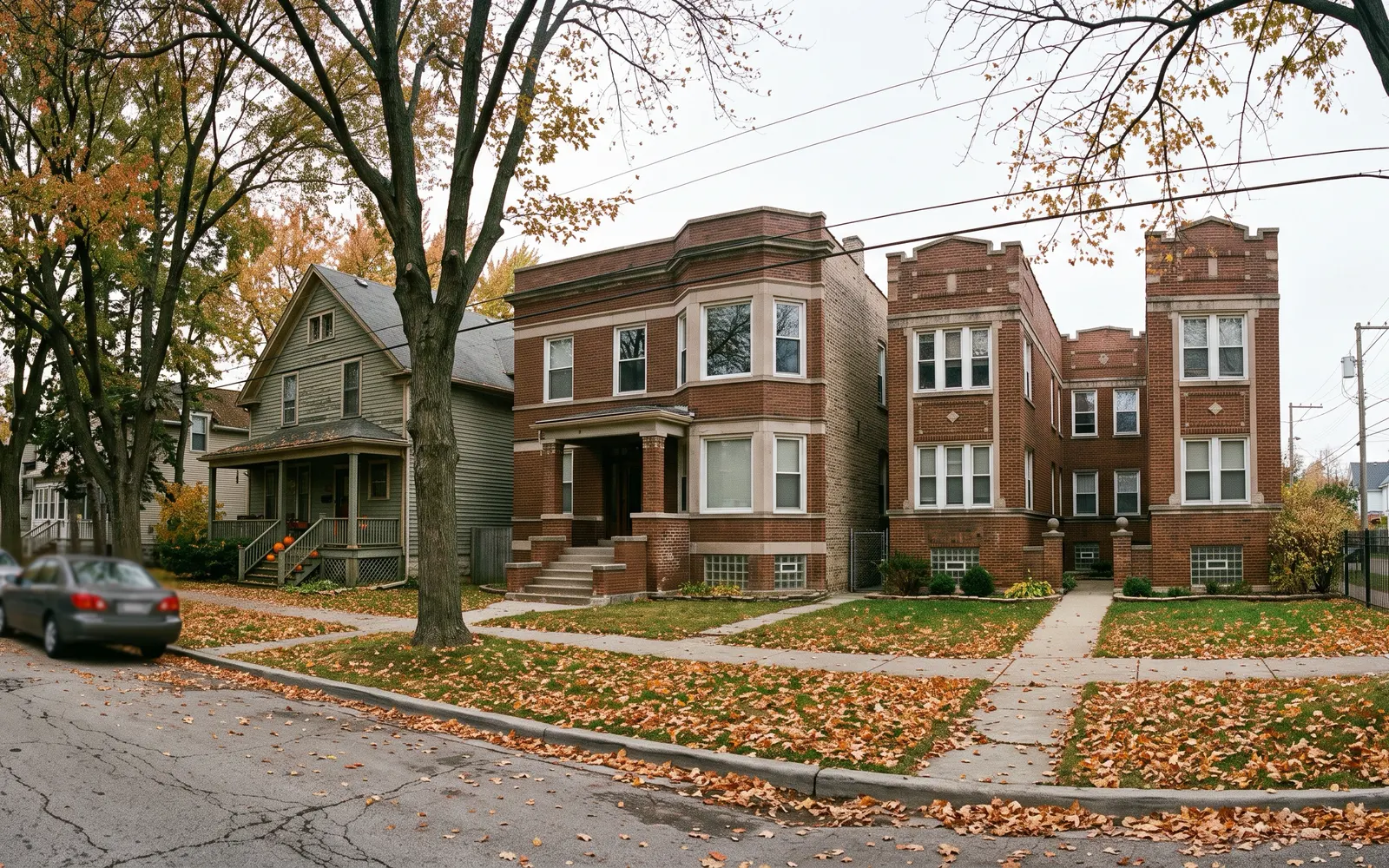
North of the Eisenhower, around Madison Street. The blocks between the Green Line and the expressway, with Madison Street through the middle. This side is in Garfield's primary attendance area, per District 91. It holds the downtown condo buildings, the densest mix of two-flats and courtyard buildings, and the shortest walks to Madison Street, the Harlem/Lake Green Line terminal and the Oak Park Metra station next to it.
Madison Street itself. The storefront blocks between Des Plaines and Harlem Avenues, with condos and apartments over shops and a few newer mixed-use buildings. Walk Score rates Village Hall at 517 Des Plaines Avenue a 90, its top category. This is the pocket for a buyer who wants to walk to dinner.
The Harrison Street and park corridor. Along the south side of the expressway, the Park District's main campus at 7501 Harrison Street and the Roos Recreation Center at 7329 Harrison sit next to the Blue Line's Harlem station. The Ferrara candy plant on Harrison is here too, per Wikipedia. South of I-290, so Betsy Ross for the primary grades.
South of the Eisenhower to Roosevelt Road. The Betsy Ross side, with more frame houses and brick bungalows on the residential streets, and Roosevelt Road at the south end with Forest Park Plaza, the Golden Steer and the Proviso Math and Science Academy at Roosevelt and First Avenue. The Franklin-Brown TIF area, covered under development, is on this side.
Des Plaines Avenue and the west side. Village Hall, the post office, the Howard Mohr Community Center at Des Plaines and Jackson, the library at 7555 Jackson and the Blue Line's Forest Park terminal at 711 Des Plaines. West and south of here the land turns to cemeteries and the river, so there are fewer homes and more open space.
The Altenheim area. The west end of Madison Street, where the Altenheim building stands at 7824 Madison and the village owns about 11 acres around it. What gets built there is the biggest open question in town, covered under development.
What Forest Park Homes Look Like, by Type and Era
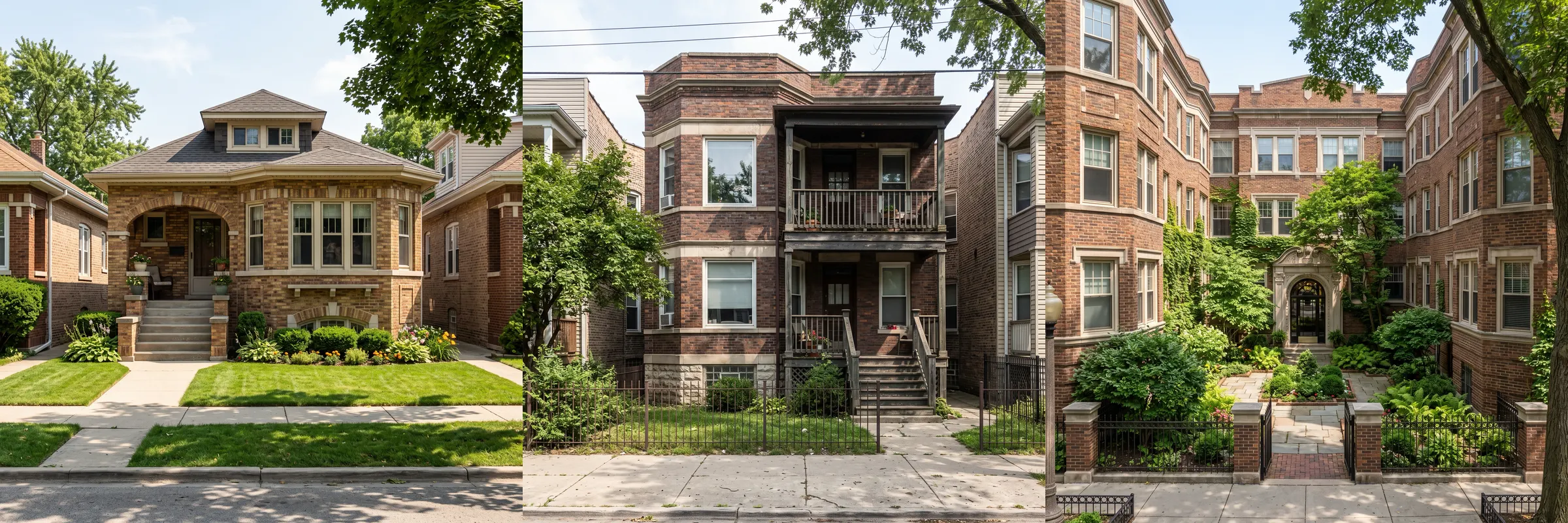
Forest Park is a town of small buildings, not single houses. CMAP's snapshot, built on the 2020-2024 ACS, counts 2,243 detached single-family homes, only 29.3% of all units, against 39.6% for Cook County. Two-unit buildings add 1,156 units, or 15.1%, well above the county's 8.9%. Three- and four-unit buildings add 7.9%, and buildings of 20 or more units add 28.1%, against 20.1% countywide. Townhomes are rare at 6.1%.
The stock is old. CMAP counts 47.8% of units built before 1940 and another 26.3% from 1940 to 1969, with a median year built of 1949, against 1961 for Cook County. Only 2.2% were built in 2010 or later. The units are small, too: 30.6% have one bedroom or none, 34.2% have two, 25.3% have three, and only 10.0% have four or more. The median home has 4.9 rooms.
In practice, that means four products under one town name. Detached houses are mostly frame houses, brick bungalows and a few American Foursquares on narrow city-style lots. Two-flats are the classic Chicago-area brick building with one unit per floor. Condos are in courtyard buildings and midrise buildings near Madison Street and the Blue Line. And there are apartment buildings of every size. The Census ACS puts the median owner-occupied home value at $304,700 and median gross rent at $1,367 for 2020-2024.
A two-flat is the product people ask me about most here. It can work as a house with rental income, but the lender, the insurance and the inspection all look different. Old houses have their own list: original wiring, galvanized or lead water service lines, clay sewer laterals, older boilers and basements that were never meant to be finished. None of that should kill a deal. All of it belongs in the price, and my home inspection checklist covers what to ask for. Forest Park adds a village inspection of its own before any sale, which I explain in the tax section.
The Forest Park Housing Market in 2026
Forest Park's sale numbers jumped this summer, and the jump needs context. In the three months ending August 2026, Redfin reported a median sale price of $386,744, up 28.9% from a year earlier. Homes sold in about 43 days, down from 49, at 100.6% of list price on average, up 1.1 points. Redfin counted 65 homes sold in August. The median price per square foot was $250, up 20.8%.
Redfin calls the market somewhat competitive. It gives Forest Park a Compete Score of 67 out of 100 and says homes get about three offers on average. Its summary is that the average home sells for around list price and goes pending in around 55 days, while hot homes sell for about 3% above list and go pending in about 41 days.
Zillow's home value index tells a calmer story. It put the typical Forest Park home at $291,076 in August 2026, up 6.8% from $272,670 in August 2025 and 8.0% from August 2024. The gap between the two is the most important thing to understand about pricing here. Zillow's index estimates every home in the village, and most homes here are condos and small units. Redfin's median is the middle of whatever sold, and in a village this small, a summer with more houses and two-flats and fewer studio condos moves the median a lot. When I price a Forest Park home, I use sales of the same product on similar blocks, never the village median.
For context, Zillow's August 2026 index put Maywood at $263,667, Cicero at $279,769, Berwyn at $321,149, Melrose Park at $323,884, River Grove at $324,957, North Riverside at $356,131 and Elmwood Park at $359,481. Oak Park, next door, was $486,880 and River Forest $738,290. Forest Park is the least expensive way into the Harlem Avenue corridor, and my guides to Oak Park and River Forest show what the extra money buys on the other side of the street. If you are working out a budget, my guide to how much house you can afford walks through the numbers.
Forest Park Property Taxes, the 2026 Proviso Reassessment and the Transfer Inspection
Property tax is the number that moves the monthly payment most. Ownwell's Cook County data for Forest Park, updated April 13, 2026, puts the median effective rate at 2.71% and the median annual bill at $5,929, against a Cook County median rate of 2.14%. All of Forest Park is ZIP code 60130, so there is no ZIP-level split.
Cook reassesses one-third of the county each year, so each township is revalued every three years. Proviso Township was last reassessed in 2023. The Cook County Assessor's Proviso Township release of October 9, 2023, listed Forest Park among 16 municipalities that are all or partly in the township. It put the township's 2022 median sale price at $278,000 for single-family homes, $145,000 for condos and $386,000 for small apartment buildings, against the assessor's median estimates of $240,000, $122,000 and $312,000.
2026 is Proviso's turn again. The assessor's calendar lists a reassessment notice date for Proviso of September 14, 2026, with appeals open until October 27, 2026. If you own in Forest Park, check your notice and the property characteristics on it before that date. If the county follows the pattern it used for the 2025 north suburban reassessment, these new values will first show up on second-installment bills issued in 2027. That is my reading of the cycle, not a date the assessor has published. By my arithmetic on the three-year cycle, the next Proviso reassessment after this one would be 2029.
The bills come in two pieces. For tax year 2025, the first installment was due April 1, 2026, and the second installment is due October 1, 2026, per the Cook County Treasurer. If you close this fall, ask your attorney how the proration handles that bill. At this summer's $386,744 median, a 2.71% rate works out to about $10,480 a year, or $873 a month. The seller's bill is often lower, because the assessment trails the market and the seller may carry exemptions you won't have in year one, so budget off the purchase price. The Cook County homeowner exemption takes $10,000 off the equalized assessed value of an owner-occupied home; the savings equal that $10,000 times your local tax rate.
Forest Park has no village transfer tax, but it has a transfer inspection. The ATG ordinance summary, last updated March 4, 2025, lists no fee for the village's compliance stamp, and requires a pre-transfer inspection, a paid final water bill and a copy of the deed and PTAX form. The village code, section 8-1-12, says the seller must request the inspection at least 10 working days before closing, the Building Department checks the property against village codes, and a certificate of compliance is good for four months. If repairs are needed, a conditional certificate lets the buyer agree to fix them within three months of closing, with a $150 administrative fee for repairs estimated up to $1,500 or $500 above that, and $300 returned once the work is done. ATG's note on inspection fees, current as of February 2017, lists $300 for a single-family home and $200 for a condo; confirm the current fee with the village.
Sellers, order that inspection early. Buyers, read the correction list; it tells you what the village already found. The county still charges its transfer tax, which the Illinois Department of Revenue lists at 25 cents per $500 of value, or about $193 on a $386,744 sale. My Illinois closing costs guide covers the rest. This is general information, not tax advice. Your bill depends on your parcel, your exemptions and the assessor.
Forest Park Schools: District 91 and Proviso Township High Schools District 209
Forest Park has its own elementary district. Forest Park School District 91 runs grade-level centers rather than neighborhood K-8 schools: two primary centers, one intermediate school for grades 3 to 5 and one middle school for grades 6 to 8. Primary students south of I-290 attend Betsy Ross (K-2), and those north of I-290 attend Garfield (preschool to 2). All preschool students attend Garfield. Every student in grades 3 to 5 attends Field-Stevenson, and every student in grades 6 to 8 attends Forest Park Middle School. The district office is at 424 Des Plaines Avenue.
The district is in a leadership change. The Forest Park Review reported on September 15, 2026 that the board is running a superintendent search with the Illinois Association of School Boards, plans to appoint a new superintendent by December and expects that person to start July 1, 2027. Two co-interim superintendents are serving until then. District 91 closed Grant-White Elementary in 2022, per Wikipedia, and in 2025 leased much of its first floor to Oak Park and River Forest High School for a transition program.
High school is Proviso Township High Schools District 209, headquartered at 8601 W. Roosevelt Road in Forest Park. According to Wikipedia's Proviso East entry, Proviso East at 807 S. First Avenue in Maywood serves Maywood, Broadview, Forest Park and Melrose Park, and it is the district's original campus from 1911. The Proviso Mathematics and Science Academy, a high school that opened in 2005, is physically in Forest Park at the same Roosevelt Road address; admission is by application, not by address.
Assignment is by address, and boundaries can change, so confirm every address with both districts before you write an offer. I don't rank schools on this page. The Illinois Report Card has each school's own data.
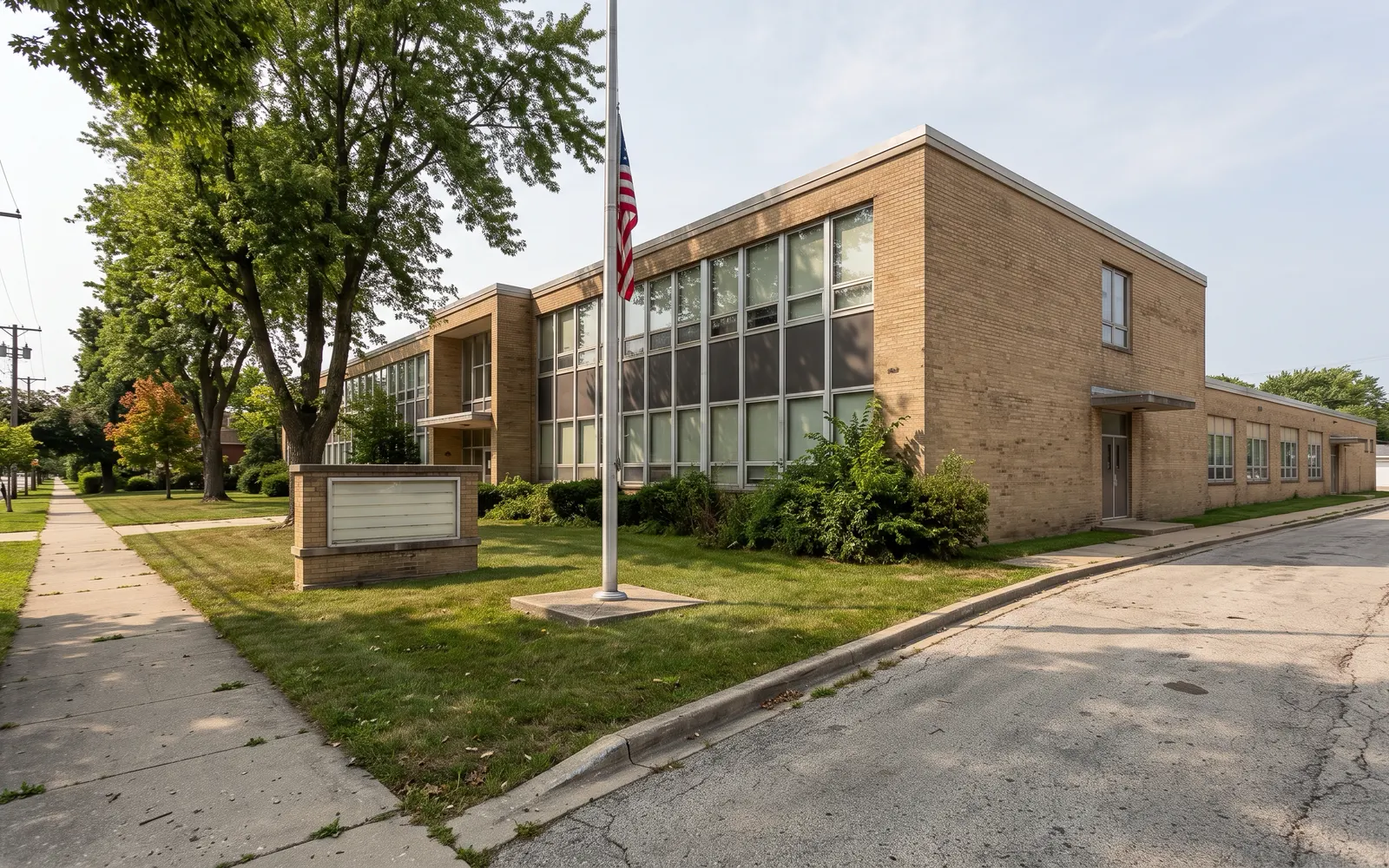
Garfield Elementary. District 91's primary center for preschool through second grade for students living north of I-290, and the preschool for the whole district.
Betsy Ross Elementary. The primary center for kindergarten through second grade for students living south of I-290.
Field-Stevenson Intermediate School. Grades 3 to 5 for the whole district.
Forest Park Middle School. Grades 6 to 8 for the whole district.
Proviso East High School. District 209's campus at 807 S. First Avenue in Maywood, listed by Wikipedia as serving Forest Park. Confirm the assignment for your address with the district.
Proviso Mathematics and Science Academy. District 209's high school at 8601 W. Roosevelt Road in Forest Park, open since 2005; students apply.
Commuting from Forest Park: Two CTA Lines and a Metra Station Next Door
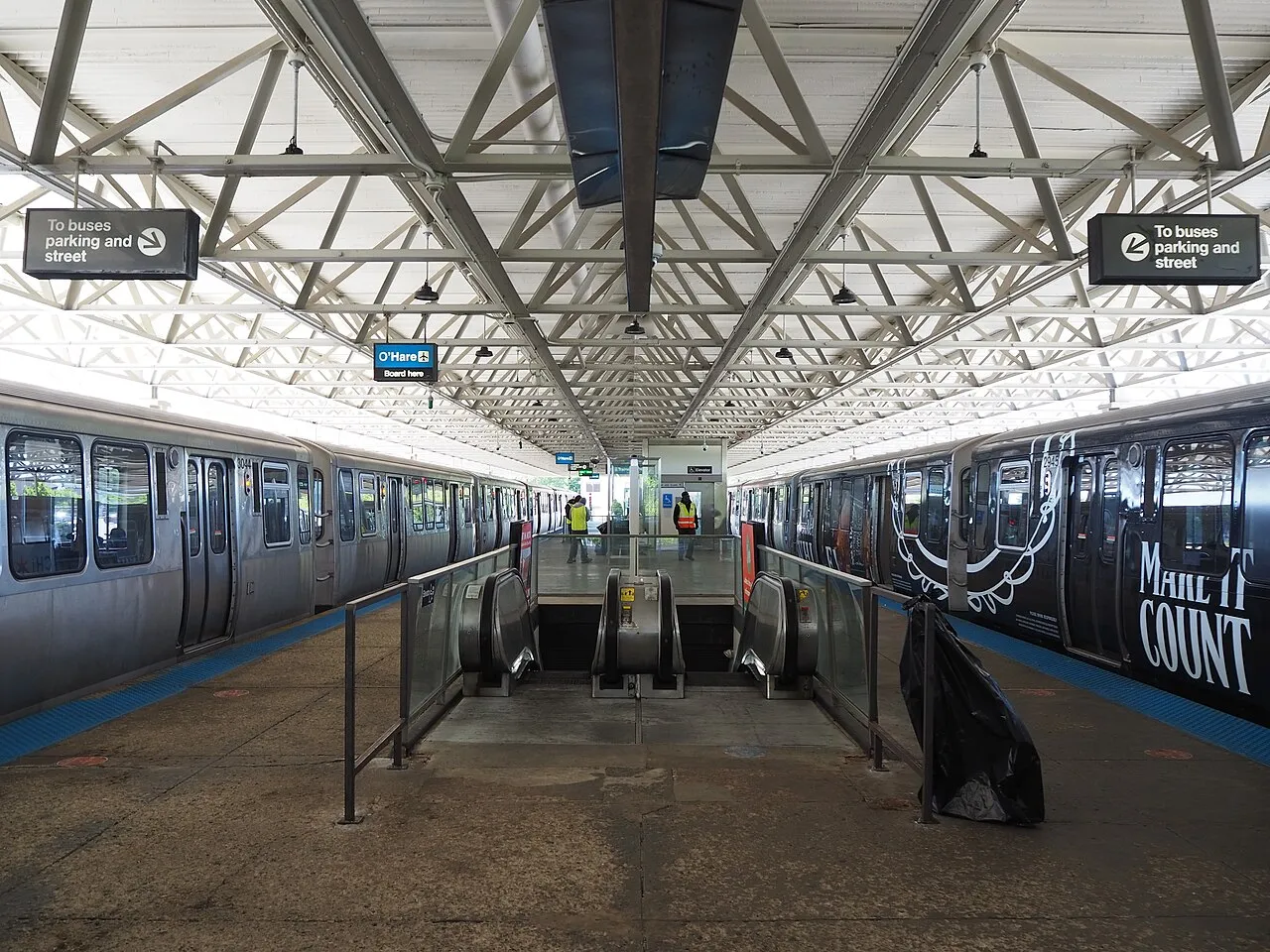
Forest Park has no Metra station of its own, but it has three CTA stations, which is rare for a suburb. Wikipedia notes that it is one of only two municipalities served by the "L" that do not border Chicago. The Blue Line's Forest Park branch ends at the Forest Park terminal, 711 Des Plaines Avenue, and stops at Harlem Avenue on the way east. The Green Line ends at Harlem/Lake, 1 Harlem Avenue, on the Oak Park line.
The Blue Line runs all night. I worked out the run times from the CTA's own published schedule data for Wednesday, September 30, 2026: 174 trains leave Forest Park for downtown on a weekday, and the scheduled ride to Clark/Lake is about 42 minutes. From the Harlem stop it is about 39. Between 6 and 9 a.m., trains leave Forest Park every 7 to 7.5 minutes; the CTA's Forest Park station timetable puts rush-hour service at every 7 to 12 minutes and overnight service at every 15 to 20. The same line continues past downtown to O'Hare, a one-seat ride of about 83 minutes from Forest Park.
The Green Line is faster to the Loop from the north side. The same schedule data shows a ride of about 31 minutes from Harlem/Lake to Clark/Lake, with trains about every 8.5 minutes in the morning rush. The CTA notes that the Metra Union Pacific West line stops at the adjacent Oak Park station. According to Metra's schedule data for the week of September 28, 2026, Oak Park has 28 inbound weekday trains to Ogilvie, the fastest six taking 18 minutes and the rest 23, in fare zone 2.
Parking at the terminal is paid. The CTA lists $7 for 12 hours in the main lot at 711 S. Des Plaines and $6 in the south and overflow lots, with monthly rates of $140 and $120, plus indoor bike parking and connections to 10 Pace routes. Transit's share of commuting is smaller than you might expect: CMAP shows 5.6% of workers taking transit, 54.5% driving alone, 24.2% working from home and 7.5% walking or biking, with an average commute of 27.4 minutes.
Two transit projects are worth watching. The CTA's Forest Park Branch Rebuild page says much of the branch dates to 1958, 84.4% of it is under slow zones and only 5 of its 11 stations were accessible as of 2025. The CTA has funding to design the rebuild of more than 13 miles of track and drainage between Illinois Medical District and Forest Park, with design expected to begin in late 2026 and a construction timeline to follow. Separately, a private O'Hare Flyer express train has proposed a stop on a village lot next to the Blue Line terminal, the Forest Park Review reported on September 22, 2026; its backer said no agreements have been reached, and River Forest's board passed a resolution against the route on September 14.
Driving from Forest Park: The Eisenhower, Harlem Avenue and Roosevelt Road
The Eisenhower Expressway, I-290, runs straight through the middle of the village with the Blue Line in its median. It is the direct route east to downtown and west to the tollways and the western suburbs. Harlem Avenue, Illinois 43, is the east edge of the village and the main north-south road. Roosevelt Road is the east-west commercial road at the south end, and First Avenue, Illinois 171 in that stretch, runs along the west side past the Proviso Math and Science Academy.
The long-planned Eisenhower rebuild is not scheduled. The I-290 project site says the Federal Highway Administration approved the final environmental study and record of decision in June 2017, selecting added tolled managed lanes (a HOT 3+ design) from west of Mannheim Road to Racine Avenue. The same page says the project was not in IDOT's FY 2021-2026 highway program and that IDOT is still evaluating how to pay for it. I found no newer construction schedule.
The expressway has a known weak spot. On July 2, 2023, about six inches of rain in 12 hours flooded I-290 in both directions between Des Plaines and Circle Avenues and stranded drivers for hours, the Forest Park Review reported. The CTA also suspended Blue Line service between Harlem and Forest Park that day.
For daily life, the practical point is that Forest Park is small enough that the drive is rarely the problem. Crossing the village takes minutes. The questions I help buyers answer are whether a house is close to an expressway ramp, whether it sits on a busy street like Harlem, Madison, Des Plaines or Roosevelt, and how far the nearest CTA station is on foot.
Is Forest Park Walkable?
Yes, more than almost any suburb I cover. Walk Score rates Village Hall at 517 Des Plaines Avenue a 90, which it calls a walker's paradise where daily errands do not require a car, with a Bike Score of 54. The Forest Park Public Library at 7555 Jackson Boulevard scores 85, very walkable. Walk Score's Forest Park page counts about 161 restaurants, bars and coffee shops in the village and says the average resident can walk to about six of them in five minutes.
The numbers match the layout. The village is only 2.4 square miles, with a grid of short blocks, Madison Street through the middle and three train stations. CMAP shows 7.5% of workers walking or biking to work, against 4.9% for Cook County. The Park District's pocket parks are spread through the residential blocks, so most homes are a short walk from a playground or a patch of green.
Two things break up the grid. The Eisenhower can only be crossed at certain streets, so the north and south halves feel more separate than the distance suggests. And the cemeteries on the west and south sides are large blocks of land with few through streets. If walking matters to you, check the route from a specific house to the train and to Madison Street, not just the score.
Shopping in Forest Park: Madison Street and Roosevelt Road
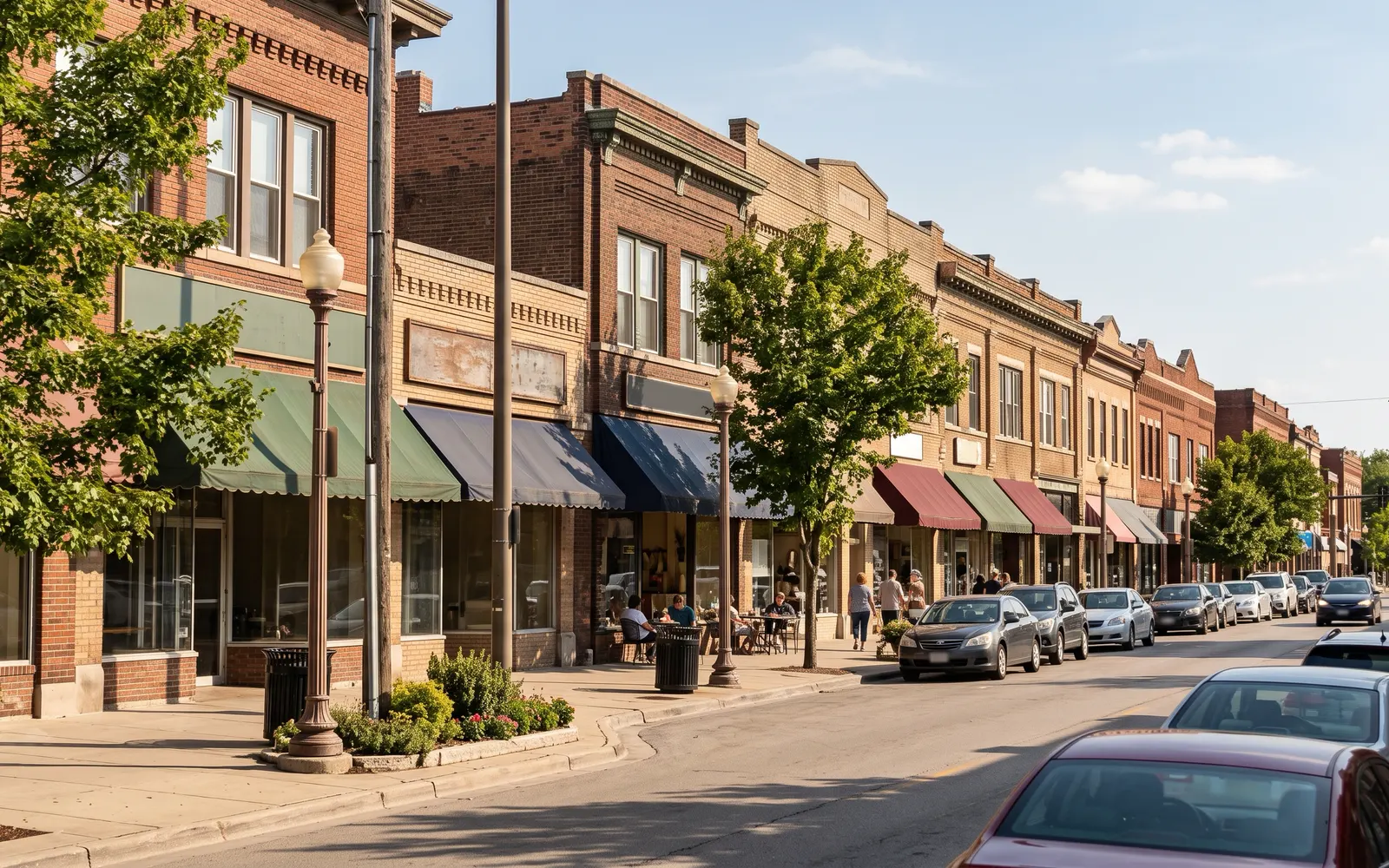
Forest Park has two shopping districts, and they could not be more different. Madison Street is the walkable downtown of independent shops, bars and restaurants. Roosevelt Road is the drive-to strip at the south end, anchored by Forest Park Plaza on the site of the World War II torpedo plant.
Madison Street's shops tend to last. The Forest Park Review's 2026 Community Guide profiles Kagan & Gaines, a music store in Forest Park since 1982; Tiffany Stained Glass, run by the same owners for more than 50 years; and a Play It Again Sports franchise that opened on Madison in 2021. The Forest Park Chamber of Commerce & Development moved into a village-owned storefront at 7410 Madison Street after a unanimous council vote on June 8, 2026, the Review reported.
Forest Park Plaza is owned by Living Word Christian Center, according to Forest Park Review coverage from December 2023. Its grocery anchor is covered in the next section. Roosevelt Road also carries fast food, auto businesses and the Golden Steer steakhouse.
The numbers show that people come here to shop. CMAP, using Illinois Department of Revenue data, counts about $423.0 million in retail sales in 2025, or $30,340 per resident, against $23,200 for Cook County. The tax base is still mostly homes: of $512.5 million in equalized assessed value in 2024, $380.9 million was residential and $98.0 million commercial.
Groceries and Everyday Errands in Forest Park
Forest Park has one full-size supermarket inside the village, and its history is unusual. The east anchor store at Forest Park Plaza on Roosevelt Road is Living Fresh Market. In October 2021 its former owners sold the store to the plaza's landlord, Living Word Christian Center, and the store stayed open under new management, the Forest Park Review reported. Check its current hours before you count on it for weekly shopping.
The rest of the week depends on which side of the village you live on. Harlem Avenue is lined with stores on both the Forest Park and Oak Park sides, so a home north of the Eisenhower is usually closer to Oak Park's grocery options, and a home near Roosevelt Road is closer to the plaza. Map the store the way you would map the train before you buy.
Everyday services are close together here. Village Hall is at 517 Des Plaines Avenue, and the post office is at 417 Des Plaines, per Wikipedia. The Howard Mohr Community Center at Des Plaines and Jackson hosts village programs and community groups. The Forest Park Review's 36-hours photo essay also shows a Portillo's at Roosevelt and Des Plaines and the Forest Bark dog park at Lehmer and Circle.
Where Forest Park Eats and Drinks
Forest Park has been the place the neighbors come for a drink for a long time. The Forest Park Review's dining history says the village has poured drinks for the region since the 1870s, and that Oak Park and River Forest did not allow alcohol to be served even with dinner until the 1970s. Oak Park did not allow drinks without a meal until 2011. That history is why Madison Street has so many bars and restaurants for a village of about 14,000 people. Walk Score counts about 161 restaurants, bars and coffee shops.
Some names are institutions. The same article calls the Golden Steer, at 7635 Roosevelt Road, the keeper of the village's old steakhouse era, known for its baked French onion soup. The Review's 2026 photo essay names Twisted Cookie at 7401 Madison, the Rhythm and Blues Cafe at Ferdinand and Madison, O'Sullivan's Public House, Roberts West Side at Madison and Circle with two stages for local bands, and Circle Lanes, a bowling alley with a bar that the Review says has been open for 85 years.
I don't try to list every restaurant here, because the list changes every year. The best advice I give buyers is to eat on Madison Street on a Friday night and walk the blocks around the house afterward. How much you like that noise and energy is the real question for a house within a block or two of Madison.
Parks, the Roos Center and the Forest Preserves in Forest Park
Most of Forest Park's recreation is on one campus. The Park District of Forest Park runs its main park at 7501 Harrison Street, with six lit tennis courts (three also lined for pickleball), the Bud Mohr Skate Park and a full-size lighted turf field that is home to the Forest Park Youth Soccer Association. Wikipedia describes the main park as 15 acres with an aquatic center.
The Aquatic Center, at the same address, has a zero-depth entry pool, water slides, lap lanes and a splash pad. It opens Memorial Day weekend and closes at 5 p.m. on Labor Day, and a 2026 resident individual pass was $85. The Roos Recreation Center at 7329 Harrison, next to the Harlem Blue Line stop, has 14,830 square feet with a gym, fitness center and indoor track; a resident membership was $29 a month at the 2025 rates. Roos opened in 2018 on the site of the old Roos chest factory, and the Forest Park Review noted in 2024 that sign-ups quickly doubled expectations, 900 against 400, and that the district was planning an expansion.
More work is coming to the main park. On January 14, 2026, the district announced a $600,000 state OSLAD grant for a new turf surface on the sports field, a renovated main playground, an outdoor classroom, a putting green, a rain garden and landscaping. The district also runs small pocket parks through the village, including Remembrance Park at 7341 Randolph Street with a splash pad and bocce court, Rieger Park at 1526 Circle Avenue with a walking track, and Lathrop Park at 1138 Lathrop Avenue.
The county preserves are next door. Miller Meadow, run by the Forest Preserves of Cook County off First Avenue and Roosevelt Road, has eight picnic groves, a 2.0-mile paved trail, a model airplane field and an off-leash dog area. The Des Plaines River runs along the village's west side.
The Forest Park Public Library
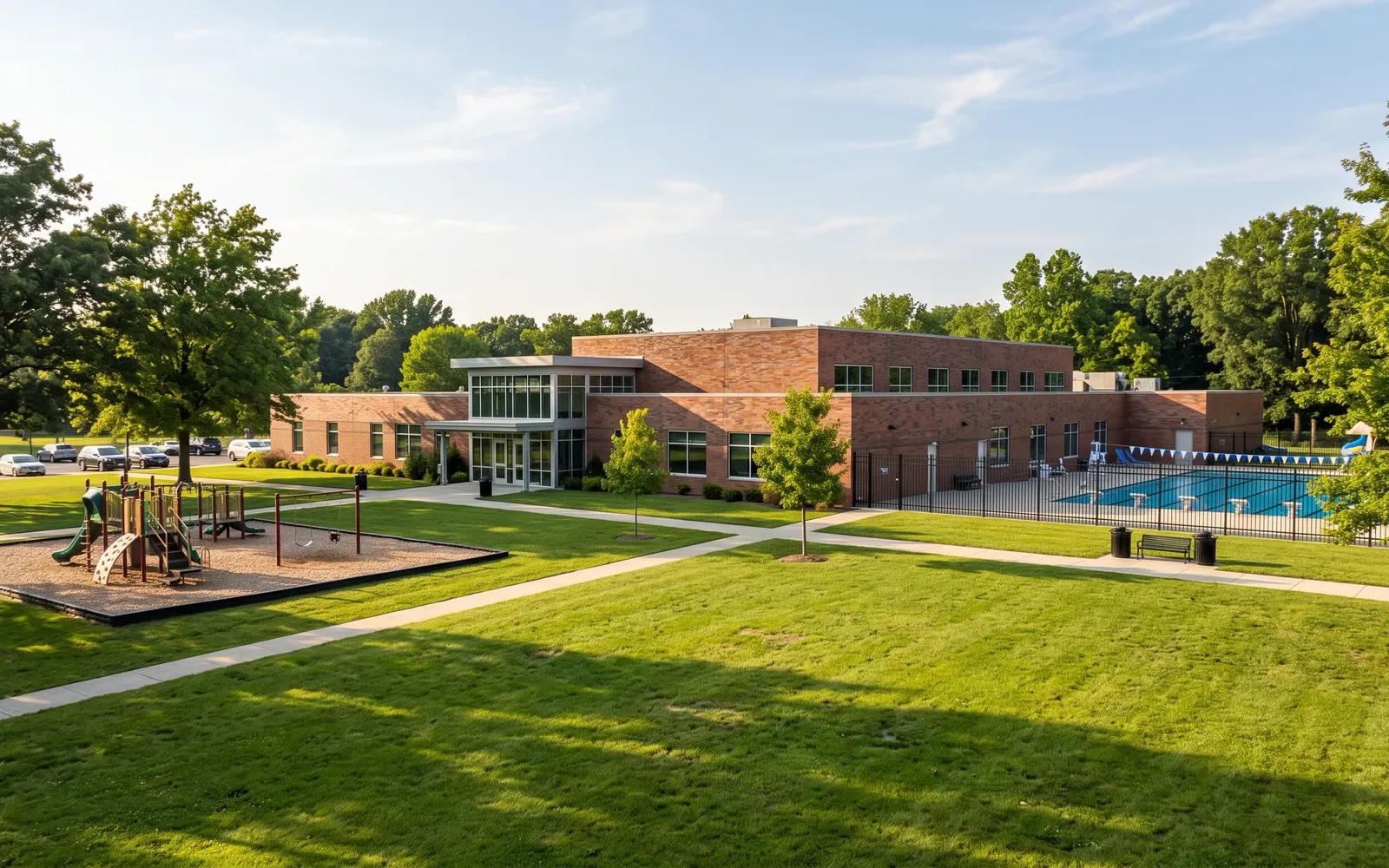
The Forest Park Public Library is at 7555 Jackson Boulevard, close to Village Hall and the Blue Line terminal. It is open seven days: 9 a.m. to 9 p.m. Monday through Thursday, 9 to 6 on Friday, 9 to 5 on Saturday and 1 to 5 on Sunday.
The library is older than the building. Its history page says the first public library opened in two rooms on the second floor of Village Hall on June 20, 1916, with 2,000 books, and the library marked 110 years in June 2026. The old building was demolished in August 1994 for the current one, which Wikipedia says opened on October 8, 1995, with 26,400 square feet on two levels. A remodel reopened in 2020. The library keeps a local history collection, which is a good place to research an old house.
Utilities, Water and Village Services in Forest Park
Forest Park buys its drinking water from Chicago. The Forest Park Review reported in May 2025 that the water comes in from Chicago to a million-gallon underground reservoir beneath the Howard Mohr Community Center, and a pump station on Des Plaines Avenue sends it around the village. That May, a computer failure left the inlet valve open and the reservoir overflowed into the community center. A Review editorial called the reservoir badly deteriorating and urged the village to plan a new one.
The sewers are old too. Parts of the village are served by combined storm and sanitary sewers, and the village code requires homes in those areas to keep downspouts and footing drains out of the sanitary line and to move them to a new storm sewer within 24 months if one is built. The village has begun sewer separation work in recent years, per the 2023 Review flood report.
The village budget is tight, and that matters for buyers. The Review reported in April 2026 that Forest Park had a projected $15 million deficit for the current fiscal year. That is one reason large projects like the Altenheim land and the reservoir move slowly. ComEd delivers electricity and Nicor Gas provides natural gas.
For sellers: the final water bill must be paid before closing, per ATG's summary, so request the final meter reading early.
Hospitals Near Forest Park
The closest large hospital is just west. Loyola University Medical Center, part of Trinity Health's Loyola Medicine, is in Maywood, with 547 beds and a Level I trauma designation. It opened in 1969 and shares its campus with Loyola's Stritch School of Medicine. Oak Park, across Harlem Avenue, and Chicago's West Side add more options, and the Blue Line reaches the Illinois Medical District on the way downtown.
Madison Street Nights, Circle Lanes and the Haymarket Monument in Forest Park
Forest Park's culture is mostly after dark and mostly on Madison Street. The Forest Park Review's 2026 photo essay lists standup and improv at Babs Comedy Club, live bands, open jams and bocce leagues at Roberts West Side, line dancing at the Rhythm and Blues Cafe and league bowling at Circle Lanes. The Blue Line runs all night, so a night out here or downtown does not require a car.
Forest Park also had a professional theater. Wikipedia notes that Circle Theatre, a non-Equity company with more than 30 Jeff Awards, spent most of its history in Forest Park before moving across Harlem Avenue to Oak Park.
The history is part of the entertainment. The Haymarket Martyrs' Monument at Forest Home Cemetery is a National Historic Landmark, and the Historical Society of Forest Park runs tours of it; the Chamber's calendar lists one on October 3, 2026. Every summer the Park District hosts the No Glove Nationals, a 16-inch softball tournament that the district says is in its 58th year in 2026.
Casket Races, No Glove Nationals and Forest Park's Yearly Calendar
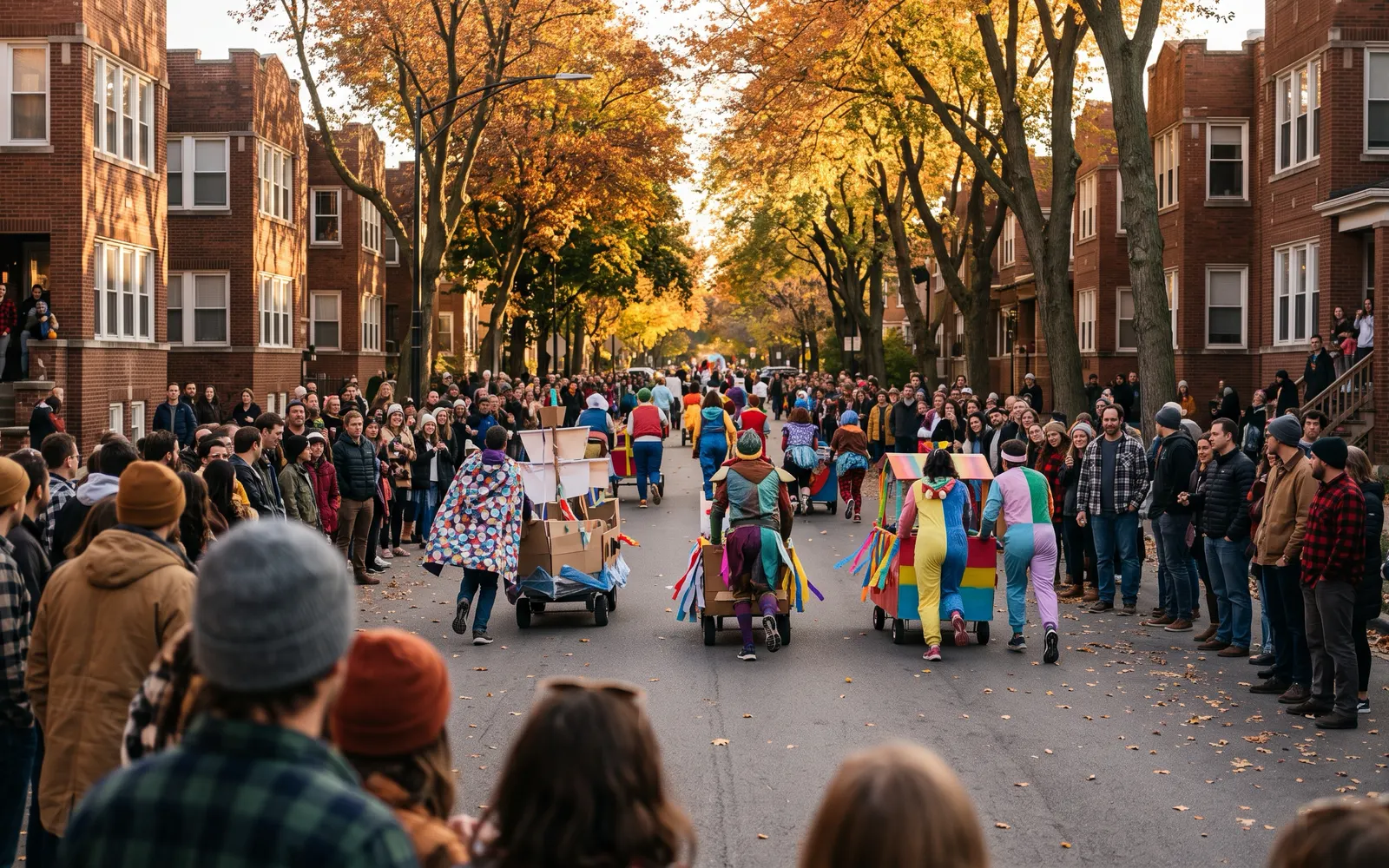
The signature event fits the village. The 14th annual Forest Park Casket Races are Saturday, October 24, 2026, on Beloit Avenue between Madison and Adams. Four-person teams push coffin-shaped carts down the street with a costumed rider inside. The parade of caskets starts at 10:30 a.m., races begin at 11, spectating is free, and Trick or Treat on Madison Street follows from 12:30 to 2:30 p.m.
The rest of the fall is on Madison too. The Chamber's calendar lists a Haymarket Martyrs' Monument tour on October 3, the Fall Wine Walk on November 7 with tastings at 17 locations for $55, and the Holiday Walk on Friday, December 4, from 6 to 9 p.m., with window displays, carriage rides and merchant open houses.
Summer belongs to the park. The Park District's softball page lists the 58th annual No Glove Nationals 16-inch softball tournament for July 23 to 27, 2026, with a play-in tournament and the Chicago 16-inch Softball Hall of Fame induction day on July 21. If you are touring houses that week, stop by. It tells you more about the town than a listing will.
What's Being Built in Forest Park
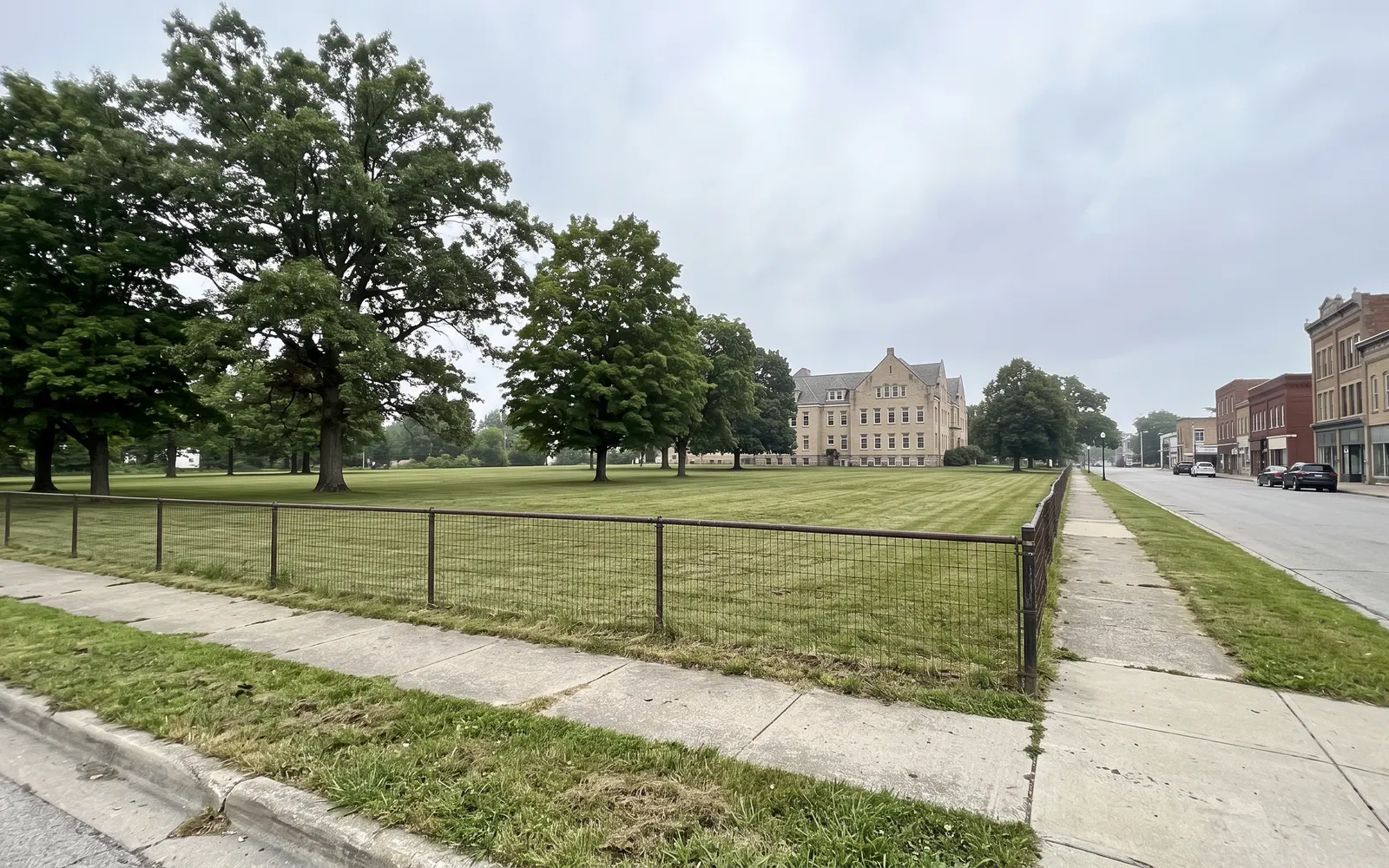
The biggest question is the Altenheim land. In 2001 the village bought 11 acres around the Altenheim building at 7824 Madison Street for $3.6 million, the Forest Park Review reported in August 2025, and it has debated what to do with them ever since. In May 2026 a developer submitted an unsolicited proposal for the village-owned land with one-, two- and three-bedroom units and some green space, the Review reported on July 14, 2026. A Review column put the proposal at $145 million, with two five-story buildings and an offer of $3.6 million for the site. Commissioners said they wanted a public request for proposals instead.
The rules on that land are a hurdle. At the August 10, 2026 council meeting, the village's new planner said current covenants with the Altenheim limit the village's part of the property to low- and medium-density housing, such as single-family homes, two-flats and townhouses, plus public parks, and that any other use would need the Altenheim's agreement, the Review reported. The council plans monthly discussions. If you are buying near the west end of Madison Street, follow them.
A new TIF aims at housing on the south side. On September 14, 2026, the council created the Franklin-Brown TIF district at Franklin Street and Brown Avenue, the Review reported. The area includes the former Suburban Lumber property, which closed in March after 80 years. It is zoned commercial and light industrial, but the village wants residential development there and has said TIF money is off the table for an industrial user. The redevelopment plan estimates $16 million for demolition, environmental cleanup and public improvements. There is no project yet.
Three other items shape the next few years. The village's residential zoning update, which the Review says would bring about 75% of nonconforming residential properties into compliance and make renovations easier, has stalled since 2024; a town hall was held in April 2026. The six-acre Armed Forces Reserve Center at 7402 Roosevelt Road was expected to go to the Illinois National Guard rather than to the village, per a 2025 Review report. And the historic building at 7200 Madison Street, at Harlem, was condemned in February 2026, with the village asking the owners to make repairs first, per the Review.
I don't label any town or neighborhood as safe or unsafe.
Flood Risk in Forest Park
Flooding is a real question in Forest Park, and it is worth asking about every house. Redfin, using First Street's model, rates Forest Park's flood risk as major and says 9% of properties are at risk of severe flooding over the next 30 years.
The history explains why. The Des Plaines River runs along the west side of the village, and the Forest Park Review has covered basement flooding for decades. On July 2, 2023, about six inches of rain fell in 12 hours, and many homes and some businesses flooded, even though the river itself did not overflow, the Review reported. The public works director said the village's recent sewer separation work blunted some of the damage. Much of the risk here is sewer backup in heavy rain, not river water, which is why the plumbing matters as much as the flood map.
Three checks before you write an offer. Look the address up on the FEMA flood map, because a mapped flood zone can mean required flood insurance. Ask the seller directly whether the basement has ever taken water; the Illinois disclosure form asks, but a direct question gets a better answer. And have the inspector look at the sump pump and its backup, any overhead sewer or check valve, the downspouts and the grading. In a village with combined sewers and pre-1940 houses, a sewer scope of the line to the street is money well spent.
Frequently Asked Questions
Is Forest Park, IL in Cook County?+
Yes. Census Bureau estimates for 2025 put all 13,829 village residents in Cook County, inside Proviso Township. Forest Park homes carry Cook County tax bills and follow Proviso's reassessment calendar, which comes up again in 2026.
How much does a house cost in Forest Park, IL?+
Redfin reported a median sale price of $386,744 for the three months ending August 2026, up 28.9% from a year earlier. Zillow's home value index, which covers every home including condos, was $291,076 for August 2026, up 6.8%. Houses, two-flats and condos trade as separate markets.
What are property taxes in Forest Park, IL?+
Ownwell (April 2026) puts the median effective rate at 2.71% with a median bill of $5,929. Proviso Township is being reassessed in 2026, with notices dated September 14 and appeals open until October 27, 2026.
Does Forest Park have a real estate transfer tax?+
No village transfer tax, but every sale needs a village compliance stamp, which requires a pre-transfer inspection requested at least 10 working days before closing and a paid final water bill. The Cook County transfer tax of 25 cents per $500 still applies.
What school district is Forest Park, IL in?+
Forest Park School District 91 for preschool through eighth grade and Proviso Township High Schools District 209 for high school. District 91 sends K-2 students north of I-290 to Garfield and south of it to Betsy Ross. Proviso East in Maywood serves Forest Park; confirm each address.
How long is the train from Forest Park to downtown Chicago?+
The Blue Line from the Forest Park terminal is scheduled at about 42 minutes to Clark/Lake and runs 24 hours. The Green Line from Harlem/Lake takes about 31 minutes, and Metra from the Oak Park station next door takes 18 to 23 minutes to Ogilvie.
Is Forest Park walkable?+
Yes. Walk Score rates Village Hall at 90, a walker's paradise, and the library at 85. It counts about 161 restaurants, bars and coffee shops in the village, most of them on and around Madison Street.
What neighborhoods are in Forest Park, IL?+
Forest Park has no named subdivisions. The key line is the Eisenhower: north of it are Madison Street and the Garfield school area, and south of it are the Harrison Street park corridor, the Betsy Ross area and Roosevelt Road. The west side holds Des Plaines Avenue, the cemeteries and the Altenheim land.
Is new construction available in Forest Park?+
Very little. Only 2.2% of Forest Park's homes were built in 2010 or later. The village created the Franklin-Brown TIF in September 2026 to attract housing, and a developer has proposed apartments on the Altenheim land, but neither has an approved project. How builder contracts, timelines and allowances work is on my new construction homes in Illinois page.
Eshu Chikoti has extensive access to off-market listings throughout Forest Park and the rest of Cook County — homes that never make it to the public listing sites. That matters right now: in a seller's market like this one, well-priced homes routinely go under contract within days, and buyers relying only on public listings are competing for whatever is left over. Working with someone plugged into off-market inventory means seeing homes before the crowd does.
Eshu Chikoti · 847-691-4282 ·
Get new Forest Park listings by email
When a home comes on the market in Forest Park, I'll email it to you.
Just your email. Unsubscribe any time by replying.
Thinking About Forest Park?
Whether you're buying, selling, or just curious what's on the market, I can walk you through Forest Park street by street.