Norridge, IL
Norridge, IL is a 1.81-square-mile Cook County village of about 14,800 people, bordered by Chicago and Harwood Heights, with O'Hare a mile to the north, the Harlem Irving Plaza on its east edge and a summer 2026 median sale price near $455,000.
Living in Norridge, IL means a median sale price near $455,000 this summer, mostly 1950s and 1960s brick houses, and property tax near 2.08% of value. There is no Metra station in the village, O'Hare is a mile north, and every sale needs a village inspection before closing. Here it is, block by block.
Written by Eshu Chikoti · 847-691-4282 ·
How Norridge, IL Got Here: From "Goat Village" to a 1948 Village
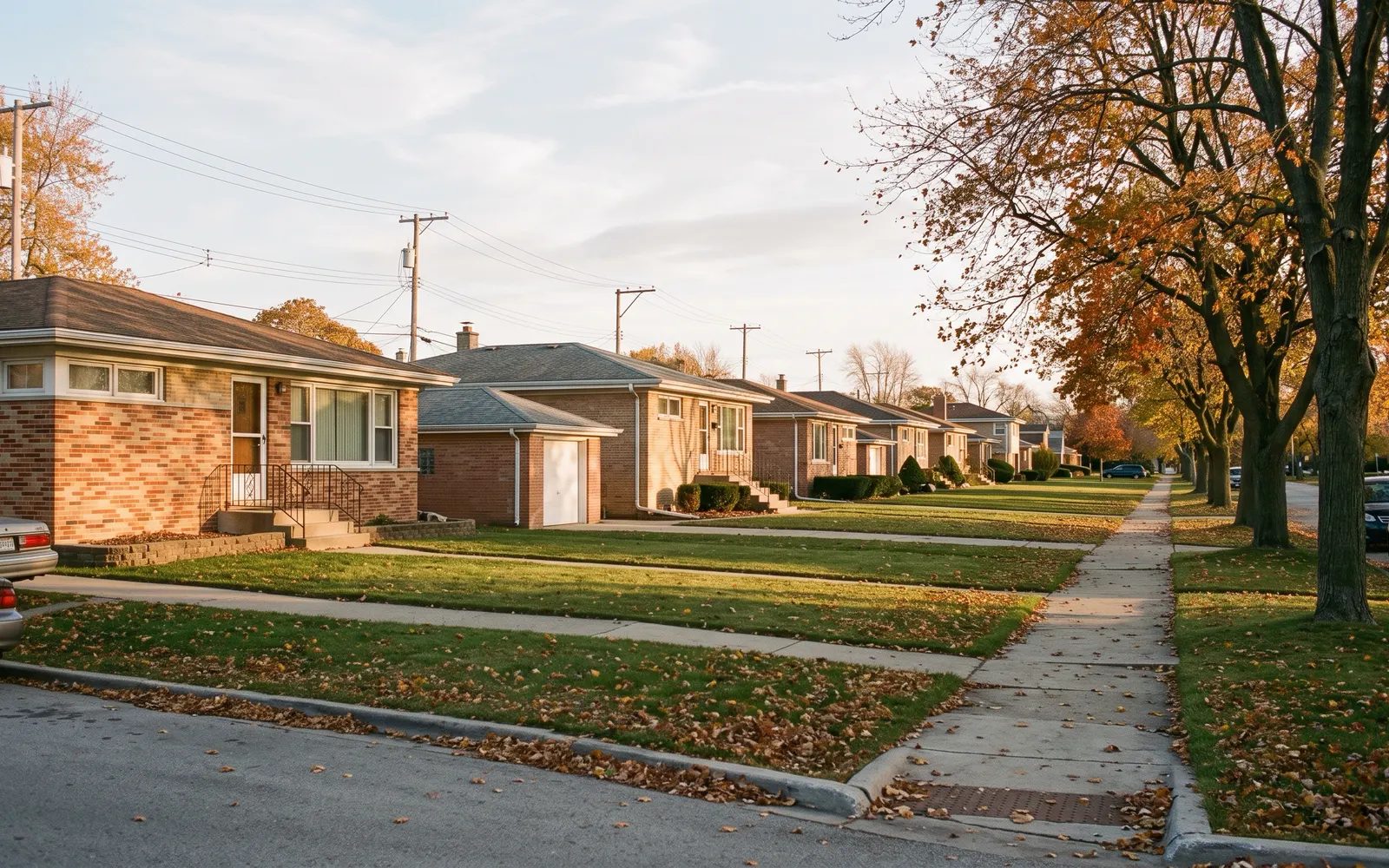
Norridge started as farmland on a low ridge. According to the village's own history page, the area sits on a moraine that forms the watershed between the Chicago River valley to the east and the Des Plaines River valley to the west, with the crown of the ridge at Overhill Avenue, 7600 West, about 645 to 649 feet above sea level. In the early 1900s it held small truck farms, and in the 1930s and 1940s it had riding stables because the forest preserves were next door. Per Wikipedia, the earliest local names for the place were "Goat Village," after a resident's goat farm, and "Swamp," because of the lack of streets.
The village exists because of one referendum. On December 4, 1948, voters approved incorporation 578 to 195, the village page says, pushed by a group called the Annexation Improvement Club. The new village had 1,675 people on about 80 acres bounded by Irving Park Road on the south, Ozanam Avenue on the west, Montrose Avenue on the north and Harlem Avenue on the east. Wikipedia says the incorporation stopped an effort by Chicago to annex the area. The name came from a resident, Mrs. Link: "Nor" from Norwood Park Township and "Ridge" from Park Ridge.
Growth came fast after that. In 1954 Norridge doubled its size by annexing the land between Montrose and Lawrence, and later annexations pushed it north to Foster Avenue, west to Dee Road and east to Sayer Avenue. The census counted 3,428 people in 1950 and 14,087 in 1960, and the village page says the population peaked at 18,043 in 1971. Joseph Sieb was appointed village president in 1951 and served for 46 years and 222 days until his death in 1998, which the village says made him the longest-serving official in Illinois at the time.
A few dates explain the map you see today. The Harlem Irving Plaza opened in 1956 as a strip mall on a former livestock farm. In 1959, the village page says, the Village Board annexed the Pennoyer School property the night before a Chicago annexation tied to O'Hare would have taken it. Voters created the Ridgewood high school district by two votes in a July 12, 1958 referendum. Norridge became a home rule community on May 1, 1973, and the current Village Hall at Olcott Avenue and Irving Park Road was dedicated on October 20, 1990.
Norridge at a Glance
Norridge is small and surrounded. The 2024 Cook County hazard mitigation plan annex for Norridge, which the village helped write, puts it 13 miles northwest of the Loop and lists its neighbors as Chicago's Norwood Park and the O'Hare airfield to the north, Chicago's Dunning to the south, Harwood Heights to the east and the forest preserves to the west. It says O'Hare is one mile directly north. Per Wikipedia, Norridge and Harwood Heights together form an enclave inside the city of Chicago, which is why Norridge is sometimes called the "Island Within a City." The Census Bureau puts its land area at 1.81 square miles, with no water.
Harwood Heights matters to almost every Norridge buyer. The two villages share a ZIP code, 60706, and several public bodies. The Eisenhower Public Library District serves both. Ridgewood High School's district takes in parts of both. Even the Norridge Park District's main park, the village history says, sits on land that stayed under Harwood Heights jurisdiction after a 1950s dispute, and Harwood Heights police patrol it. When you tour houses here, you will cross the line between the two villages without noticing. Check which village an address is in before you compare tax bills, because the village levy and services differ.
The township picture is simple, with one sliver. The Census Bureau's Vintage 2025 estimates put Norridge at 14,808 people in 2025, down from a 2020 base of 15,260, with 12,868 in Norwood Park Township and 1,940 in Leyden Township. The village page says the part of Norridge west of Cumberland Avenue is the Leyden piece. All of it is in Cook County.
Norridge is mostly owner-occupied. The 2020-2024 Census ACS counts 6,002 housing units, with 82.4% of occupied homes owned and 17.6% rented. The village itself counts over 4,900 homes, 31.65 miles of streets and 55 miles of sidewalks. Jobs are concentrated in retail: CMAP's June 2026 community snapshot counts 4,793 private-sector jobs in the village in 2025, down 1,162 (19.5%) from 2015, and retail trade is the largest industry among jobs located in Norridge.
At a $455,000 summer median, it costs about the same as Niles, more than Harwood Heights, Elmwood Park and River Grove, and far less than Park Ridge.
There is no Metra or CTA rail station in the village, and only 2.3% of workers commute by transit. First Street's model puts 875 properties at severe 30-year flood risk from heavy rain, so the basement deserves a hard look. And with five school districts in 1.81 square miles, the street address decides the school.
Norridge Neighborhoods, Block by Block
Norridge has no official neighborhoods and very few subdivision names that buyers use. Locals describe a house by its cross streets or its school: south of Montrose, near Ridgewood, north of Lawrence, west of Cumberland, by the HIP. That makes sense in a village this small, but the blocks are not all the same, because the village grew in pieces between 1948 and the 1960s and each piece has a different school feed, a different distance to the forest preserves and a different exposure to traffic.
The cleanest way to split Norridge is by the annexations the village page describes. The original 1948 village runs from Irving Park Road to Montrose between Ozanam and Harlem. The 1954 annexation runs from Montrose to Lawrence. Later growth added the area north of Lawrence to Foster and the land west toward Dee Road and east toward Sayer Avenue. Irving Park Road, Montrose Avenue, Lawrence Avenue and Foster Avenue carry east-west traffic, and Harlem Avenue and Cumberland Avenue are the big north-south roads.
Below are the areas I use when I talk buyers through the village. The boundaries are my working description built from the village's annexation history and the school district maps, not official lines, so treat them as a starting point. If you want to know which school district, which village and which flight path a specific address falls under, that is a conversation I am happy to have here.
The expectation I most often have to reset with buyers in Norridge is that a smaller village means one set of rules. It doesn't. Two houses a few blocks apart can sit in different elementary districts, different high school districts, and occasionally different villages, and each of those changes the tax bill. I pull the tax code for the exact parcel before I compare two houses.
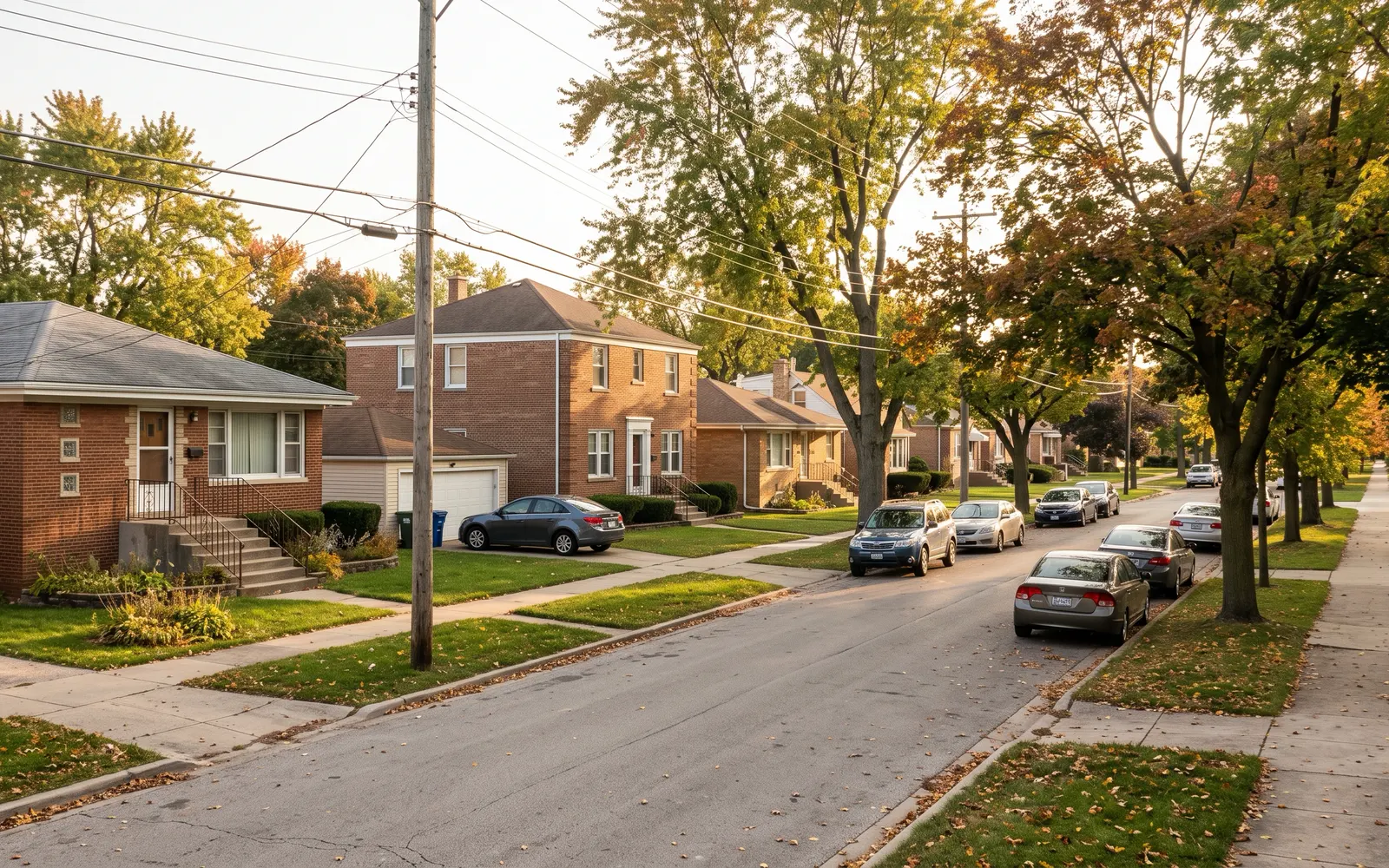
The original village: Irving Park to Montrose. The 1948 core, bounded by Irving Park Road, Ozanam Avenue, Montrose Avenue and Harlem Avenue, with Village Hall at 4000 N. Olcott Ave. and the Harlem Irving Plaza at its east end. Mostly brick houses from the late 1940s and 1950s. Blocks close to Harlem and Irving Park live with mall and arterial traffic; blocks toward Ozanam are quieter.
Montrose to Lawrence: the 1954 annexation. The middle of the village, home to Ridgewood High School) at 7500 W. Montrose Ave., the James Giles School at 4251 N. Oriole Ave., the John V. Leigh School at 8151 W. Lawrence Ave., the Norridge Park District's recreation center at 4631 N. Overhill Ave. and the former Divine Savior church property now being planned as a new civic campus. Most of this area feeds Norridge School District 80.
North of Lawrence to Foster. The northwest part of the village around Pennoyer School at 5200 N. Cumberland Ave., at Foster. The village page says Norridge students in the northwest part of the village attend Pennoyer, and that Pennoyer graduates go on to Maine Township High School District 207. This is the part of Norridge closest to O'Hare.
West of Cumberland: the Leyden Township piece. The roughly 1,940 residents the Census places in Leyden Township live here, west of Cumberland toward the forest preserves along the Des Plaines River. Schiller Woods-East has its entrance on Irving Park Road just west of Cumberland. A Jewel-Osco sits at 4734 N. Cumberland Ave., though its listed mailing address is Chicago.
The Harlem Avenue edge and the east side. Norridge's eastern blocks run along Harlem Avenue, where the village meets Harwood Heights and Chicago, and the village's annexations reached east toward Sayer Avenue. Union Ridge School District 86 says it serves parts of Harwood Heights and Norridge, generally bounded by Gunnison on the north, Harlem on the west, Forest Preserve Drive on the south and Nagle on the east. If a listing near Harlem says Norridge, confirm the village, the school district and the tax code together.
What Norridge Homes Look Like, by Type and Era
Norridge is a detached-house village from one era. The 2020-2024 Census ACS counts 4,359 detached single-family homes, 72.6% of all units. Buildings with two to four units add 5.4%, and buildings with five or more units add 20.4%, including 544 units in buildings of 50 or more. Townhomes and other attached houses are only 1.3%, so there is not much middle ground between a house and a condo here.
The age profile is tighter than in most suburbs. The same survey puts the median year built at 1962. About 32.3% of homes were built in the 1950s and 25.9% in the 1960s, so 58.2% date from those two decades alone. Only 7.4% were built before 1940, and only 7.4% were built in 2000 or later. That matches the village's own history: most of the farmland and stables were subdivided for homes in the late 1940s and 1950s.
The bedroom mix follows. Three-bedroom homes are 49.9% of the stock, two-bedroom homes 23.0% and four-bedroom homes 14.0%, with 3.0% at five or more. The ACS puts the median value of owner-occupied homes at $374,900 and median gross rent at $1,433. Both trail current sale prices, because the survey averages five years and relies on owners' own estimates.
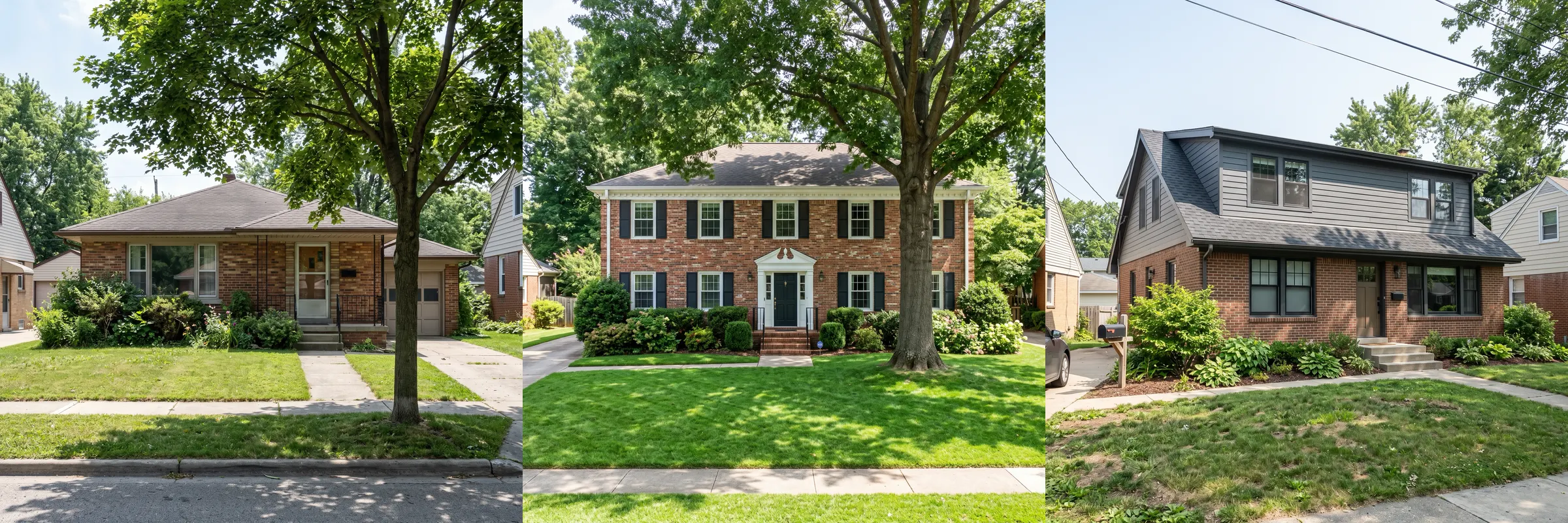
In practice that means three purchases under one name. There is the original brick ranch, raised ranch or Cape Cod from the 1950s, often with a finished basement and a detached garage off an alley. There is the expanded or rebuilt house, where an owner added a second story or rebuilt on the lot, often at twice the square footage of its neighbors. And there is the condo in one of the larger buildings along the main roads. I price them off different comparable sales, and I'd tell you the same thing I tell every buyer here: a second story added in 1995 and one added in 2020 are different houses, even when the listing photos look alike.
The 1950s house has its own checklist. Look at the age of the electrical service and panel, the sewer line to the street, the sump pump and the drain tile, and ask about any water in the basement. In Norridge, look ahead to the village's transfer inspection too, which checks the water meter, backflow protection and code items before closing. My home inspection checklist covers what to ask your own inspector.
The Norridge Housing Market in 2026
Norridge prices rose this summer. In the three months ending August 2026, Redfin reported a median sale price of $455,199, up 11.0% from a year earlier. It counted 44 homes sold in August, up from 39 a year before. The median home sold in 43 days, three days faster than last year, at 99.0% of list price, and 30.3% of homes sold above asking.
The rest of Redfin's numbers describe a market that rewards good pricing. Price per square foot was $337, up 5.0%. About 18.8% of listings took a price cut, almost unchanged from last year. Redfin gives Norridge a Compete Score of 61 out of 100, which it calls somewhat competitive, and says some homes get multiple offers: the average home sells about 2% below list and goes pending in about 44 days, while the hot homes sell about 1% above list in about 33 days.
Zillow's home value index moved more slowly. It put the typical Norridge home at $422,384 in August 2026, up 7.2% from August 2025 and, by my math, 20.2% from August 2023. The gap between the two sources is about mix. Redfin's median is the middle of what sold this summer, and a small village's summer sales can tilt toward bigger or updated houses. Zillow's index estimates every home, including the condos. Both agree on direction.
For context against the neighbors, Zillow's August 2026 index put Harwood Heights at $391,634, Elmwood Park at $359,481, Des Plaines at $358,473, River Grove at $324,957, Franklin Park at $325,395, Schiller Park at $316,417, Niles at $421,137 and Park Ridge at $597,562. Norridge sits at the top of the near-west group, level with Niles and well below Park Ridge. If you are working out a budget, my guide to how much house you can afford is a good place to start.
Norridge Property Taxes: Cook County's Three-Year Cycle
Norridge's property tax rate is lower than many of its neighbors'. Ownwell's Cook County data for Norridge, updated April 13, 2026, puts the median effective rate at 2.08% and the median annual bill at $6,483. The Cook County median effective rate on the same page is 2.14%.
The tax base is unusual for a village this size. CMAP's snapshot, using state data, shows $457.9 million of the village's $650.8 million equalized assessed value in 2024 was residential, about 70%. Commercial property was $183.2 million, about 28%, and commercial property shares the local levy with homeowners. That is general information about how a levy is spread, not a finding that it explains the rate.
Cook reassesses one-third of the county each year. Both of Norridge's townships, Norwood Park and Leyden, are in the north suburbs group, which the assessor's reassessment schedule shows was reassessed in 2025. The assessor's March 2025 Norwood Park Township release said the township, which includes Norridge, Harwood Heights and Park Ridge, saw total assessed value grow 24% over the three years since 2022. It reported a 2024 median single-family sale of $398,000 against the assessor's median estimate of $380,000, and said the 2025 values affect second-installment bills issued in 2026. By my count, the next reassessment falls in 2028.
The bills come in two pieces. For tax year 2025, the first installment was due April 1, 2026, and the second is due October 1, 2026, per the Cook County Treasurer. The second-installment bills were mailed September 1, later than usual because of the county's tax system overhaul, according to Cook County. If you close this fall, ask your attorney how the proration handles that bill.
Here is what the rate looks like on a real purchase. At this summer's $455,199 median, 2.08% works out, by my math, to about $9,470 a year, or $790 a month. Many current bills are lower because assessments trail sale prices, and the mistake I see most is buyers budgeting off the seller's bill, which may include exemptions the buyer won't qualify for. The Cook County homeowner exemption takes $10,000 off the equalized assessed value of an owner-occupied home, and new owners have to apply for it. This is general information, not tax advice. Your bill depends on your parcel, your exemptions and the assessor.
Norridge's Transfer Stamp and Pre-Sale Inspection
This is the part of a Norridge sale that surprises sellers from other towns. Norridge does not charge a village transfer tax; the ATG summary of the village ordinance, updated March 4, 2025, lists no fee for the stamp. But the village will not issue the stamp until the property passes an inspection, and the seller is the party liable.
The village's transfer page lays out the steps. You complete a transfer application, pay a $100 fee and submit a copy of the contract, plus the MLS listing if an agent sold the house. It has to be done in person; the village does not accept faxed copies or schedule by phone, and it will not take partial paperwork. The village recommends allowing at least 15 days before closing. The inspection covers residential and commercial property, and the Building Department gives the list of violations to the agent representing the property.
Then someone fixes the list. Either the owner makes the corrections, or the buyer can sign an agreement accepting responsibility for violations related to zoning or water, with 30 days after closing to correct them and call for a reinspection. If the buyer plans to demolish the house, a 90-day agreement covers the Cook County demolition permit, the water shutoff and upkeep of the empty property.
The water department runs its own check. Its transfer inspection page says the inspector will look at the water meter and its transmitter, which must be accessible, sealed and tagged; a missing or removed seal can mean a $1,000 fine under the village code and a failed inspection. It checks backflow protection under the Illinois Plumbing Code: a boiler used for heat needs a dual check valve with a vent, hose connections inside and out need vacuum breakers, and a lawn irrigation system needs an RPZ valve with a valid test report or has to be disconnected. The final water bill must be paid in cash or by check before the transfer certificate is issued, and final bills are not issued more than three business days before closing.
My advice to Norridge sellers is to schedule the inspection as soon as you have a signed contract, and to walk the house for the easy items before the inspector does: vacuum breakers on every hose bib, a visible meter, a tested backflow device if you have a boiler or sprinklers. Buyers should read the violation list closely and decide with their attorney whether to ask for repairs, a credit or the 30-day agreement. The Illinois Department of Revenue lists the Cook County transfer tax at 25 cents per $500 of value, or, by my math, about $228 on a $455,000 sale. My Illinois closing costs guide covers the rest.
Norridge Schools: Five Districts, Two High Schools
Norridge is split among more school districts than most villages its size. Per the village history and Wikipedia, three elementary districts serve Norridge addresses: Norridge School District 80, Pennoyer School District 79 and Union Ridge School District 86. Two high school districts do: Ridgewood Community High School District 234 and Maine Township High School District 207.
Most of the village is in District 80, which has two schools. The John V. Leigh School at 8151 W. Lawrence Ave. serves pre-kindergarten through fourth grade, and the James Giles School at 4251 N. Oriole Ave. serves grades 5 through 8, per Wikipedia's district entry. The National Center for Education Statistics counts 1,111 students in the district in the 2024-25 school year. Giles is the older of the two; the village page says the current building on Oriole dates to 1928 and Leigh to 1958.
The northwest part of the village goes to Pennoyer School, a single pre-K to 8 school at 5200 N. Cumberland Ave. that serves parts of Norridge, Harwood Heights and unincorporated Norwood Park Township, with 419 students in 2024-25 per NCES. The village page says Pennoyer graduates attend Maine Township High School District 207. Pennoyer's own site asks people to call the office to confirm an address and not to rely on any other source. Part of the east side goes to Union Ridge School at 4600 N. Oak Park Ave. in Harwood Heights, with 664 students in 2024-25 per NCES.
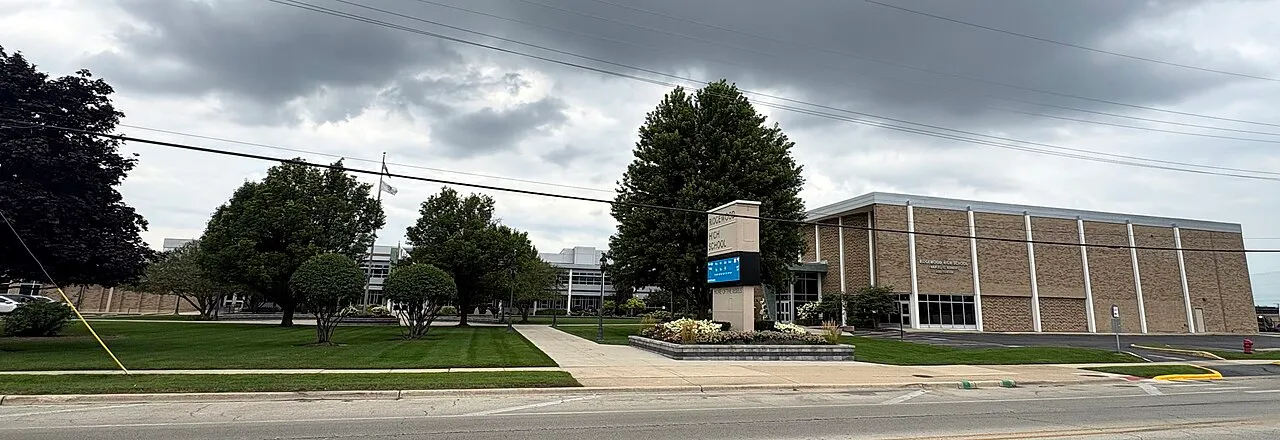
High school for most of the village is Ridgewood High School, 7500 W. Montrose Ave., founded in 1960, which serves parts of Norridge, Harwood Heights and unincorporated Norwood Park Township. NCES counts 988 students in 2024-25, a small high school by suburban standards. The Pennoyer area feeds District 207, and Wikipedia names Maine South as the District 207 school for that part of Norridge.
Assignment is by address, and in a village with five districts that is the whole game. Confirm every address with the district before you write an offer, and ask me for the boundary check if you want it done on a specific house. I don't rank schools on this page. The Illinois Report Card has each school's own data.
Norridge School District 80. John V. Leigh School (8151 W. Lawrence Ave., pre-K to 4, also the district office) and James Giles School (4251 N. Oriole Ave., grades 5 to 8).
Pennoyer School District 79. Pennoyer School (5200 N. Cumberland Ave., pre-K to 8), serving the northwest part of the village.
Union Ridge School District 86. Union Ridge School (4600 N. Oak Park Ave., Harwood Heights, pre-K to 8), serving parts of Norridge and Harwood Heights.
Ridgewood Community High School District 234. Ridgewood High School (7500 W. Montrose Ave., grades 9 to 12).
Maine Township High School District 207. Serves the Pennoyer area of Norridge; Wikipedia names Maine South (1111 S. Dee Rd., Park Ridge) for that area.
Commuting from Norridge: No Metra Station, Three Options Nearby
Norridge has no Metra station and no CTA rail station inside the village. What it has is three rail lines within a short drive, and which one you use depends on which end of the village you live in.
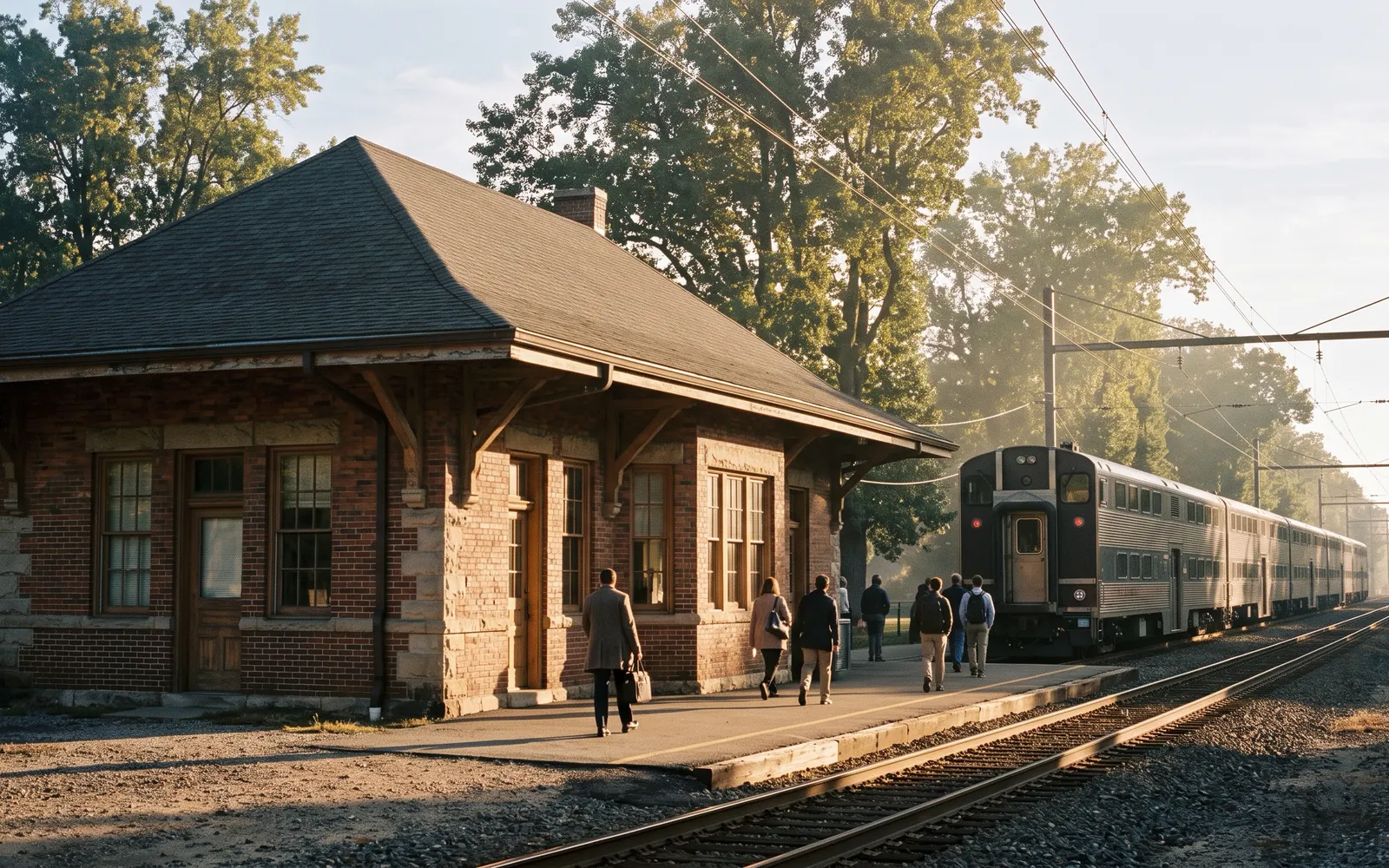
The closest Metra stop for most of Norridge is Norwood Park on the Union Pacific Northwest line, in Chicago's Norwood Park neighborhood northeast of the village; by my math it is about 2.3 miles in a straight line from the village's center point. According to Metra's schedule data for the week of September 28, 2026, 25 of the line's 39 weekday inbound trains stop there, with 25 back. The ride to Ogilvie Transportation Center takes 26 to 29 minutes. Inbound departures before 8:30 a.m. are 5:14, 5:44, 6:14, 6:45, 7:20, 7:45 and 8:20, and midday trains leave at 44 minutes past each hour. The fastest ride home from Ogilvie is 22 minutes. Saturdays have 16 inbound trains and Sundays 9. The station's 1907 depot is on the National Register of Historic Places, and Wikipedia lists street-side parking only, so check the parking before you count on it.
The Milwaukee District West line, into Union Station, is the southern option. Metra's schedule data for the same week shows 20 weekday inbound trains at the Elmwood Park station, with rides of 27 to 35 minutes (median about 29.5), and pre-8:30 a.m. departures at 5:04, 5:41, 6:49, 7:22, 7:53 and 8:22. River Grove has 20 as well, at 29 to 38 minutes, and Chicago's Mont Clare stop has 20 at 25 to 33 minutes. Saturday service at Elmwood Park is 12 inbound trains and Sunday 9. My Elmwood Park and River Grove guides cover those stations in detail.
The CTA Blue Line is the third option and the one that runs all day. Its O'Hare branch stops at Harlem), 5550 N. Harlem Ave., which has 53 parking spaces, and at Cumberland), 5800 N. Cumberland Ave., which has 1,633 spaces. By my math each is about 1.5 miles in a straight line from the center of the village. The Blue Line runs to downtown in one direction and O'Hare in the other.
Buses fill in. Per Wikipedia, CTA routes 78 Montrose, 80 Irving Park and 90 Harlem serve the Harlem Irving Plaza. The village also runs its own free bus within village limits, subsidized by Pace, on Mondays, Wednesdays and Fridays from 8 a.m. to 3 p.m. (no service from noon to 1).
Most people drive. The 2020-2024 ACS shows 77.7% of Norridge workers driving alone, 6.2% carpooling, 8.9% working from home and only 2.3% on public transit. CMAP puts the average commute at 34.2 minutes, longer than the Cook County average of 31.5.
Driving from Norridge: Harlem, Cumberland and Two Expressways
Norridge is an arterial-road village. The village's hazard plan annex notes that Interstates 90 and 294 both run next to Norridge, and that O'Hare is one mile directly north. Neither expressway runs through the village, so the daily drive starts on the surface streets.
Harlem Avenue (Illinois 43) on the east side and Cumberland Avenue (Illinois 171) through the west side are the big north-south roads, and both lead north to Blue Line stations and the Kennedy. Irving Park Road, Montrose Avenue, Lawrence Avenue and Foster Avenue run east-west. The corner of Harlem and Irving Park, at the Harlem Irving Plaza, is where I'd expect the heaviest weekend shopping traffic, so drive it on a Saturday.
For a Loop commute by car, the Kennedy is the usual route, and it is worth driving it from the house at rush hour before you decide. If you are choosing between two houses, drive both to your job at 7:30 a.m. and back at 5 p.m.
O'Hare Noise in Norridge: What to Know and How to Check
With O'Hare one mile north, airport noise belongs on every Norridge buyer's checklist. The village takes part in the formal process: Norridge is a member of the O'Hare Noise Compatibility Commission, which counts 43 communities and 18 school districts working on aircraft noise around O'Hare. The village president is its primary representative, and School Districts 80, 86 and 234 are members too.
The main nighttime tool is the Fly Quiet program. In August 2022 the commission approved a new Fly Quiet plan with six runway configurations that alternate weeks between the north and south airfields and between east and west flow, to spread nighttime noise and make it more predictable. For a buyer that means the same house can have a quiet week and a loud week.
Sound insulation depends on a map. The O'Hare Residential Sound Insulation Program covers homes that qualify under the O'Hare Modernization Program's full build-out noise contour, per the commission's eligibility page, and the Chicago Department of Aviation says more than 12,029 homes near O'Hare have been insulated at a cost of more than $385 million. Whether a given Norridge house is inside that contour, or was already insulated, is an address-by-address question. If the seller's house was insulated, ask for the paperwork.
Here is how I check a specific house. First, look the address up on the CDA's property locator to see where it sits against the noise contour. Second, use the CDA's flight tracker, linked from its sound insulation page, to watch flight paths over the block on a few different days. Third, visit at different times: a weekday evening and a late night, and ideally in weeks with different runway rotations. The north end of the village, closest to the airfield, is where I'd spend the most time listening.
Is Norridge Walkable?
Some errands are walkable; most trips are a drive. Walk Score does not publish a village-wide score for Norridge, but it counts about 100 restaurants, bars and coffee shops in the village and says people can walk to an average of three within five minutes.
The land use explains the pattern. CMAP's 2023 land use inventory shows 53.7% of the village's 1,157 acres in single-family homes, 9.5% commercial, 6.4% institutional such as schools and churches, and 25.2% in transportation and other uses, mostly streets. It records almost no open space inside the village line, 0.3 acres, because the big green spaces nearby, the park district's main park and the forest preserves, sit just outside it. The ACS shows 2.9% of Norridge workers walking to work.
Where you live decides it. A house south of Montrose near Harlem can walk to the Harlem Irving Plaza, a grocery run and a bus on Harlem or Irving Park. A house north of Lawrence is a quiet residential block that is a drive to almost everything except school. The sidewalks are there: the village counts 55 miles of them, and the grid is regular, so walking and biking inside the village are easy. The shops and services are what sit far apart.
The Harlem Irving Plaza and Everyday Errands in Norridge
Norridge is a shopping destination, and the numbers show it. CMAP's snapshot, using Illinois Department of Revenue data, shows $523.5 million in retail sales in the village in 2025, or $33,907 per resident, well above the Cook County figure of $23,200. General merchandise alone was $450.3 million. Most of that comes from one place.
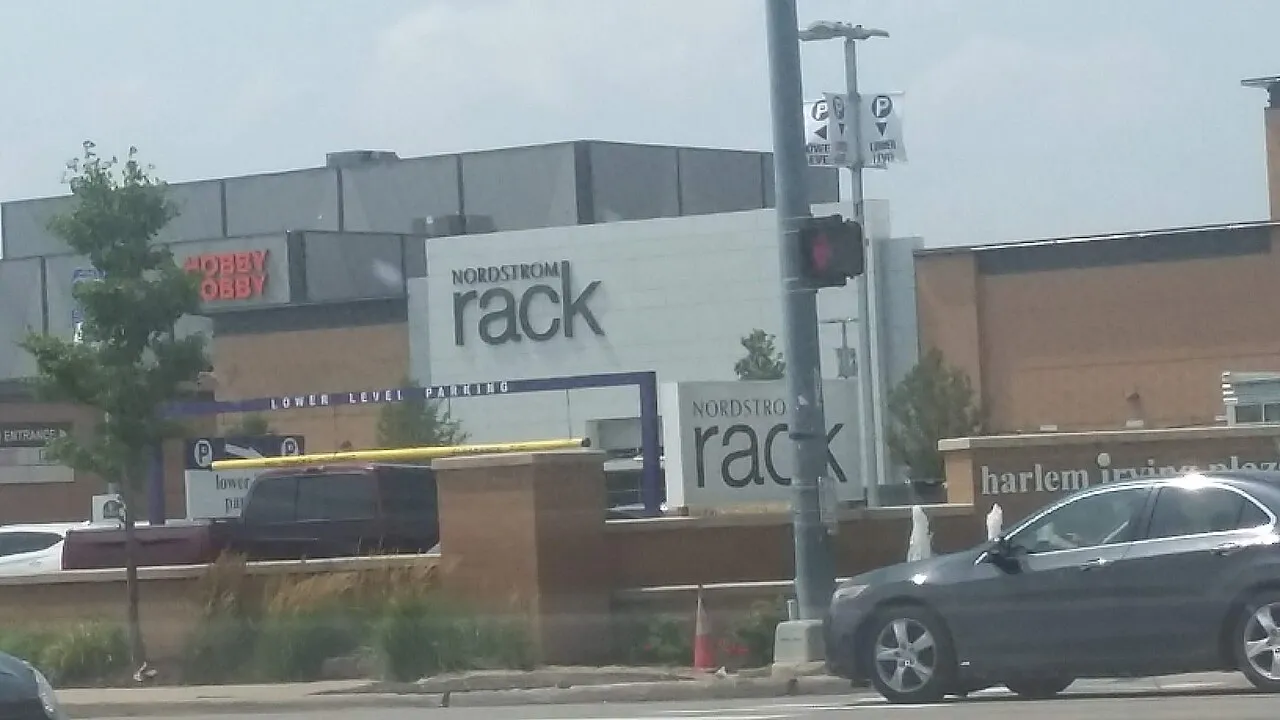
The Harlem Irving Plaza, known locally as the HIP, sits at 4104 N. Harlem Ave. It opened in 1956 as a 337,000-square-foot strip mall with about 45 tenants, was enclosed between 1975 and 1979, and now covers about 725,000 square feet with parking for about 2,600 cars, per Wikipedia. Its anchors include Target, which opened a 175,000-square-foot store there in 2004, Kohl's, Best Buy, Nordstrom Rack, Hobby Lobby, Dick's Sporting Goods, DSW and Five Below. The former Carson's space was rebuilt into a three-level atrium, and a Toys"R"Us store opened on October 26, 2024. The mall has a food court, added in 1996.
For a buyer, the HIP is both a convenience and a factor. Living a few blocks away puts Target and a dozen chains within walking distance. It also means holiday and weekend traffic on Harlem and Irving Park, and parking-garage lights and deliveries for the blocks right next to it. I'd walk the streets behind the mall at 8 p.m. on a Saturday before buying on one of them.
For groceries, the Target at the HIP carries food, and Jewel-Osco has a store at 4734 N. Cumberland Ave., on the west side of the village near Lawrence, open 6 a.m. to midnight; Jewel lists its mailing address as Chicago. Beyond that, residents shop along Harlem and Irving Park and in the neighboring Chicago neighborhoods, and which store you use depends on which end of Norridge you live in.
Where Norridge Eats
Most of Norridge's restaurants are on the arterials. Walk Score counts about 100 restaurants, bars and coffee shops in the village, and in practice they cluster along Harlem Avenue, Irving Park Road, Cumberland Avenue and Lawrence Avenue, with a food court and chain restaurants at the Harlem Irving Plaza. Per Wikipedia, a 2013 expansion of the mall added a Panera Bread and a Chipotle.
I don't try to rank restaurants here, because the list turns over and the best places in a village like this are the ones you find on your own block. The advice I give buyers is to eat near each house you are serious about. It is the fastest way to learn which part of Norridge you'd actually use day to day. A house near Harlem and Irving Park gets you a walkable meal and a lot of choice. A house north of Lawrence gets you a short drive, or a trip into Harwood Heights, Chicago's Norwood Park and Jefferson Park, or Park Ridge.
The village's own summer and fall calendar adds a few more. The Thursday cruise nights and the park district's special events usually include food vendors, and they are a good way to see a neighborhood on a weeknight.
Parks, the Pool and the Forest Preserves Around Norridge
The Norridge Park District, established in 1955, serves Norridge and parts of Harwood Heights. It manages 20.3 acres of parks and open space and four facilities: the Norridge Recreation Center, the Recreation Center East, the Pool and Fitness Center, and an early care and preschool program. The main offices are at 4631 N. Overhill Ave.
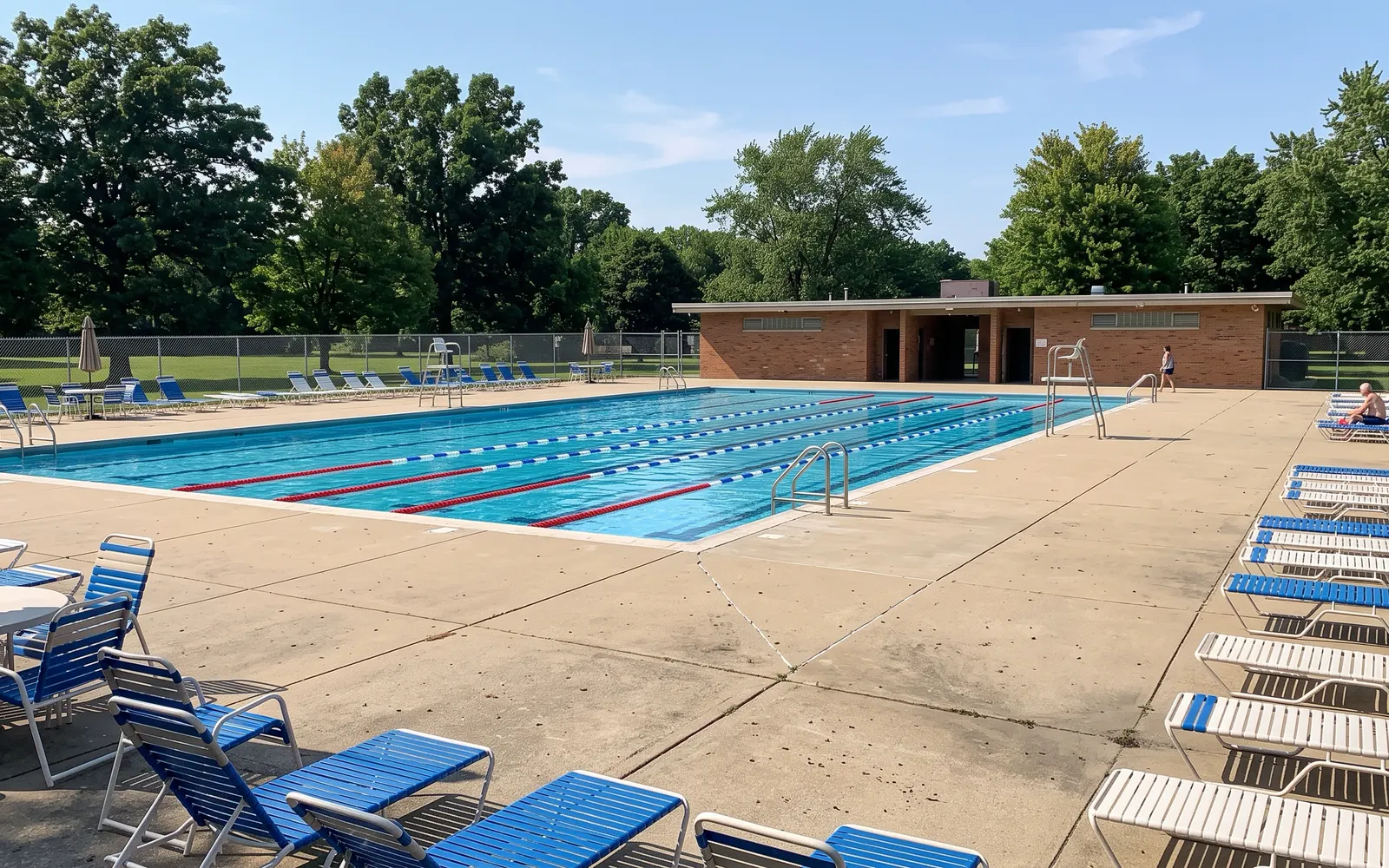
The main park carries most of the load. The district says it has two playgrounds, four ball fields, six basketball courts, four pickleball courts, two tennis courts, a futsal court and two bocce courts. The pool has a six-lane lap pool, a zero-depth leisure pool, a splash pad, two water slides, two diving boards and a drop slide, and the fitness center has 1,600 square feet of equipment. The district also keeps the smaller Iron Ball Playground at Montrose and Octavia. The village history adds a local quirk: the park district bought the main park's 20.3 acres, between Lawrence, Wilson and Overhill, on June 1, 1957, but the land stayed within Harwood Heights, whose police patrol it.
The bigger open space is next door. The Forest Preserves of Cook County run along the Des Plaines River just west of the village. Robinson Woods, 265 acres, has its south entrance on Lawrence Avenue west of East River Road, with picnic groves, trail access and on-leash dog walking. Schiller Woods has its east entrance on Irving Park Road just west of Cumberland, with picnic groves, sledding and fishing at Schiller Pond. Both connect to the Des Plaines River Trail, which runs about 28.4 miles. From much of the west side of Norridge, you can be on a forest trail in a few minutes.
The Eisenhower Public Library: Norridge's Library, Shared with Harwood Heights
Norridge shares its library with Harwood Heights. The Eisenhower Public Library District serves residents of both villages from a building at 4613 N. Oketo Ave., in Harwood Heights. Per Wikipedia, the library started in 1972 in the basement of an apartment building on Harlem Avenue, with a bookmobile; until then, Chicago had provided library service to the two villages. Voters approved a library district in 1973, and after two failed referendums, a 2003 referendum paid for the current 44,576-square-foot building, completed in January 2008 and certified LEED Silver.
According to the library's website, it is open 9 a.m. to 9 p.m. Monday through Thursday, 9 a.m. to 5 p.m. Friday and Saturday, and 1 to 5 p.m. Sunday. Wikipedia lists study rooms, a computer lab, a quiet room with a fireplace and a local history display room. For anyone working from home, it is the quietest desk in 60706.
The village's own history collection is separate. The Steve Nosko Norridge Historic Collection and a veterans and village museum are at the Estelle Sieb Community Center, 7774 W. Irving Park Rd., per the village history page.
Utilities and Village Services in Norridge
Norridge drinks Lake Michigan water bought from the City of Chicago. The village history page says the village has three storage reservoirs, one above ground and two underground, holding 2.25 million gallons, and 30.5 miles each of sanitary and storm sewers. The village's hazard plan annex describes a 20-year capital plan for the water system, with one pump house upgraded, water tower work scheduled for 2024, the second pump house scheduled for 2025 and a storm water lift station upgrade.
Garbage is a village service. Per the village's garbage page, each home gets a black village garbage cart, recycling goes in a green bin or blue cart, and carts can go out only after 6 p.m. the night before pickup. Yard waste pickup runs April 1 through November 30 in brown bags or marked 30-gallon containers. The village holds two clean-up weeks a year, and this fall's is October 19 to 23, per the village calendar. Electronics can't go in the regular trash under state law.
Two practical notes for sellers, covered in the transfer section above. The water meter has to be accessible and sealed at the transfer inspection, and the final water bill must be paid before the transfer certificate is issued. Plan both early.
Norridge's Fall 2026 Calendar
Norridge's calendar runs on small village events. The village calendar lists Weekly Cruise Nights on Thursdays from 5 to 9 p.m., with the final one of the season, paired with a Truck or Treat, on October 15, 2026. It also lists Coffee with the Mayor and Village Board on October 3, a pet vaccination clinic on October 10, trick-or-treat hours from 1 to 8 p.m. on October 31, the second annual Pumpkin Smash on November 7, a Veterans Day observance on November 11 and the annual tree lighting on November 28 from 4:30 to 6 p.m.
The park district's calendar adds its own. Bears and Brews is on October 11, the Halloween Spooktacular runs from 11 a.m. to 3 p.m. on Saturday, October 17 at the Norridge Recreation Center, with pumpkins, hay rides, games and live entertainment ($10 for residents, $16 for non-residents), and a pumpkin carving event is on October 24.
If you are touring houses on a fall Thursday, stop at a cruise night. It tells you more about how the village spends a weeknight than a listing will.
What's Being Built in Norridge: The Montrose Civic Campus
Norridge is fully built out, so the one large project in front of the village is a redevelopment. The village acquired the former Divine Savior church property on Montrose Avenue, between Ozanam and Overhill, and on July 29, 2026 it held a public open house on two preliminary concepts for a new civic campus, per the village's announcement and its project overview.
The overview says the village bought the property to address the space needs of Village Hall and the Police Department. Both concepts include a new Village Hall with a veterans museum and community meeting space, a new police station, a central village green and events area, and neighborhood shops and cafés along Montrose. One concept puts townhomes along Ozanam and Sunnyside Avenues; the other puts condominiums along Sunnyside. The village says it is exploring a tax increment financing district to help pay for public improvements, since the property is currently tax-exempt.
The timeline is early. The overview lists a December 2025 kickoff, preliminary concepts in January and February 2026, refined concepts in August and September 2026, and a final concept and second public meeting still to be scheduled. It says final design and construction depend on funding. The concepts are preliminary, and I'd treat any specific building on those drawings as a proposal until the Village Board votes.
For buyers near Montrose, Ozanam and Sunnyside, this is worth watching. A civic campus with a green and some retail could make those blocks more walkable, and new townhomes or condos would add a housing type the village has very little of today. It also means construction, and possibly more traffic, on those streets in the years ahead.
I don't label any town or neighborhood as safe or unsafe.
Flood Risk in Norridge: No Floodplain, Real Basement Risk
Flood risk in Norridge is not about rivers. The village's 2024 hazard plan annex says FEMA has advised that Norridge is not in a floodplain, that there are no FEMA-identified repetitive-loss properties in the village, and that the countywide flood insurance rate map in effect dates from August 19, 2008. The Des Plaines River is about half a mile from the west boundary.
The risk is heavy rain. Redfin, using First Street's model, rates Norridge's overall flood risk as major and says 875 properties are likely to be severely affected by flooding over the next 30 years. That is a model of rainfall and drainage, not of a river overflowing its banks. The hazard plan backs it up: it lists storms that caused street and basement flooding in the village, including 7.26 inches of rain on September 13, 2008, 4.25 inches on July 22, 2011 and three storms in 2013, and flash flooding with 2.63 inches on August 7, 2018. It says several areas are prone to flooding, some of them low-lying former natural creek areas, particularly along Oketo and Octavia Avenues.
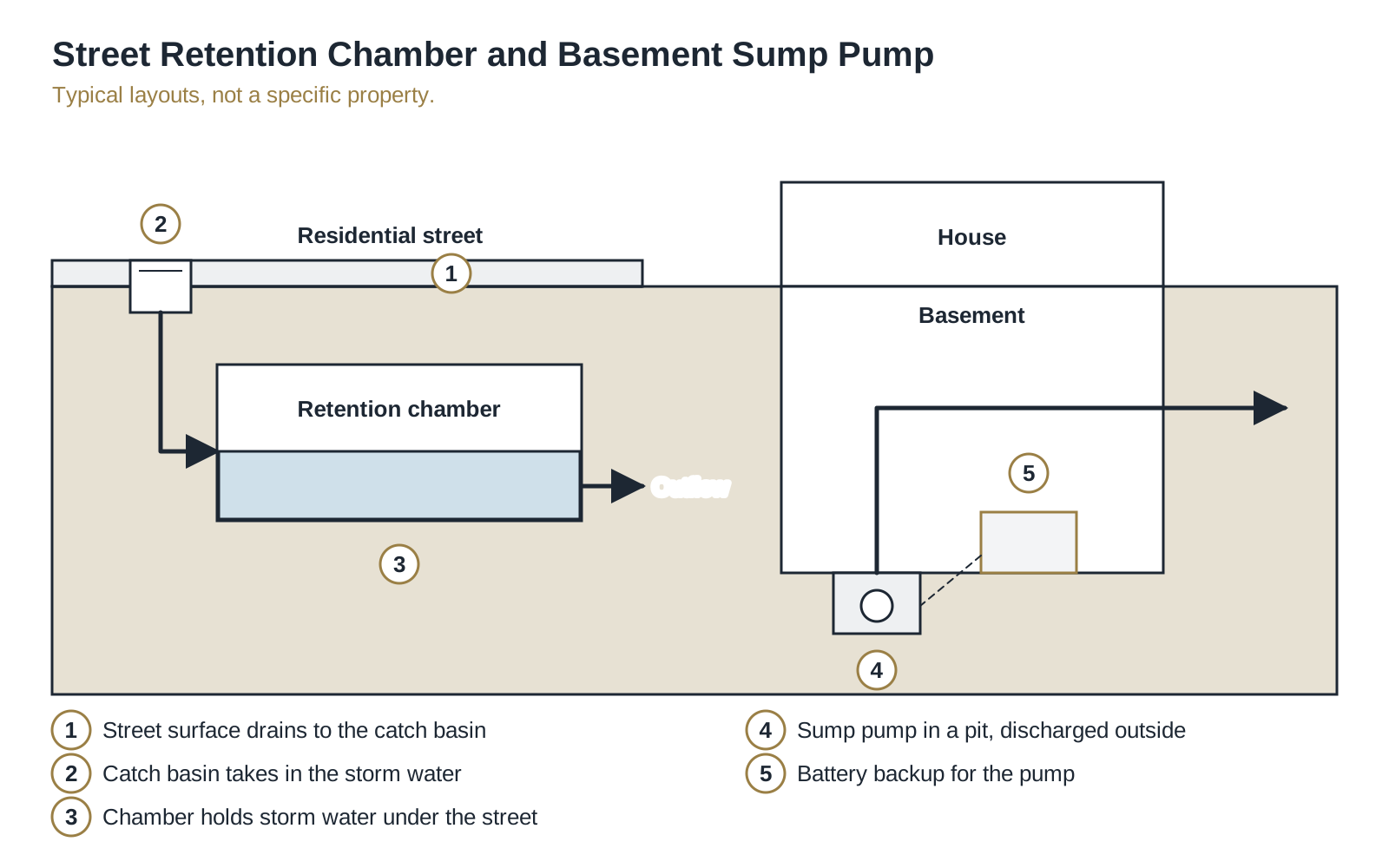
The village has a list of fixes. The plan names underground storm water retention chambers under the streets at Octavia and Belle Plaine, Ozanam and Belle Plaine, and Osage and Wilson; a joint project with Harwood Heights near the Eisenhower library at Oketo and Wilson to enlarge drainage sewers; and a joint project with the Forest Preserves to expand the reservoir at Montrose and Thatcher. One point in Norridge's favor: the village has separate storm and sanitary sewers, 30.5 miles of each, according to its history page.
Four checks before you write an offer. Look the address up on the FEMA flood map, even though the village is outside the mapped floodplain. Ask the seller directly whether the basement has ever taken water, and when. Have a sewer camera inspection done on the line to the street. And check the sump pump, its battery backup, the downspouts and the grading. On the blocks near Oketo and Octavia, I'd ask all four questions twice. If you are buying your first home here, these checks matter as much as the kitchen does.
Frequently Asked Questions
What county and township is Norridge, IL in?+
Cook County. Census Bureau estimates for 2025 put Norridge's 14,808 residents in two townships: about 12,868 in Norwood Park Township and 1,940 in Leyden Township, which covers the part of the village west of Cumberland Avenue. Both were reassessed by the Cook County Assessor in 2025.
How much does a house cost in Norridge, IL?+
Redfin reported a median sale price of $455,199 for the three months ending August 2026, up 11.0% from a year earlier. Zillow's home value index was $422,384 for August 2026. Original 1950s brick houses, expanded houses and condos trade as separate markets.
What are property taxes in Norridge, IL?+
Ownwell (April 2026) puts the median effective rate at 2.08% with a median bill of $6,483, below the Cook County median of 2.14%. At the $455,199 summer median, that rate works out to about $9,470 a year. Cook County reassesses every three years; Norridge's townships were revalued in 2025.
Does Norridge require an inspection before a home sale?+
Yes. The village requires a transfer stamp on every sale, and the stamp requires a Building Department inspection and a water department check of the meter seal and backflow devices. The application is $100, filed in person with the contract and MLS listing, ideally at least 15 days before closing. Norridge charges no village transfer tax.
What school district is Norridge, IL in?+
It depends on the address. Most of the village is in Norridge School District 80 (Leigh and Giles schools) and Ridgewood High School District 234. The northwest area is in Pennoyer District 79 and feeds Maine Township District 207, and part of the east side is in Union Ridge District 86. Confirm each address with the district.
Does Norridge have a Metra station?+
No. The closest Metra stop for most of the village is Norwood Park on the Union Pacific Northwest line, in Chicago, with 25 weekday trains each way in fall 2026 and a 26- to 29-minute ride to Ogilvie. The CTA Blue Line's Harlem and Cumberland stations are about 1.5 miles from the center of the village.
Is Norridge affected by O'Hare noise?+
It can be, depending on the block and the week. O'Hare is one mile north of the village, and the 2022 Fly Quiet program rotates nighttime runways weekly. Norridge is a member of the O'Hare Noise Compatibility Commission. Check the address on the Chicago Department of Aviation's property locator and visit at different times.
Does Norridge, IL flood?+
FEMA says Norridge is not in a floodplain, but heavy rain has flooded streets and basements, including in 2008, 2011 and 2013, per the village's hazard plan. First Street's model (via Redfin) counts 875 properties at severe 30-year flood risk. Ask about water in the basement and scope the sewer line.
Is Norridge part of Harwood Heights?+
No. They are separate villages with separate governments, but they share a ZIP code (60706), a library district and parts of their school and park districts, and together they form an enclave surrounded by Chicago. Check which village an address is in before comparing tax bills.
Eshu Chikoti has extensive access to off-market listings throughout Norridge and the rest of Cook County — homes that never make it to the public listing sites. That matters right now: in a seller's market like this one, well-priced homes routinely go under contract within days, and buyers relying only on public listings are competing for whatever is left over. Working with someone plugged into off-market inventory means seeing homes before the crowd does.
Eshu Chikoti · 847-691-4282 ·
Get new Norridge listings by email
When a home comes on the market in Norridge, I'll email it to you.
Just your email. Unsubscribe any time by replying.
Thinking About Norridge?
Whether you're buying, selling, or just curious what's on the market, I can walk you through Norridge street by street.