Palatine, IL
Palatine, IL is a Cook County village of about 66,000 people built around a downtown Metra station on the Union Pacific Northwest line, with Route 53 and I-90 close by and a summer 2026 median sale price near $395,000.
Living in Palatine, IL means a median sale price of about $395,000 this summer, a 40-minute express train from a walkable downtown to Ogilvie, and property tax near 2.66% of value. Most homes are 1950s to 1980s subdivision houses, townhomes and condos, and every one sits in Cook County. Here it is, pocket by pocket.
Written by Eshu Chikoti · 847-691-4282 ·
How Palatine, IL Got Here: From Deer Grove to a Railroad Village
Palatine started in the woods at its north edge. According to the Village of Palatine's history page, George Ela built a log cabin in Deer Grove in 1835 and is credited as the first European settler in the area. The Illinois and Wisconsin Railroad reached the Deer Grove Trading Post in 1853, and in 1855 Joel Wood surveyed and laid out the Village of Palatine. Wikipedia says the name is thought to come from a town in New York.
The railroad made the village. Palatine incorporated on April 2, 1866, around a station on what became the Chicago and North Western Railway, and the state chartered it in 1869. Two years later the village bought 12 street lamps for $3 each and hired a lamplighter for 50 cents a night, per the same village page. From 1911 to 1924 a short line, the Palatine, Lake Zurich and Wauconda Railroad, ran north out of town.
For almost a century Palatine stayed small. Wikipedia's census table shows 1,020 people in 1900 and 4,079 in 1950. Then the subdivisions arrived. The count was 11,504 in 1960, 26,050 in 1970, 39,253 in 1990 and 65,479 in 2000. The Palatine Historical Society's subdivision list, built from Daily Herald archives and plat books, shows why: Winston Park from 1957, Reseda from 1963, Hunting Ridge and Pepper Tree from 1967, Virginia Lake from 1965 to 1969. It also notes that the Route 53 extension forced homes in one 1963 subdivision along Northwest Highway to be demolished or moved.
Some of the old village is still standing. The George Clayson House, built in 1873 at 224 E. Palatine Road, was listed on the National Register of Historic Places on March 21, 1979, and the park district now owns it as a museum. The original 1928 Palatine High School is today the park district's Community Center, and its auditorium is Cutting Hall. If you are looking at a house in Palatine, most of what you will see was built in that 1955 to 1990 run, on land that was farms and woods within living memory.
Palatine at a Glance
Palatine covers about 14.25 square miles in northwestern Cook County, roughly 30 miles from the Loop and 14 miles from O'Hare, per the village's About page. Arlington Heights is to the east, Rolling Meadows and Schaumburg to the south, Inverness to the west and Deer Park and Lake Zurich to the north.
The county question is simple here. The Census Bureau's Vintage 2025 population estimates put all 65,842 residents in Cook County and none in Lake County. By township, 65,784 of them are in Palatine Township and 58 are in Wheeling Township. So every home with a village of Palatine address pays a Cook County tax bill on Palatine Township's assessment calendar. The same file counts 7,069 people in the part of Palatine Township outside any village, which is a reminder that a "Palatine" mailing address and the village limits are not the same thing.
The housing is a mix of owned and rented. The 2020-2024 Census ACS counts 28,469 housing units, with 67.4% of occupied homes owned and 32.6% rented. The rental share is mostly the apartment and condo buildings along Rand Road, Dundee Road and Northwest Highway.
Palatine is more of a place people live than a place people commute into. CMAP's June 2026 community snapshot counts 19,284 private-sector jobs in the village in 2025, or 0.71 jobs per household, against 1.07 for Cook County. Weber-Stephen Products, the grill maker, keeps its world headquarters here, per the village.
At a $395,000 summer median, it offers everything from a downtown condo to a four-bedroom colonial, with no village transfer tax and one county to learn.
Only 1.8% of homes were built since 2010, the village Walk Score is 41, and the 2.66% effective rate is above the county's 2.14%.
Palatine Neighborhoods, Pocket by Pocket
Palatine has no official neighborhoods, but it has more named subdivisions than most towns its size. The Palatine Historical Society's list runs from an 1876 plat near downtown to two 2024 infill projects, and most of the big ones came from a handful of builders between 1957 and 1970: Winston Park-Northwest Corp., Gleich Corp., Kaufman & Broad and Arthur T. McIntosh.
The easiest way to split the village is by road. Downtown sits around the Metra station, Slade Street and Northwest Highway, with the oldest streets and the newest condos. The land north of Palatine Road and west of Route 53 is the big Winston Park and Hunting Ridge area. The middle, between Plum Grove and Hicks Roads, holds Reseda, Pepper Tree Farms and Kenilwicke near Palatine High School. The north end along Rand and Dundee Roads carries most of the shopping, the car dealers and a lot of the apartments and condos. The south side near Harper College and Algonquin Road has late-1960s subdivisions and some of the newest houses in the village.
Below are the names you will see on listings. Build dates come from the historical society and an agent directory, and a few of them disagree, so treat them as a starting point. If you want to know which subdivision, school and park district a specific address falls in, that is a conversation I am happy to have here.
The expectation I most often have to reset with buyers in Palatine is that a ranch in Winston Park and a ranch near Virginia Lake are the same house. They were built by different companies a decade apart, on different lot sizes, and they can feed different schools. The subdivision name tells you more than the square footage does.
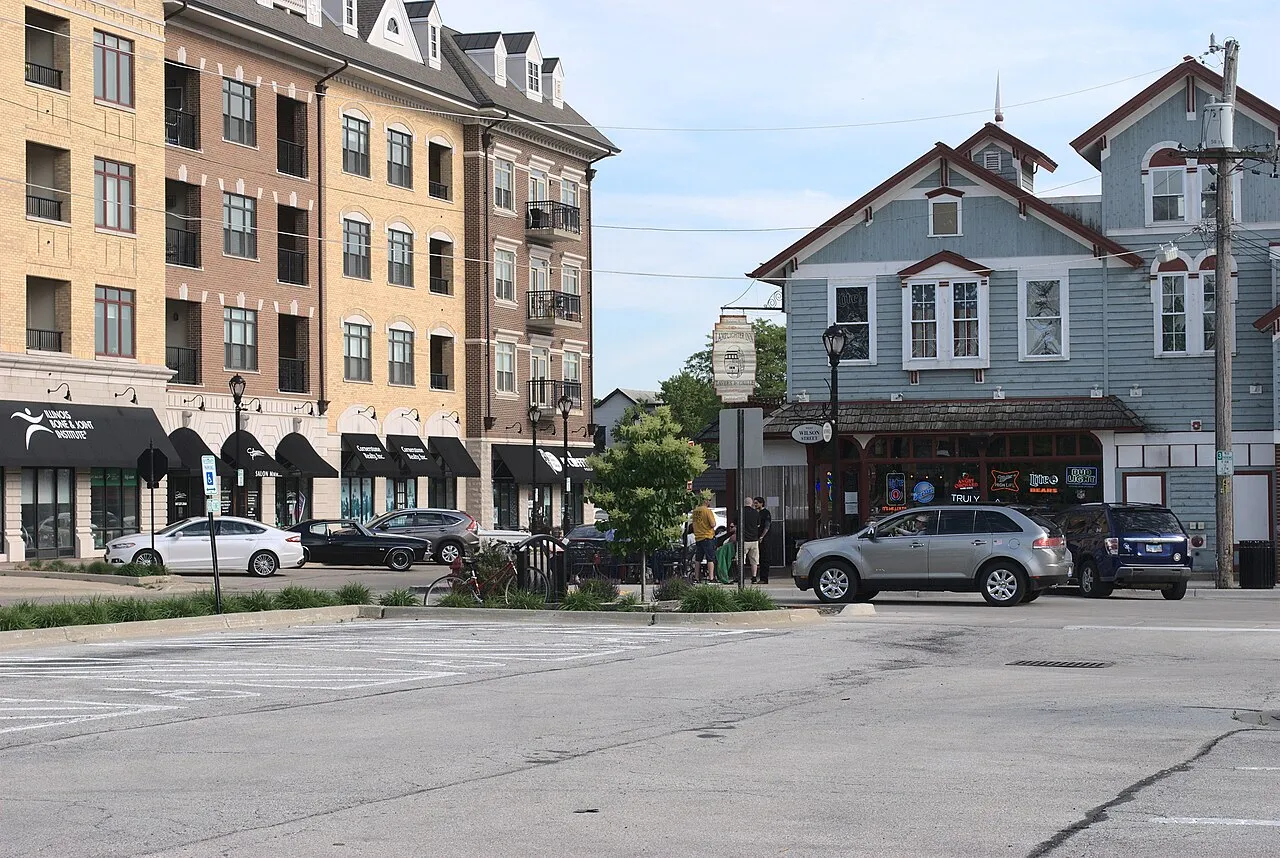
Downtown. The streets around the station, Slade, Brockway, Wood and Smith, include plats from 1876 to the 1920s, per the historical society. The village's TIF page says the downtown TIF district, created in December 1999, has added about 975 residential units, 93,000 square feet of restaurant and retail space and 120,000 square feet of office space. Two small infill projects, Olm's Corner and Slade Street Crossing, date to 2024. This is the condo and townhome end of the market.
Winston Park. Winston Park-Northwest Corp. sought 755 acres for annexation from 1957 to 1962 and planned 1,896 homes, per the historical society, which also records flooding there in 1962. An agent directory places it north of Palatine Road and west of Route 53, built in the 1950s and 1960s. Winston Park Northwest (1963), northwest of Wilke Road and Kenilworth Avenue, has streets named after astronauts.
Hunting Ridge. The same builder, approved in 1967 on 200 acres west of Quentin Road along Illinois Avenue. The historical society notes that it surrounds Fremd High School.
Reseda. Gleich Corp. built 271 homes at Reseda Parkway and Hicks Road on a former farm, starting in 1963, with Reseda II opening in 1966 and colonial-style Reseda West in 1968, per the historical society. An agent directory dates it to the late 1960s and early 1970s and places it west of Hicks Road and south of Dundee Road, close to the library, Palatine High School and downtown.
Pepper Tree Farms. Kaufman & Broad, from 1967, southeast of Smith Street and Dundee Road, advertised in 1970, per the historical society. The agent directory dates it to the late 1960s and early 1970s and puts it near Eagle Park and the Deer Grove forest preserve.
Kenilwicke and Heatherlea. Kenilwicke (Mor-Well Builders, 1968) is on the east side of Hicks Road south of Dundee Road, and Heatherlea (Kaufman & Broad, 1970) is on the west side, per the historical society. The agent directory says Kenilwicke is within walking distance of Palatine High School and the library.
Virginia Lake. Leslie Bezark's 187-home subdivision southwest of Route 53 and Rand Road, planned from 1965 with construction beginning in 1969, per the historical society. District 15 has an elementary school by the same name.
Cannongate and Cambridge at Palatine. Two 1968 subdivisions on the south side: Cannongate, 139 homes on 75 acres southeast of Roselle and Palatine Roads, and Cambridge at Palatine, 291 homes on 141 acres near Illinois Avenue east of Roselle Road.
Pleasant Hill. Pleasant Hill Estates was built on a former farm and opened in 1961, per the historical society, and Sutton Place followed in 1963 along Pleasant Hill Boulevard west of Plum Grove Road. Redfin tracks Pleasant Hill as its own neighborhood market.
Newer infill. Windhill (1991, northeast of Roselle Road and Euclid Avenue), Peregrine Lakes Estates (1998), Maison du Comte (2009, northwest of Algonquin and Roselle Roads) and Lexington Chase (2016, off Quentin Road) are among the few subdivisions built after 1990, per the historical society.
What Palatine Homes Look Like, by Type and Era
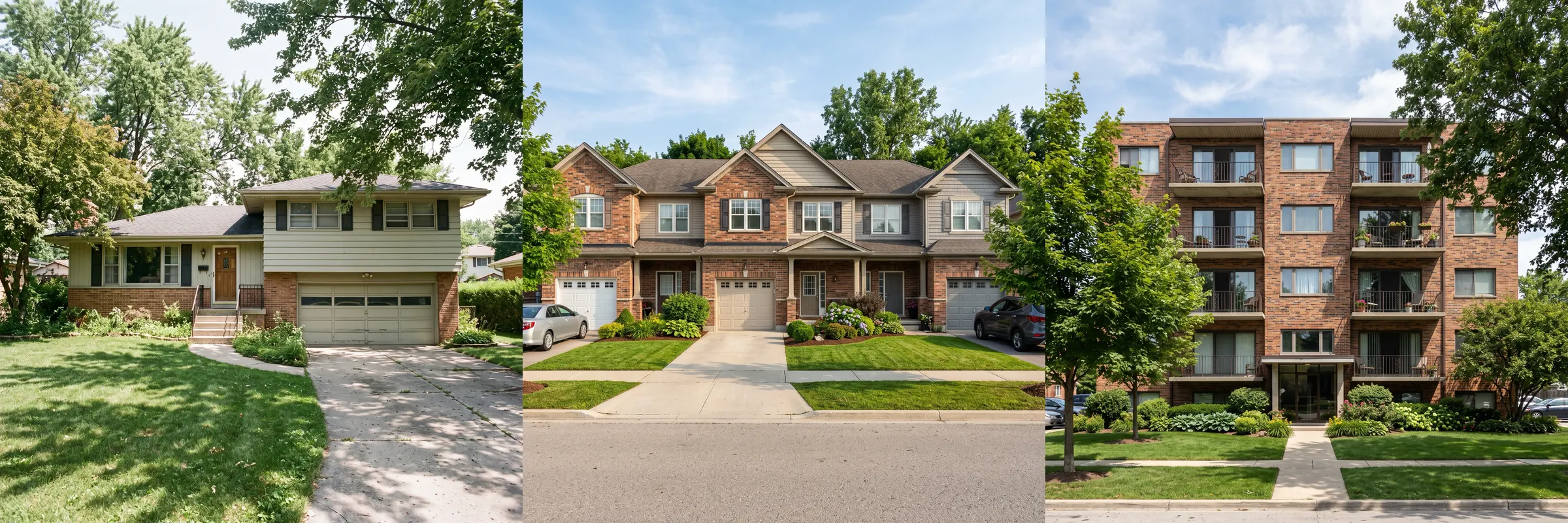
Palatine's housing is more mixed than its reputation. CMAP's snapshot, built on the 2020-2024 ACS, counts 12,089 detached single-family homes, 42.5% of all units, and 4,409 attached single-family homes such as townhouses, another 15.5%. Buildings of five to nine units add 16.2%, which is well above the Cook County share of 9.7%. Buildings of 20 or more units add 12.9%. So a little more than four in ten homes here are detached houses.
The era is concentrated. CMAP counts 45.5% of units built from 1970 to 1989 and 28.1% from 1940 to 1969, with a median year built of 1977. Another 21.4% date from 1990 to 2009, and only 1.8% were built in 2010 or later. The bedroom mix follows the product: 33.3% of units have two bedrooms, 28.0% have three, 20.4% have four and 4.2% have five or more. The four-bedroom share is higher than Cook County's 12.8%, which is the Winston Park and Hunting Ridge colonials and split-levels showing up in the data.
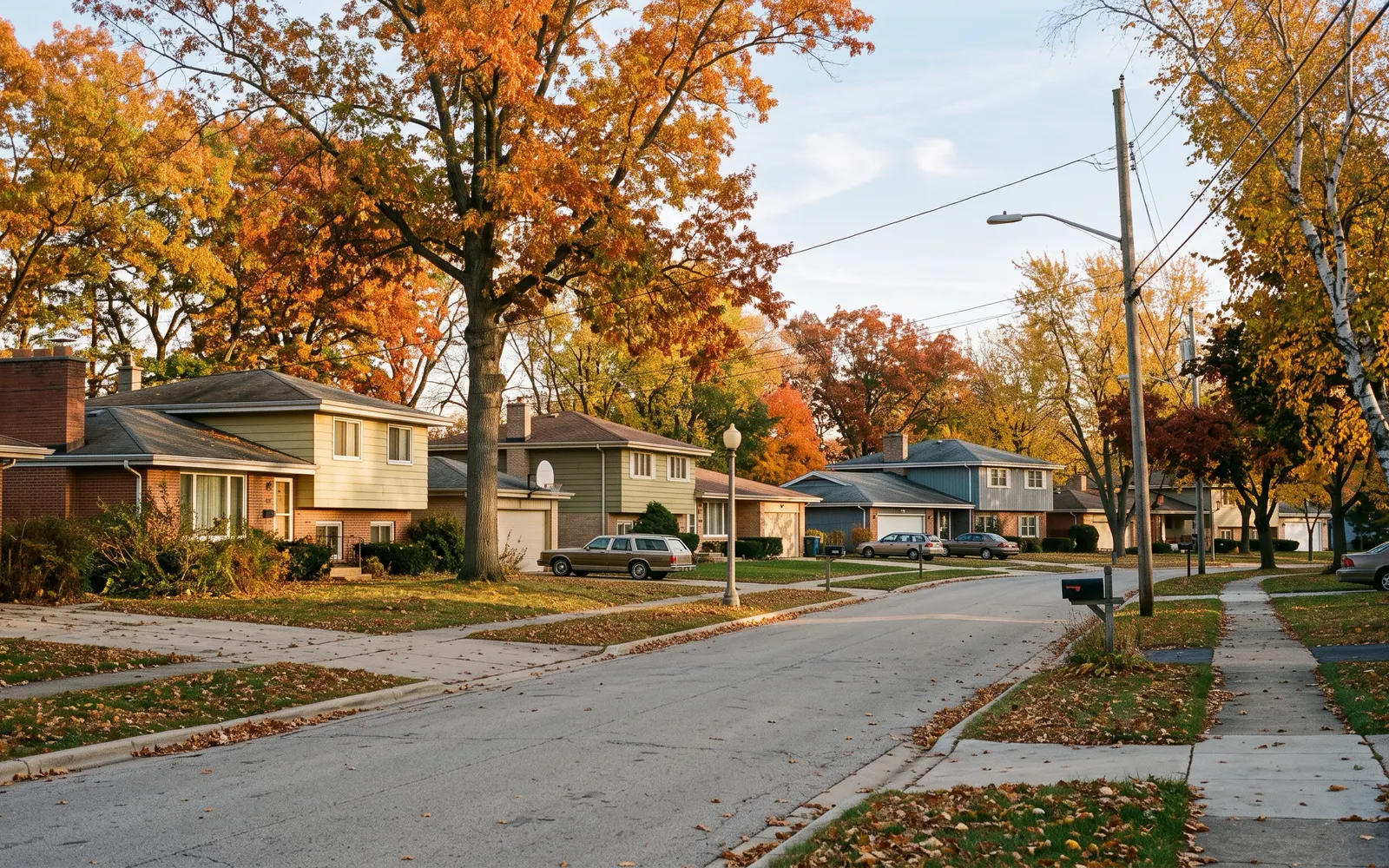
The detached houses are mostly ranches, raised ranches, split-levels and two-story colonials on subdivision lots. The attached stock runs from 1970s townhome rows to downtown condo buildings put up under the TIF. The Census ACS puts the median home value at $355,600 and median gross rent at $1,549 for 2020-2024.
For a buyer, that mix means three markets under one town name: detached houses, townhomes and condos. They carry different association costs, appraise off different comparable sales and move at different speeds, so I price them separately. The 1960s and 1970s houses also have their own inspection list. Original windows, older furnaces and water heaters, aging sewer lines to the street and some aluminum branch wiring from that era are all common. None of those should kill a deal. All of them belong in the price. My home inspection checklist covers what to ask for.
The Palatine Housing Market in 2026
Palatine is a busy, competitive market. In the three months ending August 2026, Redfin reported a median sale price of $394,739, up 3.6% from a year earlier. Its report shows 297 homes sold in August, up from 293 a year before. Homes sold in about 42 days, down from 45, at 101.0% of list price on average.
The rest of Redfin's numbers say a well-priced house still draws a crowd. The median sale price per square foot was $241, up 5.7%. Redfin gives Palatine a Compete Score of 77 out of 100, which it calls very competitive, and says homes get about four offers on average. Its summary is that the average home sells for about 1% above list and goes pending in about 42 days, while hot homes sell for about 4% above list and go pending in about 26 days.
Zillow's home value index agrees on the level and is a little stronger on the trend. It put the typical Palatine home at $393,104 in August 2026, up 6.4% from $369,433 in August 2025 and 9.8% from August 2024. The two measures do different jobs. Redfin's median is the middle of whatever happened to sell this summer. Zillow's index estimates every home in the village, including condos and townhomes that did not sell. When Redfin's price per square foot rises 5.7% and its median rises only 3.6%, it tells me the typical home gained value and this summer's sales tilted a little toward smaller homes.
For context against the neighbors, Zillow's August 2026 index put Rolling Meadows at $339,504, Schaumburg at $360,740, Hoffman Estates at $408,240, Buffalo Grove at $447,960, Arlington Heights at $495,520 and Lake Zurich at $512,227. Palatine sits in the middle of that group, and it has the widest spread of product in it, from a Rand Road condo to a four-bedroom colonial near Fremd. If you are working out a budget, my guide to how much house you can afford walks through the numbers.
Palatine Property Taxes: The 2025 Reassessment and Your 2026 Bill
Property tax is the number that moves the monthly payment most, and in Palatine it runs through Cook County. Ownwell's Cook County data for Palatine, updated April 13, 2026, puts the median effective rate at 2.66% and the median annual bill at $7,115. By ZIP code it lists 2.69% and $8,492 for 60067 and 2.63% and $5,236 for 60074. The Cook County median on the same page is 2.14%.
Cook reassesses one-third of the county each year, so each township is revalued every three years. Palatine Township's turn was 2025. The Cook County Assessor's Palatine Township release of September 9, 2025, said the new values would affect second-installment bills issued in 2026, and that the township was last reassessed in 2022. It put the 2024 median single-family sale in the township at $425,000 against the assessor's median estimate of $431,000. The township covers more than the village; the release lists all or part of Arlington Heights, Barrington, Deer Park, Hoffman Estates, Inverness, Palatine, Rolling Meadows, Schaumburg and South Barrington. Between reassessments, a house's assessed value usually stays put even if the market moves.
The bills come in two pieces. For tax year 2025 the first installment was due April 1, 2026, per the Cook County Treasurer. The second installment carries the new 2025 values. In 2026 those bills were mailed September 1 and are due October 1, about two months late because of the county's tax system overhaul, according to Cook County. If you close this fall, ask your attorney how the proration handles that bill.
Here is what the rate looks like on a real purchase. At this summer's $394,739 median, 2.66% works out to about $10,500 a year, or $875 a month. The seller's current bill is often lower, because the assessment trails the market and the seller may carry exemptions you won't have in year one. Budget off the purchase price, not the seller's bill. The Cook County homeowner exemption takes $10,000 off the equalized assessed value of an owner-occupied home; the savings equal that $10,000 times your local tax rate. You apply once, and it renews as long as you live there.
Sellers get one break here. The village FAQ says there is no real estate transfer tax in Palatine, and the ATG ordinance summary adds that the final water bill must be paid and there is no pre-sale inspection. The county still charges its transfer tax. The Illinois Department of Revenue lists the county rate at 25 cents per $500 of value, or about $197 on a $394,739 sale. My Illinois closing costs guide covers the rest. This is general information, not tax advice. Your bill depends on your parcel, your exemptions and the assessor.
Palatine Schools: District 15, District 211 and Harper College
Most of Palatine is in Community Consolidated School District 15 for kindergarten through eighth grade. According to Wikipedia's District 15 entry, the district serves all or part of Palatine, Rolling Meadows, Hoffman Estates, Arlington Heights, Inverness, Schaumburg and South Barrington, was established in 1946 and runs 14 elementary schools and five middle schools. Its last listed enrollment is 11,477 students in 2021, and Wikipedia calls it the second-largest elementary-only district in Illinois.
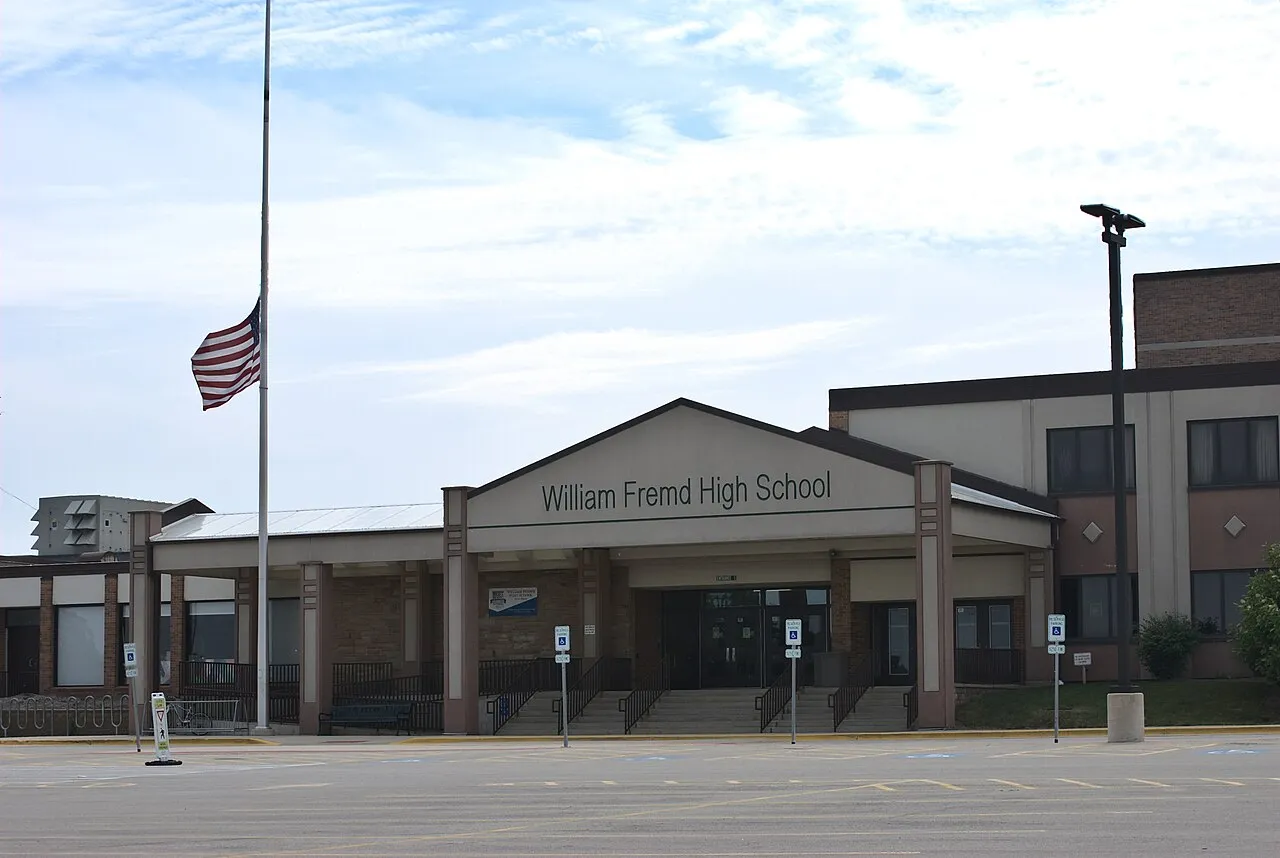
High school is Township High School District 211. The District 211 entry lists five high schools, and two of them are in Palatine: Palatine High School and William Fremd High School. The district also runs Schaumburg, Conant and Hoffman Estates high schools. Which one a house feeds depends on the street, and the line between Palatine and Fremd runs through the village.
District 15's own description says it serves "all or part" of each town, so a few Palatine addresses near the edges may belong to a different elementary district. Check every address with the district before you write an offer, and ask me for the boundary if you want it done for a specific house. I don't rank schools on this page. The Illinois Report Card has each school's own data.
Palatine also has its own college. Harper College was created by referendum in 1965, began classes in September 1967 and sits on a 200-acre campus in the village, with its own performing arts center.
District 15 elementary schools. Central Road, Frank C. Whiteley, Gray M. Sanborn, Hunting Ridge, Jane Addams, Kimball Hill, Lake Louise, Lincoln, Marion Jordan, Pleasant Hill, Stuart R. Paddock, Virginia Lake, Willow Bend and Winston Campus, per Wikipedia's district list. Not all of them are inside the village.
District 15 middle schools. Carl Sandburg, Plum Grove, Thomas Jefferson, Walter R. Sundling and Winston Campus.
District 211 high schools in Palatine. Palatine High School and William Fremd High School. Some village addresses may be assigned elsewhere in the district; check the address.
Harper College. The area's community college, on a 200-acre campus in Palatine since 1967.
Commuting from Palatine: The Metra UP-NW Line Downtown
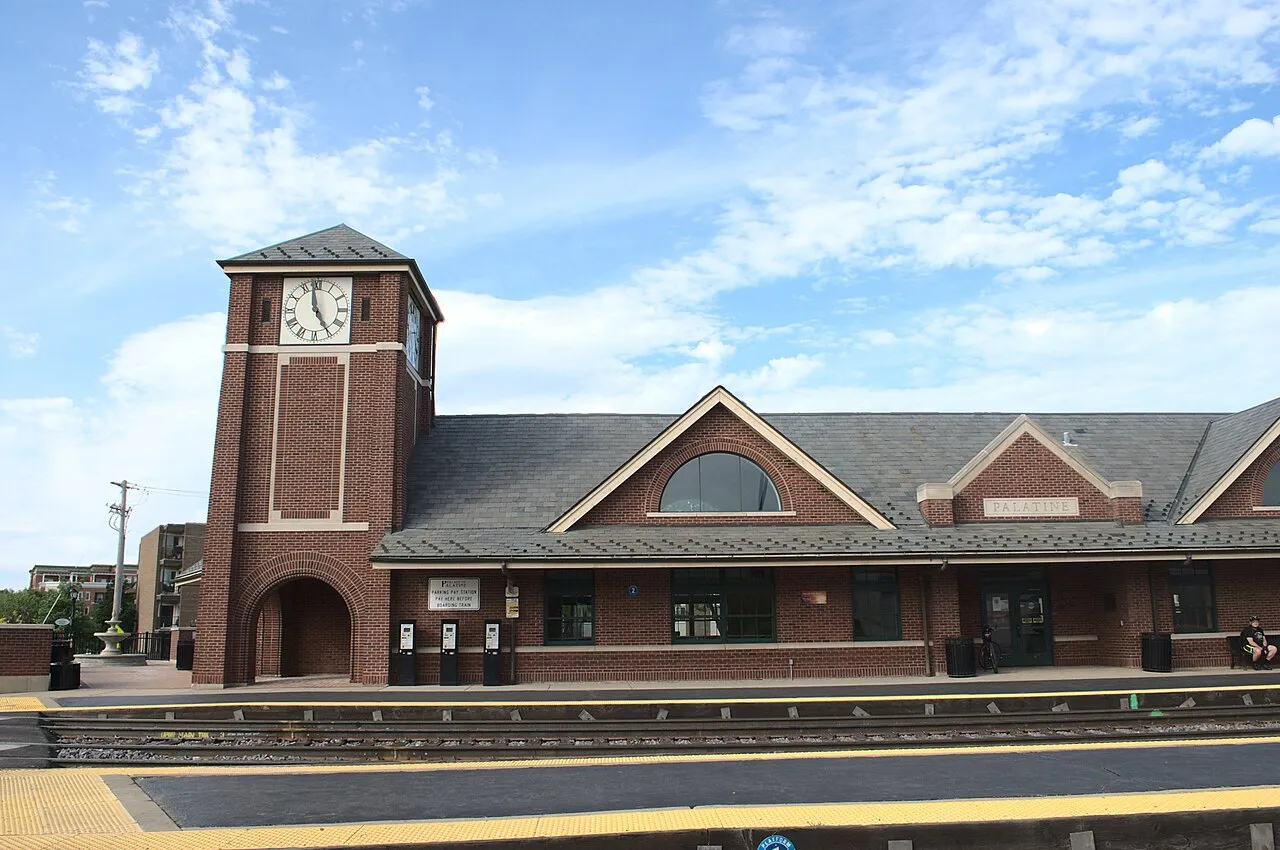
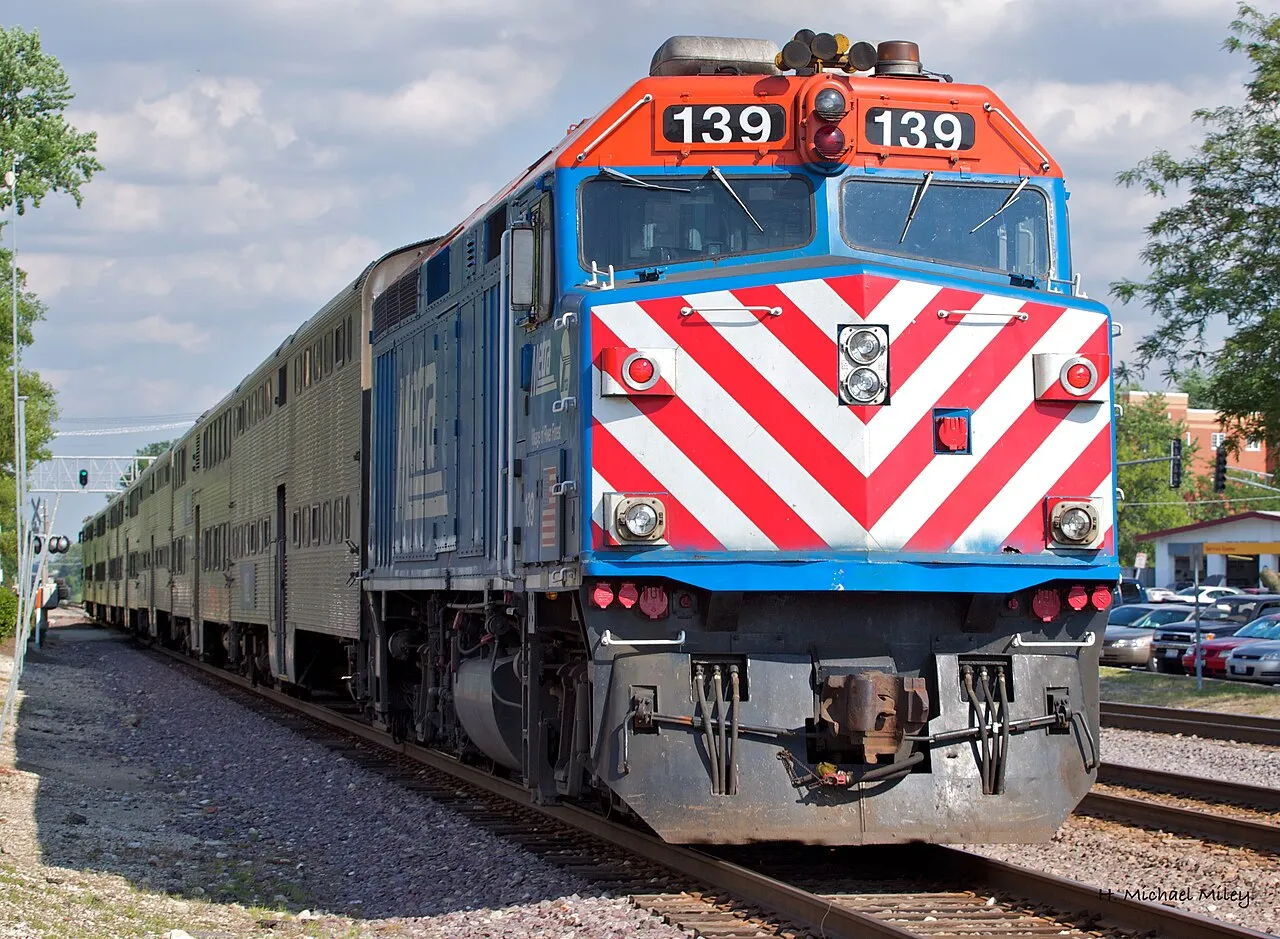
The train is the center of Palatine. The Palatine station at 137 W. Wood Street sits in the middle of downtown on the Union Pacific Northwest line, 26.8 miles from Ogilvie Transportation Center, in fare zone 4. The current station building dates to 2001. Wikipedia reports that as of October 2025 it averaged about 1,610 weekday boardings, fourth among the 236 Metra stations outside downtown Chicago.
The schedule is one of the best in the suburbs. According to Metra's schedule data for the week of September 28, 2026, 35 trains leave Palatine for Ogilvie on weekdays and 34 come back. The fastest morning expresses, at 6:22, 6:52, 7:22 and 7:52 a.m., reach Ogilvie in 40 minutes, and a second set at 5:58, 6:28, 6:58, 7:28 and 7:58 a.m. takes 48. The typical train takes 58 minutes. Saturdays have 16 inbound and 17 outbound trains, with the fastest at 44 minutes, and Sundays have 9 inbound and 11 outbound.
Parking is run by the village. Its downtown parking page lists 248 permit spaces in the Gateway Center garage at 251 W. Colfax Street and 78 daily-fee spaces in Lot B at 117 W. Wood Street, next to the station. From May 16, 2026, the lot south of the tracks at 150 W. Wilson went to the park district as part of the Clu Building sale, so older parking maps are out of date.
Most people still drive to work. CMAP's snapshot shows 69.4% of Palatine workers driving alone, 20.6% working from home and 2.3% on transit, with an average commute of 27.7 minutes. The train numbers are small as a share, but for a downtown Chicago job, living within reach of this station is the main reason many buyers put Palatine on the list.
Driving from Palatine: Route 53, I-90 and O'Hare
The village lists four highways: Interstate 90, Illinois Route 53 and U.S. Highways 12 and 14. In practice, Route 53 is the one that shapes daily life. It runs north-south along the east side of the village, south to I-90 and I-290 and north to Lake Cook Road. U.S. 12 is Rand Road, the commercial spine across the north side, and U.S. 14 is Northwest Highway, which follows the railroad through downtown.
O'Hare is about 14 miles away, per the village, and I-90 is the usual route. Chicago Executive Airport is nearby for private flying. For local trips, Dundee, Palatine, Euclid and Algonquin Roads carry east-west traffic, and Quentin, Hicks, Plum Grove, Roselle and Rohlwing Roads carry north-south traffic.
The practical point is that Palatine's east side and west side live differently. A house near Route 53 can be on the ramp in two minutes. A house on the far west side near Quentin Road is closer to Deer Grove and farther from the highway. If you are choosing between two houses and your job is south on I-90 or I-290, drive both routes at rush hour before you decide.
Is Palatine Walkable?
Village-wide, no. Downtown, yes. Walk Score rates Palatine 41 for walking, which it calls car-dependent, and 51 for biking, which it calls somewhat bikeable. Its page counts about 143 restaurants, bars and coffee shops in the village, but the average resident can walk to about two of them in five minutes.
Downtown is the exception. Walk Score's rating for Village Hall at 200 E. Wood Street is 78, very walkable, with a Bike Score of 64. That is the station, the farmers market, the downtown restaurants, the Community Center and Cutting Hall, all within a few blocks. The condos and townhomes built under the downtown TIF are the main way to buy into that walkability.
The layout explains the rest. CMAP's land use inventory for 2023 shows 44.0% of the village's 9,138 acres in single-family residential use and only 6.6% in commercial use, most of it along Rand, Dundee and Northwest Highway rather than inside the subdivisions. The Palatine Trail helps: its east-west run from Anderson Drive to Quentin and Dundee Roads is 4.7 miles, and a north-south leg connects Ashwood Park, the Community Center and Riemer Reservoir to Harper College.
Shopping in Palatine: Rand and Dundee and Downtown
Palatine shops in strips, not malls. The village says there are 30 shopping areas in the community, and the biggest concentration is where Rand Road meets Dundee Road on the north side. Mayor Jim Schwantz called that corner "our economic engine" in a September 2026 Daily Herald report, which notes the corridor has drawn a Walmart and several car dealerships.
Downtown is the other shopping district, smaller and on foot: shops and restaurants along Slade, Brockway, Wood and Smith Streets around the station. For big-box errands, Woodfield Mall and the Golf Road corridor in Schaumburg are a short drive south on Route 53.
The numbers show that most retail spending happens elsewhere. CMAP's snapshot, using Illinois Department of Revenue data, shows about $1.31 billion in retail sales in the village in 2025, or $19,834 per resident, against $23,200 for Cook County. The tax base is mostly homes: of $2.35 billion in equalized assessed value in 2024, about $1.89 billion was residential. That is one reason the village keeps buying land on Rand and Dundee.
Groceries and Everyday Errands in Palatine
The anchor store for the north side is Jewel-Osco at 423 E. Dundee Road, with a pharmacy, open 6 a.m. to midnight. It is the only Jewel listed in the village.
The bigger grocery story is next door. The former Whole Foods space near Rand and Dundee Roads is being converted into the flagship store of Shop & Save Market, an independent Chicago-area grocer. The Daily Herald reported on June 26, 2026 that construction had been going on for more than a year and that at 76,000 square feet it will be the chain's largest location. The same article listed a second Palatine location among the stores the company was taking over. Check whether it is open before you count on it.
The rest of the week is the strip centers along Rand, Dundee, Northwest Highway and Palatine Road. Because the village is long from north to south, the store you use will depend on which side you live on. That is worth mapping before you buy, the same way you would map the train.
From May through October, the Palatine Farmers' Market runs every Saturday, 7 a.m. to 1 p.m., in the lot directly east of the train station. A winter market runs on the first and third Saturdays from November through April, 9 a.m. to noon.
Where Palatine Eats
Walk Score counts about 143 restaurants, bars and coffee shops in Palatine. The two concentrations are downtown, where you can walk from the train to dinner, and the Rand and Dundee corridor, where most of the chains and quick-service places are. Independent restaurants are spread through the strip centers on Northwest Highway, Palatine Road and Dundee Road.
Downtown's best-known name is changing hands. The Daily Herald reported on August 24, 2026 that Iowa-based Big Grove Brewery has a contract to buy Durty Nellie's, the restaurant and music venue at 180 N. Smith Street since 2003. The plan is a restaurant, taproom and small brewery, a larger patio and a remodel estimated at more than $4.5 million, opening next summer if the village approves it. The 2023 plan to replace the building with a six-story, 85-apartment project is dead; the developer could not meet the village's parking requirements.
I don't try to list every restaurant here, because the list changes every year. The best advice I give buyers is to eat near each house you are serious about. It is the fastest way to learn which part of Palatine you would actually use day to day.
Parks, Deer Grove and Recreation in Palatine
The Palatine Park District was created by voters in 1945 and bought its first park, Community Park, in 1947. It built Palatine Hills Golf Course, Maple, Oak, Willow and Ashwood Parks and part of Birchwood Park between 1966 and 1969, the Palatine Trail and the Birchwood Recreation Center in 1972, and Eagle Park in 1976. It merged with the Palatine Rural Park District in 1975, while the Salt Creek Rural Park District still operates separately. The district says it serves just over 83,000 people, more than live in the village. Park district lines do not match the village lines, so check which district an address pays into.
The golf course is the district's biggest single amenity. Palatine Hills is an 18-hole, par 72 course of about 6,800 yards with six sets of tees. Community Park, at Northwest Highway and Wood Street, has the Veterans Memorial and hosts Hometown Fest every July.
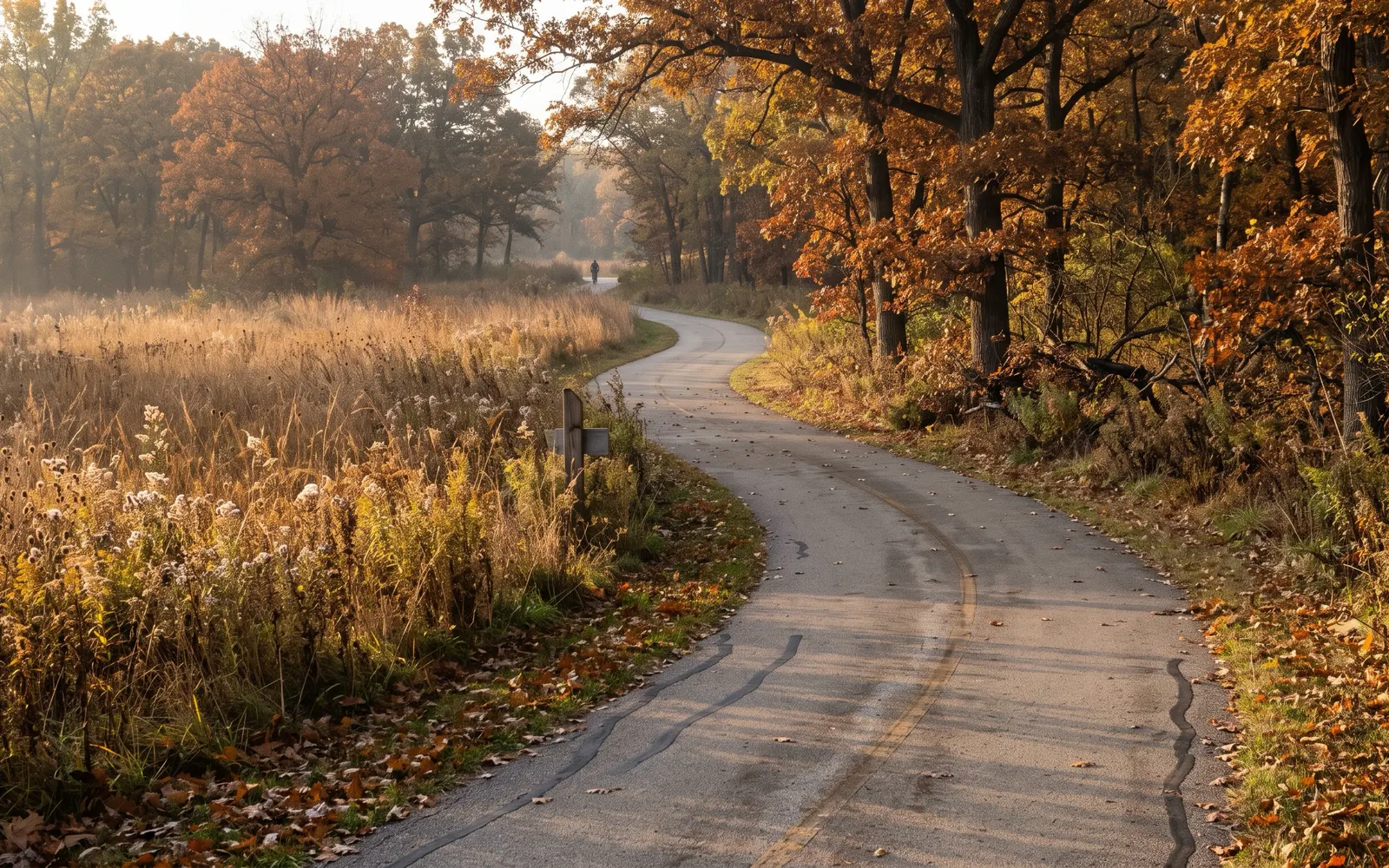
The largest open space is county land on the north edge. Deer Grove, the Forest Preserves of Cook County's first preserve, covers nearly 2,000 acres of upland forest, ravines, wetlands and prairie, with about 15.5 miles of paved and unpaved trail. Two areas inside it are recognized by the Illinois Nature Preserves Commission as some of the highest quality natural areas in the state. The main entrances are on Quentin Road north of Dundee Road and on Dundee Road west of Hicks Road, and the 2.8-mile Red Paved Loop at Deer Grove East is the easy introduction.
The Palatine Public Library District
The Palatine Library District runs three buildings. The main library is at 700 N. North Court, a few blocks from the station, and is open seven days: 9 a.m. to 9 p.m. Monday through Thursday, 9 to 6 on Friday, 9 to 5 on Saturday and noon to 5 on Sunday. The Rand Road Branch at 1585 Rand Road serves the north side, and the North Hoffman Branch at 3600 Lexington Drive in Hoffman Estates serves the part of the district that crosses into that village.
Like the park district, the library district does not match the village boundary exactly. If library access matters to you, confirm that a specific address is inside the district before you buy.
Utilities and Village Services in Palatine
Palatine drinks Lake Michigan water. The village's Water Division says the water comes from Lake Michigan by way of the Evanston treatment plant and the Northwest Water Commission, through 301.2 miles of water main serving more than 22,000 homes and businesses.
Trash and recycling go through Groot, which handles all residential collection for the village. Carts come in 35-, 65- and 95-gallon sizes, and swapping sizes costs $30. Yard waste is picked up from the first full week of April through the second full week of December, unlimited and with no stickers. New owners set up service through the village's utility billing office. ComEd delivers electricity and Nicor Gas provides natural gas.
Fiber is coming to some older pockets. In a September 22, 2026 notice, the village said AT&T has permits to install fiber in Winston Park Units 1 and 2, Reseda, Reseda North, Reseda West and Pepper Tree Farms Unit 4, with work expected to span multiple years.
One note for sellers: the village requires the final water bill to be paid before closing, so schedule the final meter reading early.
Hospitals Near Palatine
The closest full-service hospital is just east of the village. Northwest Community Hospital, now part of Endeavor Health, is at 800 W. Central Road in Arlington Heights and has 489 beds and a Level II trauma center. Other hospitals in the northwest suburbs are a short drive on Route 53 or I-90, and which one is closest depends on which side of Palatine you live on.
Cutting Hall, Durty Nellie's and Nights Out in Palatine
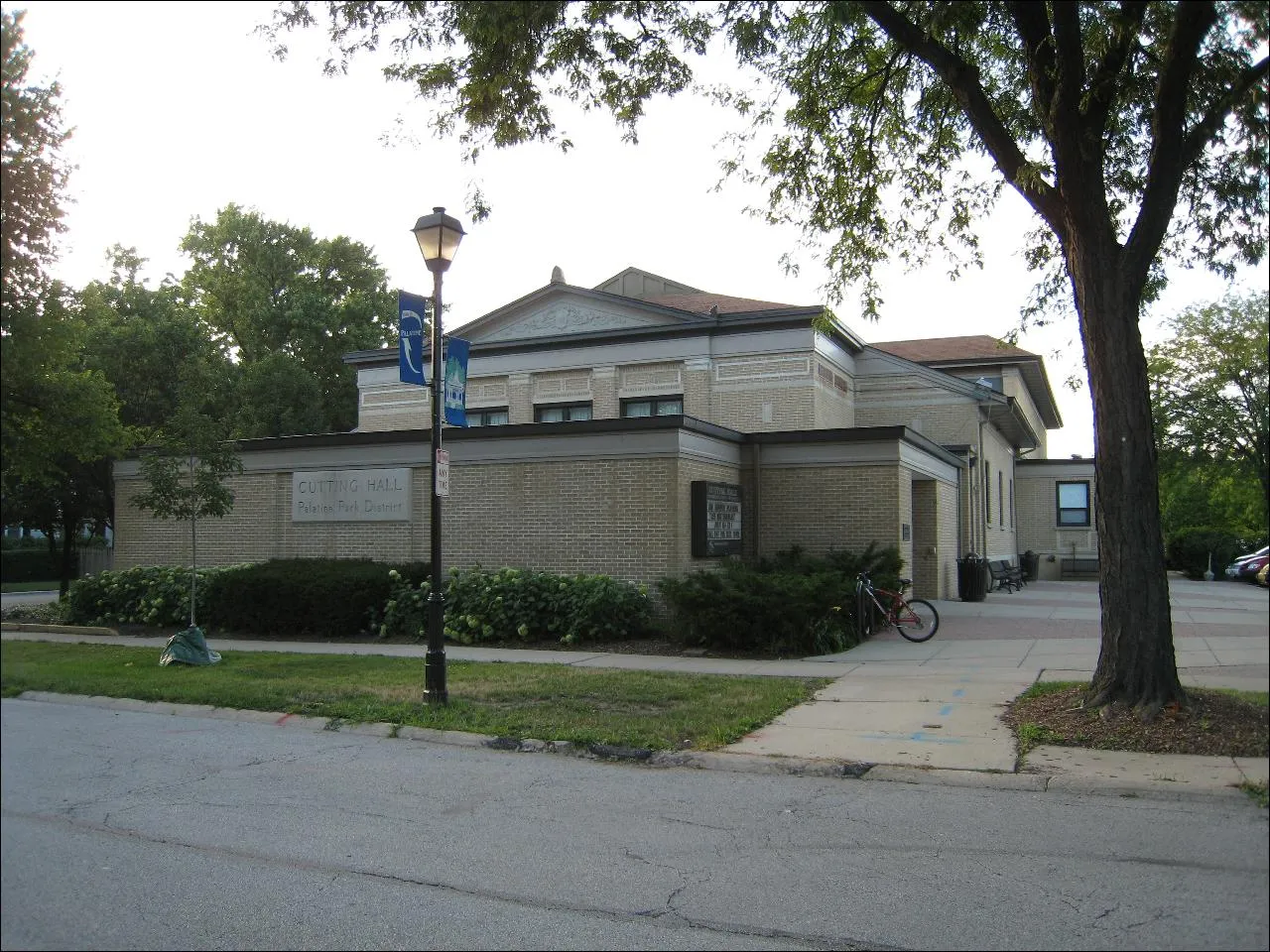
Palatine's culture is downtown and small-scale. Cutting Hall Performing Arts Center, the 431-seat auditorium built in 1928 as part of the original Palatine High School, is run by the park district and is a nine-minute walk east of the station on Wood Street. Its curtain first opened on September 15, 1928, and it hosts theater, concerts and film nights through the year.
Durty Nellie's on Smith Street has been the village's live-music room since 2003 and is headed for new ownership, covered above. The Clayson House museum on Palatine Road holds the historical society's collection, which the village says includes more than 1,000 objects from Palatine's early days.
For a bigger night out, Woodfield and the Schaumburg entertainment district are about 15 minutes south, Arlington Heights has its own downtown theater and restaurant scene, and Chicago is one train from the station. Check the evening schedule before a late night; the last outbound trains leave Ogilvie earlier than many people expect.
Hometown Fest and Palatine's Yearly Calendar
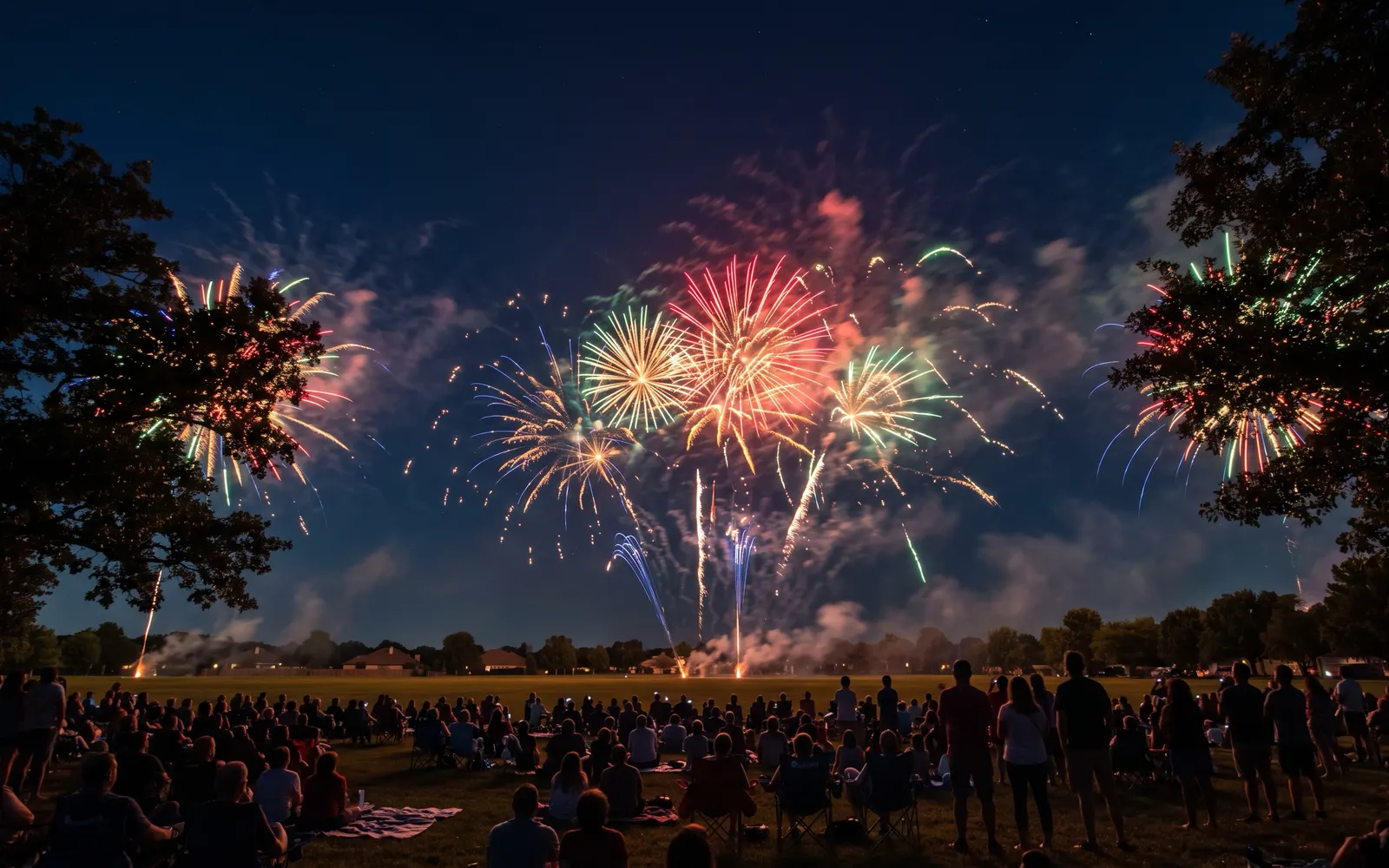
The big one is the Fourth of July. Hometown Fest ran July 2 to 5, 2026, at Community Park. The Palatine Jaycees have hosted it since 1957 with the village and the park district, and it is the village's Independence Day celebration: carnival, parade, entertainment and fireworks, with the proceeds going back into community grants and scholarships. If you are touring houses over the holiday, stop by. It tells you more about the town than a listing will.
Late summer belongs to downtown. Street Fest takes over Brockway and Slade Streets with live music and food; the village's Street Fest page still showed the 2025 dates, August 22 to 24, when I checked in September 2026, so watch it for next year's.
The rest of the year has a steady rhythm. The farmers market runs every Saturday from May through October next to the station. The village announced the annual Fire Department Open House for Saturday, October 3, 2026, 10:30 a.m. to 1 p.m., at Fire Station 84, 220 W. Illinois Avenue. The park district runs fall film nights and programs at Cutting Hall and the Fred P. Hall Amphitheater.
What's Being Built in Palatine
The newest for-sale housing is a small project on the northwest side. On September 21, 2026, the village council approved 38 townhouses at the southwest corner of Dundee and Quentin Roads, across from the Deer Grove forest preserve, the Daily Herald reported. The 4.84-acre site held a gas station and car wash until 2021. The council annexed and rezoned it, and the developer, Cornersite Development, said the two- and three-story units would take 18 to 24 months to build. With only 1.8% of the village's homes built since 2010, any new construction here is notable.
The village is also assembling land. The council authorized buying four parcels at 1102, 1110, 1114 and 1122 E. Dundee Road, 2.2 acres near Rand Road, for up to $3 million in TIF money, per a separate September 2026 Daily Herald report. Two vacant buildings would come down, the existing tenants would stay for now, and the village plans to sell the site to a developer later. Closing was targeted for December 1. Separately, the village created a Dundee Road and IL 53 TIF district on August 5, 2024.
Three commercial changes will shape everyday life. Shop & Save's 76,000-square-foot flagship is going into the former Whole Foods near Rand and Dundee. Big Grove Brewery is under contract to buy and remodel Durty Nellie's downtown. And the park district bought the Clu Building south of the tracks, with the village noting planned improvements along Slade Street that will affect downtown parking during construction.
Behind all of it is the 2025 Comprehensive Plan, which the village council adopted on April 14, 2025, with a future land use map. If you are buying near Rand and Dundee or downtown, read the map for your block.
I don't label any town or neighborhood as safe or unsafe.
Flood Risk in Palatine
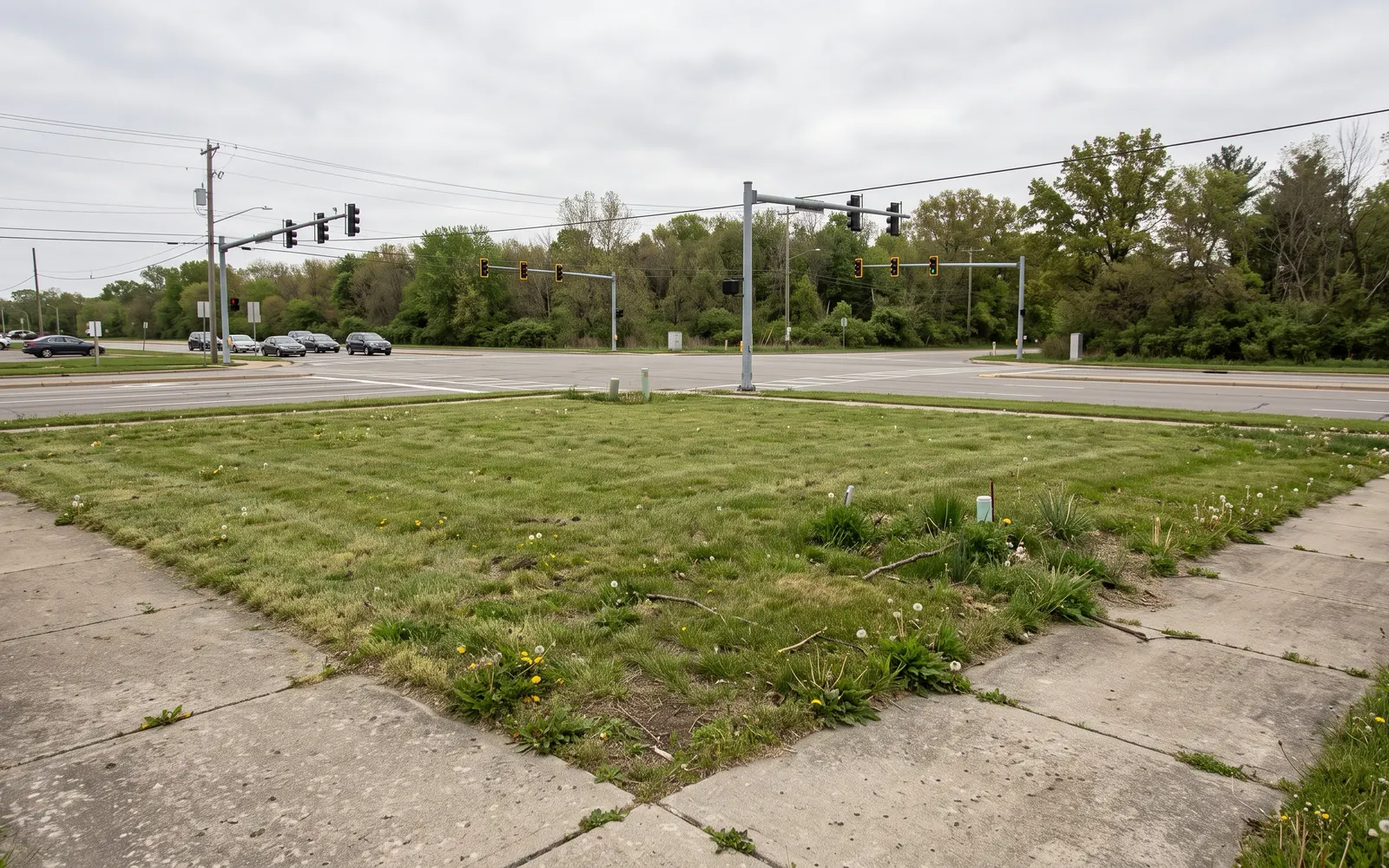
Flooding is a house-by-house question in Palatine, and it is worth asking. Redfin, using First Street's model, rates Palatine's flood risk as minor overall but says 8% of properties are at risk of severe flooding over the next 30 years. That share is higher than in many of the neighboring towns.
The village explains where. Its flood hazard page says land along Salt Creek, Buffalo Creek and their branches, plus several low-lying areas, is identified as flood hazard area, and that floodwater outside the creek banks is usually shallow but can reach yards, streets, garages and basements. The historical society's records mention flooding in Winston Park as early as 1962. The village takes part in the National Flood Insurance Program, and its flood insurance page points out that 25% of flood insurance claims nationwide are for homes outside a designated flood hazard area.
Three checks before you write an offer. Look the address up on the FEMA flood map, because a mapped flood zone can mean required flood insurance. Ask the seller directly whether the house has ever taken water; the Illinois disclosure form asks, but a direct question gets a better answer. And have the inspector look at the sump pump, the backup, the overhead sewer or check valve if there is one, and the grading.
Frequently Asked Questions
Is Palatine, IL in Cook County or Lake County?+
Cook County. Census Bureau estimates for 2025 put all 65,842 village residents in Cook County, 65,784 of them in Palatine Township and 58 in Wheeling Township, with none in Lake County. Homes in the village carry Cook County tax bills.
How much does a house cost in Palatine, IL?+
Redfin reported a median sale price of $394,739 for the three months ending August 2026, up 3.6% from a year earlier. Zillow's home value index was $393,104 for August 2026, up 6.4%. Detached houses, townhomes and condos trade as separate markets.
What are property taxes in Palatine, IL?+
Ownwell (April 2026) puts the median effective rate at 2.66% with a median bill of $7,115. Palatine Township was reassessed in 2025, and those values land on the 2026 second-installment bills, mailed September 1 and due October 1, 2026.
Does Palatine have a real estate transfer tax?+
No. The village says there is no real estate transfer tax in Palatine, though the final water bill must be paid before closing. The Cook County transfer tax of 25 cents per $500 of value still applies.
What school district is Palatine, IL in?+
Most of the village is in District 15 for kindergarten through eighth grade and District 211 for high school. Palatine High School and William Fremd High School are both in the village. Assignment is by street, so confirm each address with the district.
How long is the train from Palatine to Chicago?+
The fastest weekday morning trains from the Palatine station reach Ogilvie in 40 minutes, and the typical train takes 58. In fall 2026 there are 35 inbound weekday trains on the Metra UP-NW line.
Is Palatine walkable?+
Not village-wide. Walk Score rates Palatine 41 (car-dependent), but the downtown around Village Hall and the station scores 78 (very walkable). The Palatine Trail adds 4.7 miles of east-west trail.
What neighborhoods are in Palatine, IL?+
Commonly named subdivisions include Winston Park, Hunting Ridge, Reseda, Pepper Tree Farms, Kenilwicke, Heatherlea, Virginia Lake, Pleasant Hill, Cannongate and Cambridge at Palatine, plus the downtown condo and townhome area around the Metra station.
Is new construction available in Palatine?+
Very little. Only 1.8% of Palatine's homes were built in 2010 or later. The village approved 38 townhouses at Dundee and Quentin Roads in September 2026, with construction expected to take 18 to 24 months. How builder contracts, timelines and allowances work is on my new construction homes in Illinois page.
Eshu Chikoti has extensive access to off-market listings throughout Palatine and the rest of Cook County — homes that never make it to the public listing sites. That matters right now: in a seller's market like this one, well-priced homes routinely go under contract within days, and buyers relying only on public listings are competing for whatever is left over. Working with someone plugged into off-market inventory means seeing homes before the crowd does.
Eshu Chikoti · 847-691-4282 ·
Get new Palatine listings by email
When a home comes on the market in Palatine, I'll email it to you.
Just your email. Unsubscribe any time by replying.
Thinking About Palatine?
Whether you're buying, selling, or just curious what's on the market, I can walk you through Palatine street by street.